
Open letter to the EU on glyphosate
In recent years, the Senior Expert Chemists (SEC) Division has addressed the question “Is glyphosate probably carcinogenic according to the IARC report?” and demonstrated in a 1st open letter to the European Commission dated 16 June 2020 that this statement is scientifically untenable. Following a positive response from the Commission (14 July 2020), the experts in the Division (Dr. Eckhart Louis, Prof. Dr. Klaus-Dieter Jany and Prof. Dr. Klaus-Peter Jäckel) were encouraged to support the further activities of various expert groups in the EU.
The findings of the Assessment Group Glyphosate (AGG, consisting of representatives from France, the Netherlands, Croatia and Sweden) impressively confirmed that glyphosate per se does not cause a carcinogenic effect in humans.
However, certain components of the herbicide formulation could substantiate the suspicion of carcinogenicity. This prompted us, in a 2nd open letter (18 May 2022), to ask the Commission to support intensive research into the different formulations available on the market. We believe that a general ban on glyphosate-containing formulations would have a significantly negative impact on global food security .
German Chemical Society
Senior Expert Chemists
Varrentrappstraße 40-42
D-60486 Frankfurt
Telephone 069-7917-0
Fax 069-7917 374
E-mail sec(at)gdch.de
Internet www.senior-expert-chemists.eu
Frankfurt/Main, 16 June 2020
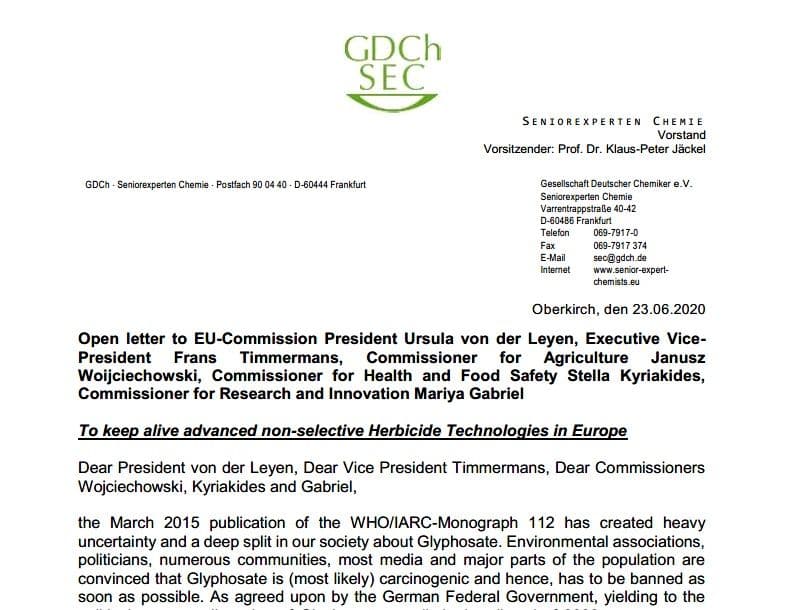
Open letter to the President of the European Commission Ursula von der Leyen, Executive Vice-President and Commissioner for the European Green Deal Frans Timmermans, Commissioner for Agriculture Janusz Wojciechowski, Commissioner for Health and Food Safety Stella Kyriakides, Commissioner for Innovation, Research, Culture, Education and Youth Mariya Gabriel
Regarding the current discussion of more advanced non-selective herbicide technologies in Europe
Dear President von der Leyen, Dear Vice-President Timmermans, Dear Commissioners Wojciechowski, Kyriakides and Gabriel,
Since 2018, Senior Expert Chemists (SEC), a section of the German Chemical Society (GDCh), led by renowned experts Prof. Dr. Klaus-Dieter Jany and Eckhart Louis, has been focused on possible negative outcomes for the agricultural sector and food security associated with the EU’s total ban on herbicides containing glyphosate after December 2022.
The WHO/IARC Monograph 112 (March 2015) created widespread uncertainty and a divide in our society over the use of glyphosate. Environmental associations, politicians, numerous communities, most of the media and the majority of the European population are convinced that glyphosate is carcinogenic. As a consequence, political leaders all across Europe are being put under pressure by society to change legislation in favour of banning glyphosate as soon as possible. For example, the German Federal Government, yielding to political pressure, limited the licensing of glyphosate until the end of 2022. We believe this to be a premature decision since many of the major negative consequences for the European agricultural sector and food security have not been considered.
The SEC has taken a close look at Monograph 112, the IARC Statutory Regulations and EU and US legal regulations governing the use of herbicides and pesticides. Our literature study concludes that the methodology applied in the IARC hazard assessment processes and the conclusions provided by IARC in Monograph 112 are highly questionable and contestable with regard to their scientific validity (Annex 1).
In contrast to the IARC hazard classification, risk assessments performed by all national competent agencies worldwide considered glyphosate safe to use when used correctly. The SEC’s academic literature review clearly shows that renowned scientists from around the globe find that glyphosate combined with certain adjuvants, in particular polyethoxylated amines (POEA), triggers distinctly more serious physiological reactions in humans and animals than glyphosate by itself. These findings support the EU’s ban on POEA in 2016.
We welcome the Commission’s decision to allow the Glyphosate Renewal Group to seek renewal of approval for glyphosate after 2022. Whether their application for renewal will be successful is uncertain. This circumstance increases uncertainty for the agricultural sector and European food security since there is currently no effective alternative to herbicides containing glyphosate. What makes this issue even more pressing is rapidly progressing climate change, in relation to which glyphosate can play an important role, for example in counteracting soil erosion and controlling soil moisture; this does not allow for uncertainty. The SEC is aware of European farmers’ frustration as publicly displayed over recent times. Their frustration is triggered by growing concerns about their future resulting from a plethora of unfathomable EU agricultural policies and regulations, particularly regarding the use of herbicides and pesticides. European farmers’ uncertainty and anxiety are underpinned by the vital question: What will be the effective, non-selective herbicide of the near future?
As long as there is no clear answer to the question of whether glyphosate and some of its formulations are carcinogenic or not, we have to rely on the official statements issued by regulatory agencies such as EFSA and EPA, and by the competent authorities worldwide, acknowledging the low levels of risk involved when using herbicides containing glyphosate. Thus, the SEC argues that efforts to develop even more effective and safe-to-use active ingredients and formulations (e.g. biodegradation, multifunctionality, combating pesticide resistance, minimising the quantity required) need to continue in order to prevent food insecurity and a decline in agricultural-sector productivity.
A decline in European agricultural production, greater dependence on non-EU imports and thus increasing economic pressure and uncertainty for European farmers are only some of the immediate consequences arising from a total ban on glyphosate, as our analysis shows (Annex 2). As demonstrated in Annex 3, agrochemical research has already made far-reaching advances in current POEA-free technology, leading to remarkable further innovations, particularly in the field of adjuvants. In view of this substantial progress, the SEC agrees with the Commission and its pursuit of more advanced non-selective future herbicide technologies.
In Annex 4, we argue for the implementation of new organisational processes in order to avoid running into formal regulatory roadblocks under Regulation No 1107/2009 in general and Article 7 in particular.
We would like to ask the Commission to initiate and guide the development process for more advanced non-selective herbicides in Europe. This will ensure that the livelihood and economy of European agriculture survive. That is the basis of our proposal.
We thank you for your kind consideration of the SEC’s proposals, suggestions and ideas. We are interested in a scientific dialogue with you and the relevant EU institutions.
Yours respectfully,
Prof. Dr. Klaus-Peter Jäckel, Chairman of the Board of “Senior Expert Chemists” (SEC), section of the German Chemical Society (GDCh)
Prof. Dr. Klaus-Dieter Jany, Member of the SEC Board
Eckhart Louis, SEC – Member
Facsimile of open letter (PDF)
Annexes to open letter:
Annex 1 Annex 2 Annex 3 Annex 4
Response from the European Commission dated 14 July 2020 (PDF)
2nd Open Letter to the EU Commission of 18 May 22
Attachment to the 2nd Open Letter to the EU Commission of 18 May 22
This 2nd Open Letter was sent both to the EU Commission and to the German Federal Institute for Risk Assessment (BfR). The responses from both institutions can be downloaded below