
School and University

    Students and Apprentices

    Undergraduate and PhD Students

    Teachers

    Higher Education Statistics

    Scholarships

Career

    Career Guidance

    Job Vacancies

    Salary Information and Income Survey

    Academy

    Mentoring

Community

    Divisions

    Young Chemists’ Forum (JCF)

    Local Sections

    Regulars' Get-Togethers

    Chem_Connect

    Equal Opportunities and Diversity

    Partnerships and International Activities

    Volunteering

    Membership

Discover Chemistry

    Top Topics

    “Nachrichten aus der Chemie” – Members’ Magazine

    Scientific Journals

    Statements and Position Papers

    Press Releases

    Brochures and Academic Publications

    Books, Videos and Podcasts

    The Fascination of Chemistry

    Cartoons

    Biographies of Female Chemists

Events

    Conferences

    Academy

    Lectures

    Further Events

Awards

    Prices

    Historical Sites of Chemistry

About Us

    Board and Other Bodies

    The Office

    Statutes and Code of Conduct

    Charities

    Press and Public Relations

    Sustainability

MyGDCh

GDCh

Chemistry for a better world

© 2026 Gesellschaft Deutscher Chemiker. All rights reserved.

NewsletterDownloadsPressContactGDCh Shop
Legal NoticeData PrivacyTerms & Conditions
Homepage/Divisions/Senior Expert Chemists/Online lectures/Hartwig Müller
Online lectures

Hartwig Müller

Hartwig Müller

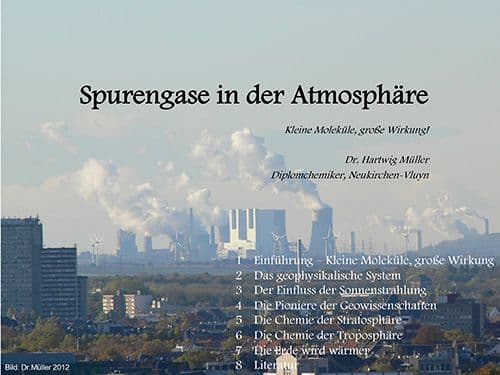
Small Molecules, Big Impact – Trace Gases in the Atmosphere

Online lecture by Hartwig Müller on 19 October 2021, 2–3 pm

Moderation: Klaus-Peter Jäckel

When he began his career in 1977, the author first came into contact with the products of human activities in the form of the small molecule CF4. Following the laborious processing of huge quantities of air in cryogenic rectification apparatus to obtain krypton and xenon, a trace impurity was found in the krypton that threatened its industrial use as lamp gas. Starting with this incident at the beginning of his professional career, he repeatedly encountered the atmospheric legacy of industrial activities throughout his working life, culminating in the ozone hole discovered in the 1980s and the harmful effects of ground-level ozone. Step by step, these experimental findings are used to illustrate research into the atmosphere and the modern threats to life on Earth posed by the combustion of fossil fuels to generate energy.