Gisela Boeck
Chair: Eva E.Wille
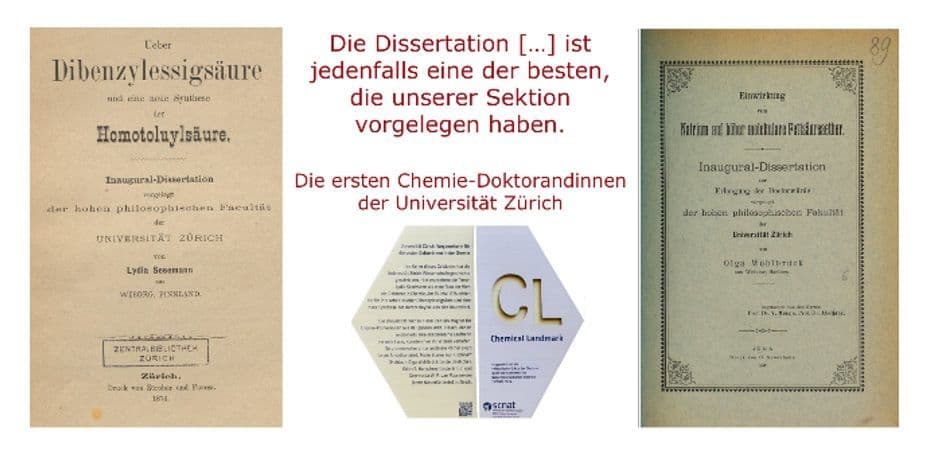
Almost two years ago, the 150th anniversary of a woman being awarded a doctorate on the basis of a chemistry thesis was celebrated. This doctor was Lydia Sesemann (1845–1925), who was awarded the title Dr. phil. by the University of Zurich. At that time, the University of Zurich was a magnet for women wishing to study who had been denied an academic education elsewhere. They included, for example, Rachel Lloyd from the USA, the German Olga Wohlbrück, Geertruida W. P. van Maarseveen from the Netherlands and the British woman Edith E. Humphrey. They studied and conducted research at the Swiss Federal Polytechnic (today’s Swiss Federal Institute of Technology) or at the University of Zurich. In all cases, the doctorate was awarded by the university. The lecture will present the lives and work of these women and explore why so many female students came to Switzerland from abroad, while hardly any Swiss female students could be found.
Zoom link to the lecture: https://us06web.zoom.us/j/88544918573?pwd=c9vmDO62e4NaekjqoNlFTqJQMnfnkQ.1
There will be a five-minute start-up presentation before the lecture. Dr. Jonas Schubert from DERMAPURGE (www.dermapurge.com ) will show you innovative solutions for cleaning hazardous substances from the skin for occupational safety.
Moderator: Wolfgang Gerhartz
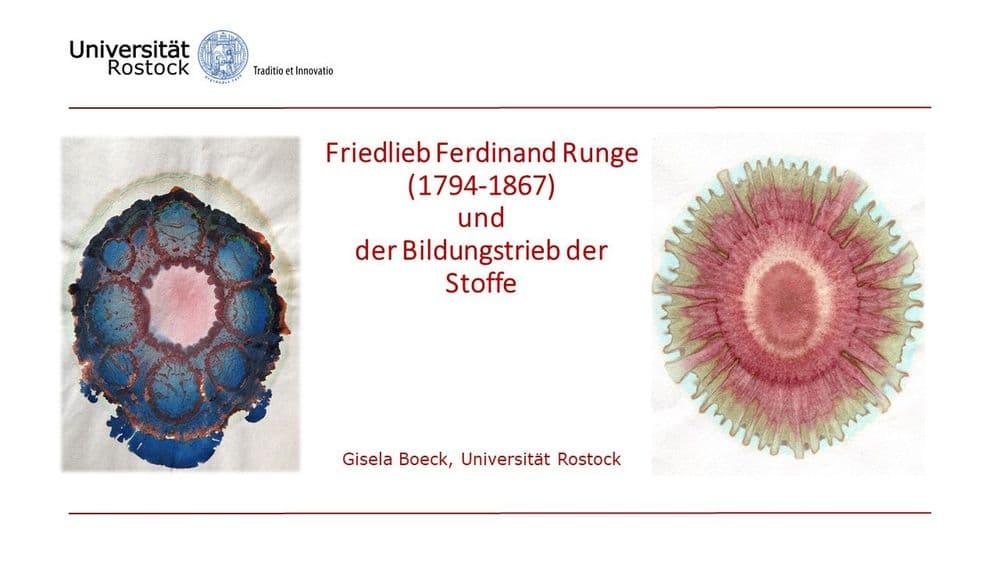
Have you ever held Runge’s book Der Bildungstrieb der Stoffe in your hands? You will be impressed by the images, some of which may even bring depictions of nature to mind. Yet essentially they are nothing more than the product of a chemical reaction in which different solutions had been dripped onto blotting paper. In this way, Runge developed a precursor to chromatography. In this context, however, he was also interested in the question of whether, by analogy with the vital force (vis vitalis), a force of nature might lie behind these images. During the lecture, it will be possible to enjoy some photographs from the original edition held in Rostock, as well as to learn about Runge’s life, his significant discoveries (caffeine, quinine, aniline, carbolic acid, pyrrole) and hear passages from his Hauswirthschaftlichen Briefen.
Chair: Hans-Uwe von Grabowski
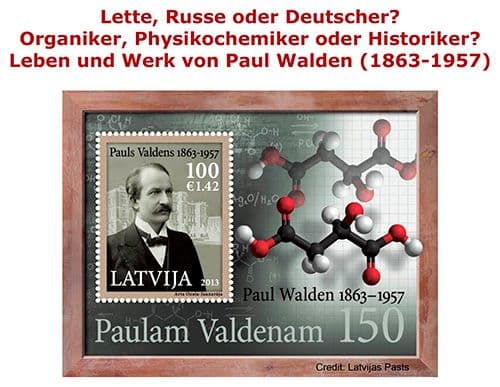
In lectures on organic chemistry, first- and second-order nucleophilic substitution reactions are discussed. When second-order substitution takes place at a carbon atom that is a stereogenic centre, the configuration is inverted, which is often described by the flipping of an umbrella. This phenomenon entered the literature as Walden inversion, because it was first described by the scholar Paul Walden. However, his main field of work was physical chemistry; he is even occasionally celebrated as the father of ionic liquids. Yet the name Walden is also encountered in the history of chemistry: he concealed his origins in a Latvian peasant family and presented himself as a Baltic German. Alongside an appreciation of his achievements in chemistry and a critical examination of his historical contributions, the biography of this chemist is presented—a man who experienced Tsarist Russia, the briefly independent Latvia, Germany during the Weimar Republic and National Socialism, and finally the Federal Republic of Germany.
Moderator: Uwe von Grabowski
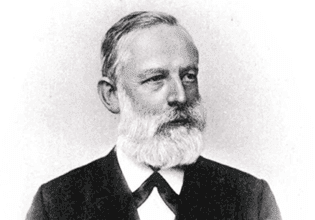
The lecture will pay particular tribute to the life and work of the lesser-known chemist Meyer. The individual stages of Meyer’s path towards recognising periodicity will be the focus of the presentation. His drafts of (partly unpublished) classification systems from 1864, 1868 and 1869 to 1872 will be discussed.