
Ekkehard Schwab
Chair:Hans Günther Schmalz
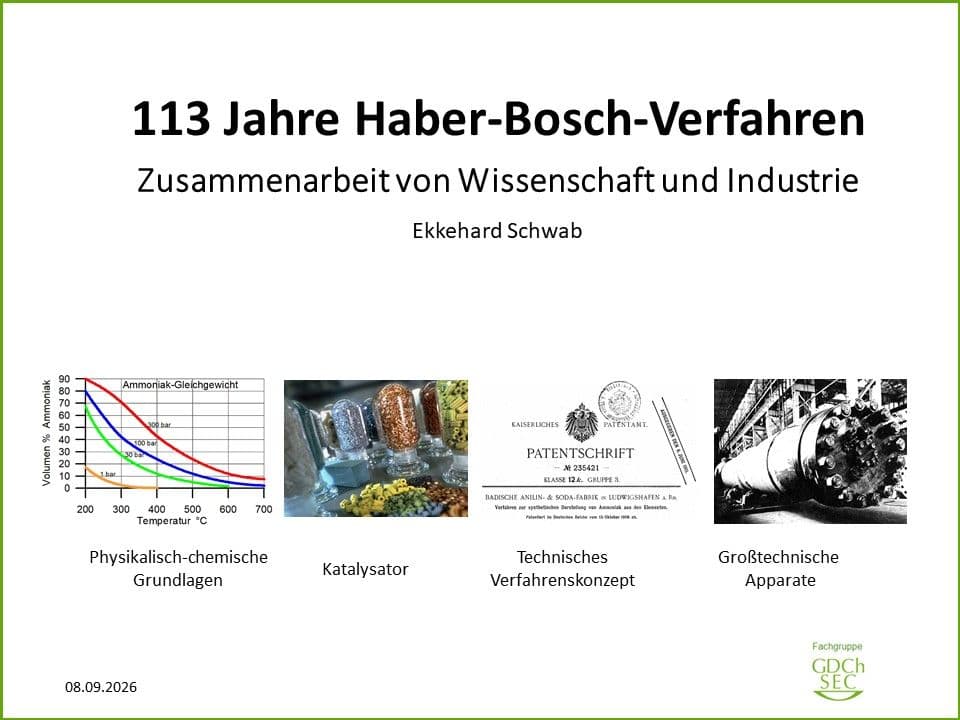
Almost exactly 113 years ago, the first large-scale plant for producing ammonia from the elements hydrogen and nitrogen was commissioned in Ludwigshafen. Just five years earlier, Fritz Haber had published his data on the equilibrium position of this reaction: at normal pressure and 700°C, only a few per mille of ammonia are formed. The journey from this point to the industrial process required innovations in the catalyst, apparatus engineering and, last but not least, the technical process design. The lecture traces this still almost incredible success story, which could only be achieved through intensive collaboration between the disciplines involved. The Haber–Bosch process became essential for feeding the world’s population.
Zoom:
https://us06web.zoom.us/j/88931613668?pwd=3xRff8aDm0YRPpRw1zhbArMkWHuPZ9.1
Moderation:Wolfgang Gerhartz
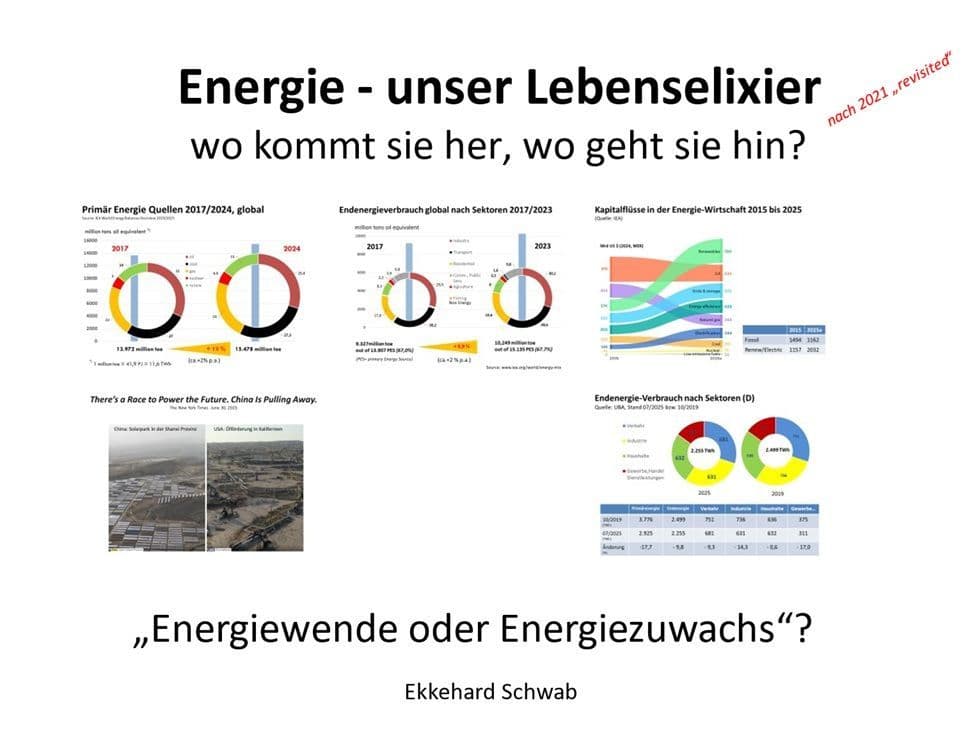
There is no life without energy. For thousands of years, humanity used only muscle power (including slaves), renewable raw materials, hydropower and wind energy as energy sources. However, the amount of energy available was always limited. This changed dramatically when it became possible to exploit the seemingly unlimited fossil fuels coal, crude oil and natural gas. However, the excessive use of these sources has now altered the composition of the Earth’s atmosphere to such an extent that serious climatic changes must be expected globally. The lecture shows what scale of challenges must be overcome in the global transition from a fossil-based to a sustainable energy system once again, and what developments have taken place since the “first edition” of the lecture in 2021, both globally and in Germany.
Zoom: Meeting ID 837 2713 6354 Passcode 664407
https://us06web.zoom.us/j/83727136354?pwd=ch7wHuGFDhaaZBPo1P4fOuXVRElC5V.1
Moderation: N.N.
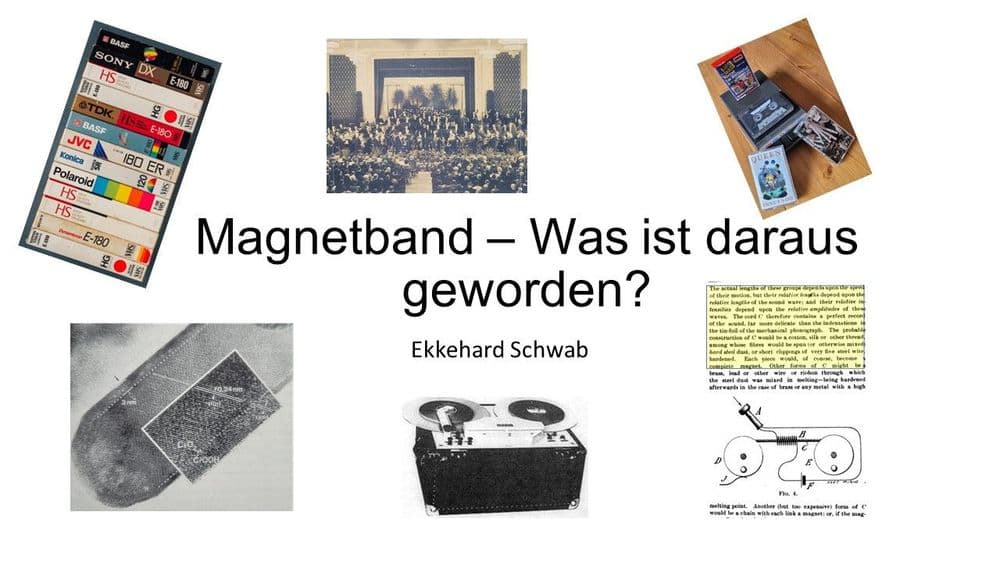
Language and sounds are the basis of communication and the transmission of information. It was not until the end of the 19th century that sounds could first be stored and made audible again using Thomas Alva Edison’s phonograph. The principle is based on converting sound waves into a mechanical image as a storage medium. Also at the end of the 19th century, Oberlin Smith first proposed storing sound waves as a magnetisation pattern on the surface of a permanently magnetic material. This technology only became successful when, from the 1930s onwards, BASF, in collaboration with AEG, developed magnetic tape and the associated recording devices. One hundred years after Oberlin Smith’s publication, the market penetration of audio cassettes (Walkman) and VHS video cassettes reached its peak. In the meantime, other digital technologies have displaced magnetic tape from the market; instead, CD, DVD and MP3 formats dominate. However, this does not apply to large data centres, where magnetic tape remains indispensable for storing backup copies.
Moderation: Klaus-Peter Jäckel
The German chemical and pharmaceutical industry currently holds a share of approximately 4.2% of the global market (VCI). Its carbon-containing products are predominantly manufactured from the energy sources oil (72%) and gas (14%). At least 13% of the products are based on renewable raw materials. Coal plays practically no role, accounting for less than 2%. Overall, the German chemical industry uses around 20 million tonnes of organic raw materials. The chemical industry is an energy-intensive sector; its most important energy sources are gas and electricity.
The raw materials used by the chemical industry have been and continue to be constantly adapted. At the beginning of the 19th century, wood was the raw material. Later, coal transformed the entire industry, and growth accelerated. After 1945, oil became the globally dominant raw material. At present, however, coal in China and, in particular, gas in the USA are (once again) gaining importance. The lecture explains the criteria used to select the raw material base at different locations. Technical processes for using all raw materials are known.
On a global scale, the chemical industry is the third-largest industrial emitter of CO2 after steel and cement, accounting for 8%. The key to reducing this share will be the availability of “green” electricity and hydrogen without an atmospheric CO2 footprint. Increasing the amount of carbon derived from renewable raw materials is encountering ecological limits.
Moderation: Klaus-Dieter Jany
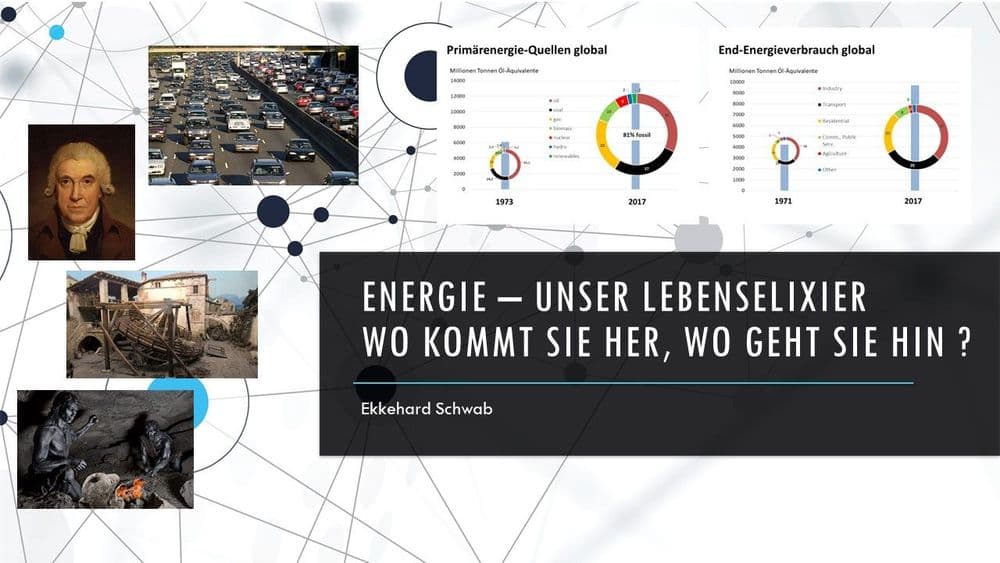
There is no life without energy. For millennia, renewable raw materials, hydropower and wind energy were the only energy sources available for the development of humanity. Despite increasingly efficient use, the amount of energy available was always limited. This changed dramatically after James Watt’s steam engine made it possible to exploit seemingly unlimited coal reserves. Later, technologies for oil and natural gas extraction were added. The excessive use of these sources has meanwhile altered the composition of the Earth’s atmosphere so significantly that serious global climate changes must be expected. The lecture demonstrates the scale of the challenges that must be overcome in the global transformation from a fossil-fuel-based energy system to one that is sustainable again.
Moderator: Klaus-Dieter Jany
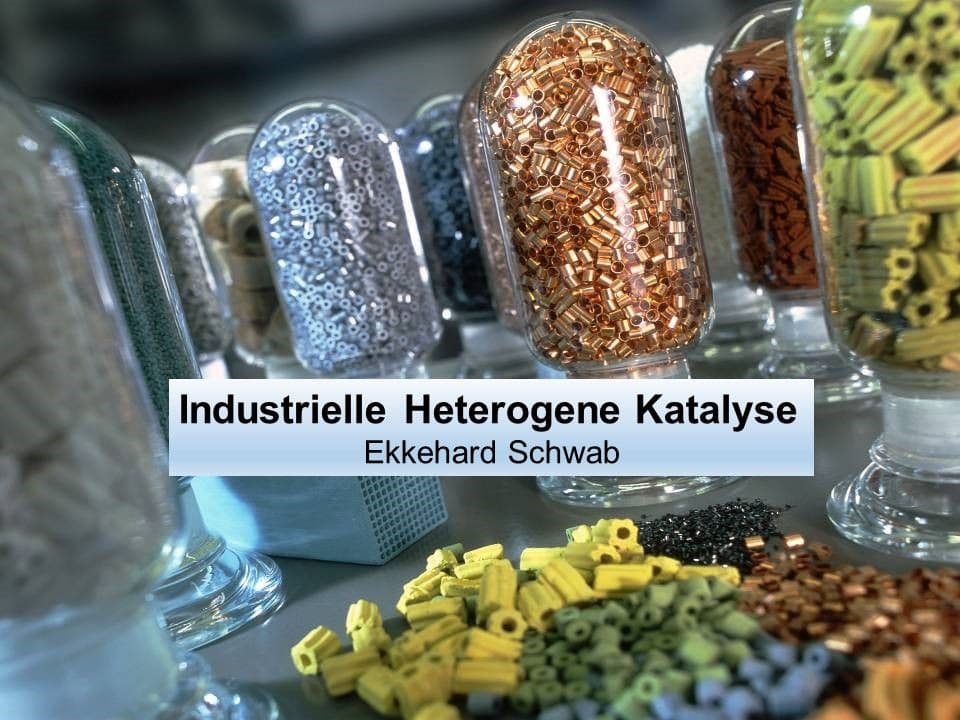
Heterogeneous catalysts are the backbone of modern petrochemicals. Their successful development requires the close collaboration of a wide range of technical and scientific disciplines: inorganic solid-state chemistry, surface science, chemical reaction engineering and, last but not least, solids process engineering for reproducible production on an industrial scale. The aim of every development is a catalyst that selectively converts the feedstocks into the desired product, ideally over a period of years, whereby this can be achieved using very different types of reactor. The latter, in turn, determine the external form of the catalyst. Over the course of more than a century of development, a gradual transition from purely empirical to increasingly rational catalyst design can be observed. Yet even today, the complex multiscale phenomenon of heterogeneous catalysis can only be fully described theoretically for a few simple model reactions.
