School and University

    Students and Apprentices

    Undergraduate and PhD Students

    Teachers

    Higher Education Statistics

    Scholarships

Career

    Career Guidance

    Job Vacancies

    Salary Information and Income Survey

    Academy

    Mentoring

Community

    Divisions

    Young Chemists’ Forum (JCF)

    Local Sections

    Regulars' Get-Togethers

    Chem_Connect

    Equal Opportunities and Diversity

    Partnerships and International Activities

    Volunteering

    Membership

Discover Chemistry

    Top Topics

    “Nachrichten aus der Chemie” – Members’ Magazine

    Scientific Journals

    Statements and Position Papers

    Press Releases

    Brochures and Academic Publications

    Books, Videos and Podcasts

    The Fascination of Chemistry

    Cartoons

    Biographies of Female Chemists

Events

    Conferences

    Academy

    Lectures

    Further Events

Awards

    Prices

    Historical Sites of Chemistry

About Us

    Board and Other Bodies

    The Office

    Statutes and Code of Conduct

    Charities

    Press and Public Relations

    Sustainability

MyGDCh

GDCh

Chemistry for a better world

© 2026 Gesellschaft Deutscher Chemiker. All rights reserved.

NewsletterDownloadsPressContactGDCh Shop
Legal NoticeData PrivacyTerms & Conditions
Homepage/Divisions/Senior Expert Chemists/Online lectures/Bernhard Fritz
Online lectures

Bernhard Fritz

Bernhard Fritz

Contact with food: laws, physics, chemistry

Online lecture by Bernhard Fritz on 3 December 2024, 3 pm

Moderator: Hans-Uwe von Grabowski

Nothing is closer to people’s hearts than their own health. The effects of substances that we deliberately or unintentionally consume have therefore been studied from an early stage. For 500 years, the Paracelsus principle of the concentration dependence of toxic substances served as a guiding principle for all those dedicated to toxicology.

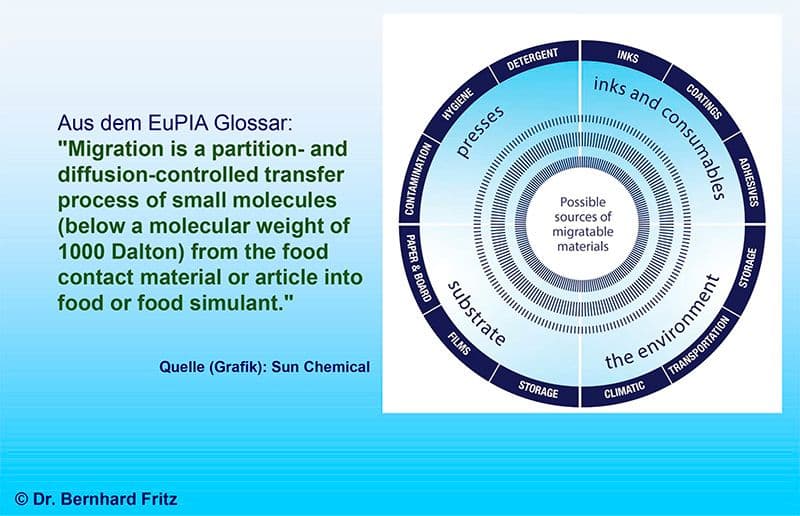
With increasingly high-resolution analytical methods in the second half of the 20th century, ever smaller concentrations could be detected in (foreign) substances that enter the human body with food. As a result, the transfer of substances from food contact materials (or from the “environment” in general) into food became increasingly relevant and was reflected in legislation. Since the 1980s, the EU Member States have progressively established a legal framework that, to this day, based on scientific data, is globally (!) pioneering for the assessment of food contact materials.

The lecture covers the (EU) legal framework for substances/materials/articles intended for food contact and the physical and chemical principles underlying it.