
Albert-Overhauser Award
In honour of Albert W. Overhauser’s groundbreaking research, the GDCh Division of Magnetic Resonance has awarded the Albert-Overhauser Award since 2019. The award recognises an outstanding scientific publication by an early-career researcher (PostDoc). The award is generally presented annually and comprises a certificate and prize money of 750 euros. The award is decided by a panel of reviewers appointed by the Division Board.
Presentation of the Albert-Overhauser Award: Selection process
The prize is not currently open for applications (next call for proposals: early 2027).
The Albert-Overhauser Award was presented during the 46th FGMR Annual Discussion Meeting on 17 September 2025 in Bonn to Dr. Vrinda Sant (Max Planck Institute for Multidisciplinary Sciences, Göttingen) for her publication Lipidic folding pathway of α-Synuclein via a toxic oligomer (Nat. Commun. 2025, 16, 760).
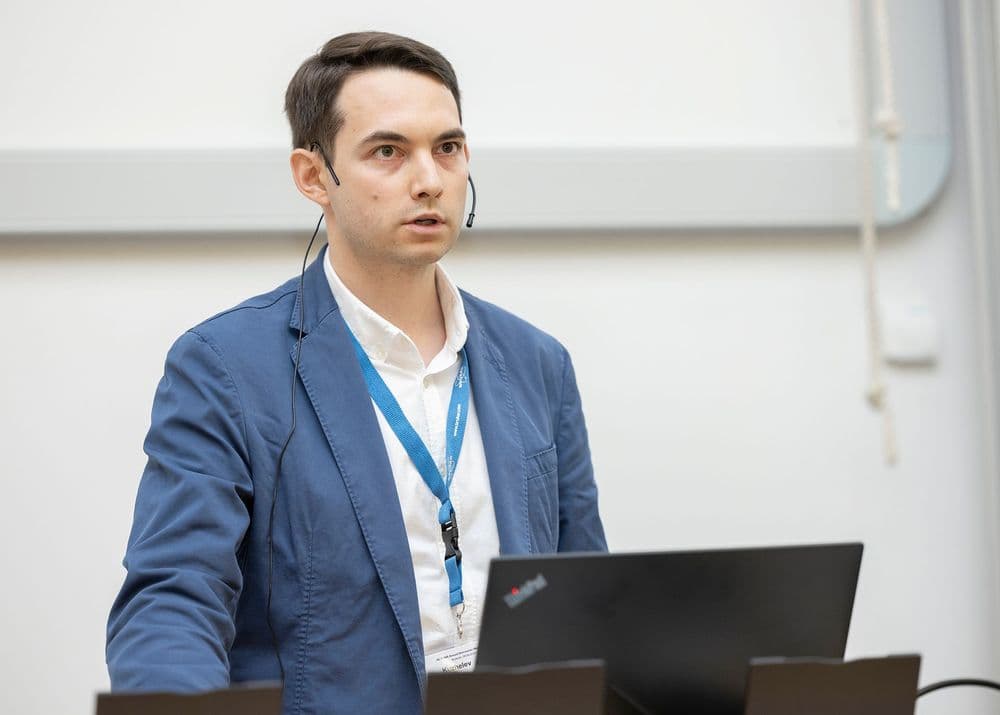
The Albert-Overhauser Award was presented during the 45th FGMR Annual Discussion Meeting on 10 September 2024 in Rostock to Dr. Andrei Kuzhelev (Goethe University Frankfurt) for his publication Solid-Effect Dynamic Nuclear Polarization in Viscous Liquids at 9.4 T Using Narrow-Line Polarizing Agents (J. Am. Chem. Soc. 2023, 145, 10268).
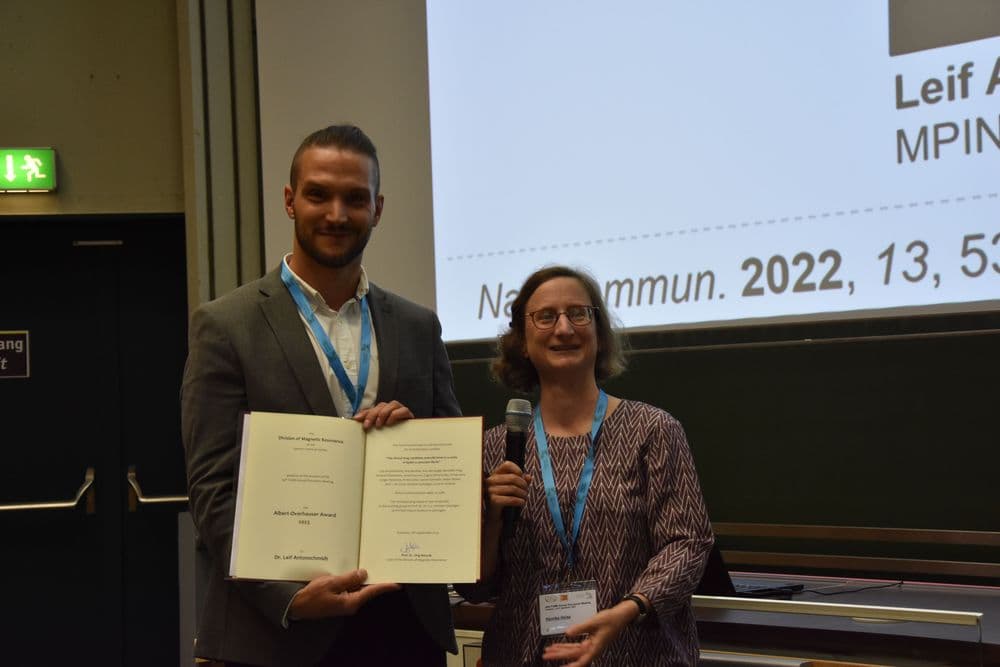
The Albert-Overhauser Award was presented to Dr. Leif Antonschmidt during the 44th FGMR Annual Discussion Meeting on 18 September 2023 in Konstanz for his publication “The clinical drug candidate anle138b binds in a cavity of lipidic α-synuclein fibrils” (Nature Communications).
The Albert-Overhauser Award was presented to Dr. Angeliki Giannoulis during the 42nd FGMR Annual Discussion Meeting on 28 September 2021 for her publication “Two closed ATP- and ADP-dependent conformations in yeast Hsp90 chaperone detected by Mn(II) EPR spectroscopic techniques” (National Academy of Sciences).
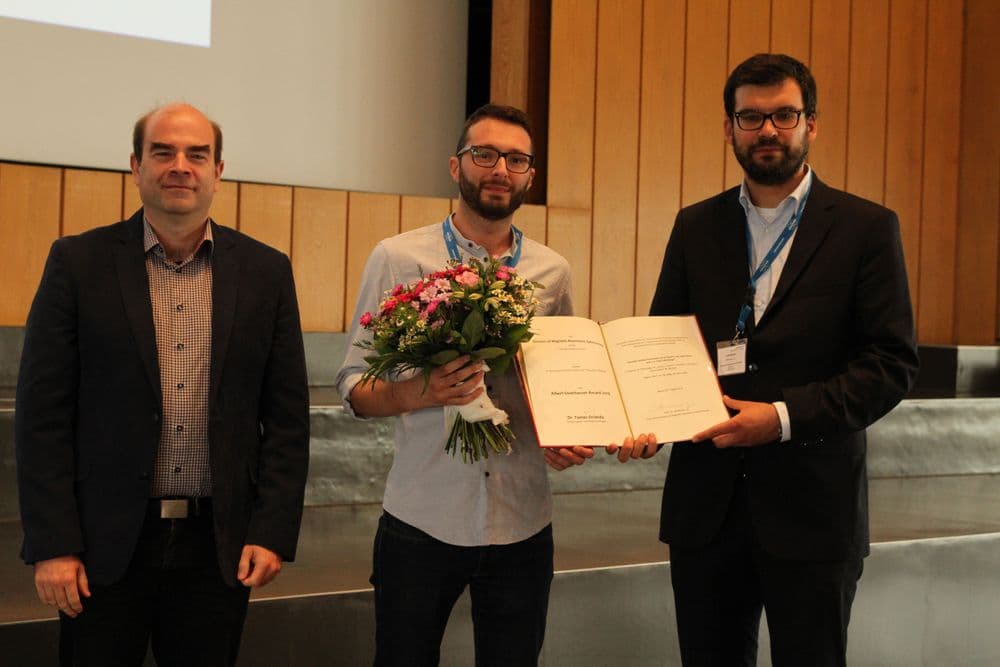
The first Albert-Overhauser Award was presented to Dr. Tomas Orlando during the 41st FGMR Annual Discussion Meeting (EUROISMAR; Berlin) on 28 August 2019 for his publication “Dynamic Nuclear Polarization of 13C Nuclei in the Liquid State over a 10 Tesla Field Range” (Angew. Chem. Int. Ed.).
| Year | Place of award ceremony | Name | Affiliation at the time of the award | |
| 2025 | Bonn | Dr. Vrinda Sant | Max Planck Institute for Multidisciplinary Sciences, Göttingen | |
| 2024 | Rostock | Dr. Andrei Kuzhelev | Goethe University Frankfurt | |
| 2023 | Konstanz | Dr. Loren B. Andreas | Max-Planck Institute for Multidisciplinary Sciences, Göttingen | |
| 2022 | Not awarded | |||
| 2021 | Not awarded | |||
| 2020 | Awarded in 2021 Frankfurt | Dr. Angeliki Giannoulis | Weizmann Institute of Science in Rehovot (Israel) | |
| 2019 | Berlin | Dr. Tomas Orlando | Georg-August University Göttingen |