
School and University

    Students and Apprentices

    Undergraduate and PhD Students

    Teachers

    Higher Education Statistics

    Scholarships

Career

    Career Guidance

    Job Vacancies

    Salary Information and Income Survey

    Academy

    Mentoring

Community

    Divisions

    Young Chemists’ Forum (JCF)

    Local Sections

    Regulars' Get-Togethers

    Chem_Connect

    Equal Opportunities and Diversity

    Partnerships and International Activities

    Volunteering

    Membership

Discover Chemistry

    Top Topics

    “Nachrichten aus der Chemie” – Members’ Magazine

    Scientific Journals

    Statements and Position Papers

    Press Releases

    Brochures and Academic Publications

    Books, Videos and Podcasts

    The Fascination of Chemistry

    Cartoons

    Biographies of Female Chemists

Events

    Conferences

    Academy

    Lectures

    Further Events

Awards

    Prices

    Historical Sites of Chemistry

About Us

    Board and Other Bodies

    The Office

    Statutes and Code of Conduct

    Charities

    Press and Public Relations

    Sustainability

MyGDCh

GDCh

Chemistry for a better world

© 2026 Gesellschaft Deutscher Chemiker. All rights reserved.

NewsletterDownloadsPressContactGDCh Shop
Legal NoticeData PrivacyTerms & Conditions
Homepage/Divisions/Environmental chemistry & ecotoxicology/Publications/Announcements
Publications

Announcements

2025
2024
2023
2022
2021
2020
2019
2018
2017
2016
2015
2014
2013
2012
2011
2010
2009
2008
2007
2006
2005
2004
2003
2002
2001
Authors
Briefly Introduced
Year groups
Press releases

Announcements

Communications from the GDCh Division of Environmental Chemistry & Ecotoxicology

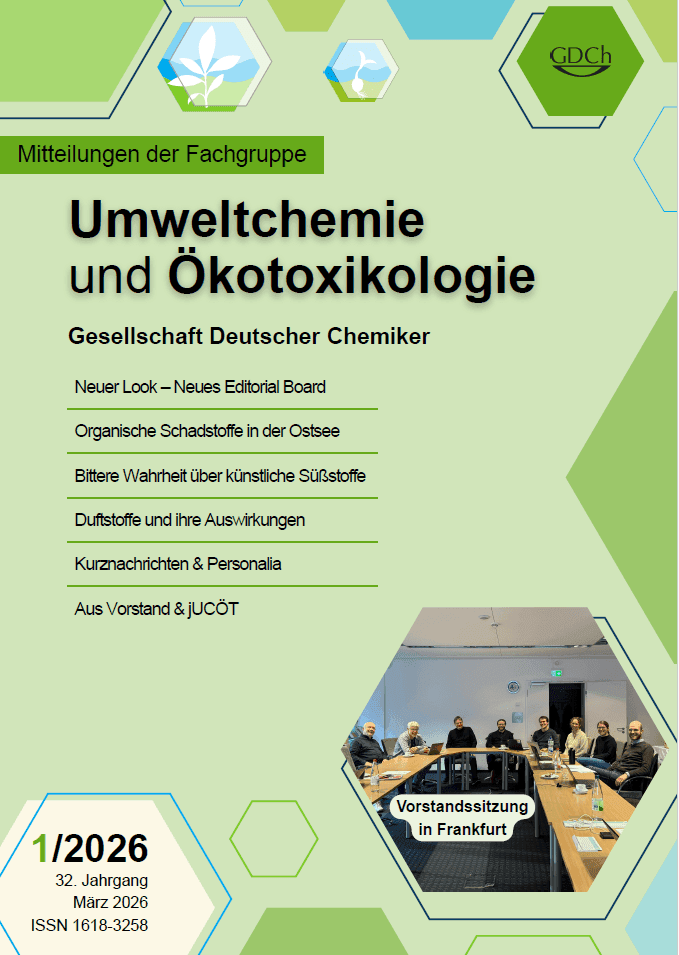
The journal Communications of the Division of Environmental Chemistry and Ecotoxicology is the official members’ magazine of the Division. The first volume was published in 1998. Until 2005, the journal was published by Wiley-VCH (Weinheim); since 2006, the Division has published the Communications of Environmental Chemistry and Ecotoxicology independently. From 2026, the four online issues per year can be accessed as PDFs and as a page-turning catalogue.

Please send your contributions by email to ucoet-mitteilungen@go.gdch.de.

Editorial Board: Dr. Charlotte Henkel, Timm Knautz, Angus Rocha Vogel, Dr. Nadin Ulrich

ISSN (Online) 1618-3258

CURRENT EDITION: PDFs & Flip Catalogues

2026 volume
1/2026: PDF; Page-turning catalogue
2/2026: PDF; Page-turning catalogue
3/2026: PDF; Page-turning catalogue
4/2026: PDF; Page-turning catalogue

Volumes 2001-2025
+++ 2025 +++ 2024 +++ 2023 +++ 2022 +++ 2021 +++
+++ 2020 +++ 2019 +++ 2018 +++ 2017 +++ 2016 +++
+++ 2015 +++ 2014 +++ 2013 +++ 2012 +++ 2011 +++
+++ 2010 +++ 2009 +++ 2008 +++ 2007 +++ 2006 +++
+++ 2005 +++ 2004 +++ 2003 +++ 2002 +++ 2001 +++

Contents lists up to 2025
− Authors (2001-2025)
− Volumes & issues (2006-2025)
− "Briefly introduced" section (2002-2025)
− Press releases & brief news (2011-2025)

ISSN
1998-2000: 0948-6283 (print)
2001-2005: 1617-5301 (print)
2006ff: 1618-3258 (Online)

The communications inform Division members about the activities of the Division (annual conferences, work of the executive committee etc.) and its working groups. The work of the Divisions is a flagship of the GDCh and enables their members to participate in discussions and to be represented in public and political spheres with expert knowledge in the diverse problem areas in which chemistry plays a role today. Current topics are reported on through original contributions, news etc.

The PRO and CONTRA section aims to present opposing viewpoints on a scientific basis in order to stimulate discussion and draw attention to the need for further research—particularly in relation to interdisciplinary issues. PRO and CONTRA are interchangeable. CONTRA is not intended to encourage inaction. In many areas of environmental protection, there is no definitive answer; this does not, however, exempt us from taking precautionary measures and acting in good time to prevent problems. Conversely, the opposing viewpoint must not be characterised as a frivolous attitude. Scientific debate must be conducted independently of external influences. Consensus should be achieved wherever possible.

We look forward to receiving your letters to the editor and suggestions for topics. Please also inform us about honours, appointments and nominations involving members, so that the sense of cohesion within the Division can be further strengthened.

  • Text length: max. 5 pages (approx. 1,500 words)
  • Precede the text with an abstract of no more than 100 words
  • Continuous text without automatic hyphenation
  • Create citations without citation software (e.g. "EndNote")
  • Where possible, create figures (in either black and white or colour) as a separate file, even if they have already been inserted in Word; adjust the figure width to the two-column layout (8.75 or 17.5 cm); figure captions in Arial, 10 pt font
  • Provide the full correspondence address of the first author, as well as the e-mail addresses of all authors
  • Include a digital photograph of the first author or the group of authors
  • Authors will receive a PDF file of their contribution for free (non-commercial) use after online publication.

Key topics

  • Waste treatment
  • Analytical chemistry
  • atmospheric chemistry
  • Bioindication
  • Soil chemistry and soil ecology
  • chemical assessment and chemical safety
  • Chlorine chemistry
  • Endocrine disruptors
  • Division
  • Research and teaching
  • Genetic engineering
  • Legislation / guidelines
  • International cooperation
  • IUPAC
  • Climate change
  • Microorganisms
  • Ecotoxicology
  • Sample banking

Sections

  • Editorial
  • Original articles
  • From the Division
  • Briefly introduced
  • Information (conference announcements, conference reports and brief news items)
  • People