
Bunsen-Kirchhoff Award
The German Working Group for Analytical Spectroscopy (DAAS) of the GDCh Division of Analytical Chemistry awards the "Bunsen-Kirchhoff Award for Analytical Spectroscopy" in even-numbered years to recognise outstanding spectroscopic achievements by established early-career researchers from universities, research institutes or industry. Outstanding work (publications, patents and similar) from all areas of analytical spectroscopy is considered, particularly from innovative fields such as nanoscale spectroscopy, spectroscopy of biomolecules or spatially resolved spectroscopy. The award, endowed with 3000 euros by Analytik Jena since 2020, is presented as part of the analytica conference in Munich.
The "German Working Group for Applied Spectroscopy" (DASp) began awarding the Bunsen-Kirchhoff Award in 1990. Since 2014, the DAAS, which emerged from the merger of the DASp and A.M.S.El. ("Working Group for Microanalysis and Trace Analysis of elements and element species"), has continued this tradition.
Call for applications period: July to October of odd-numbered years
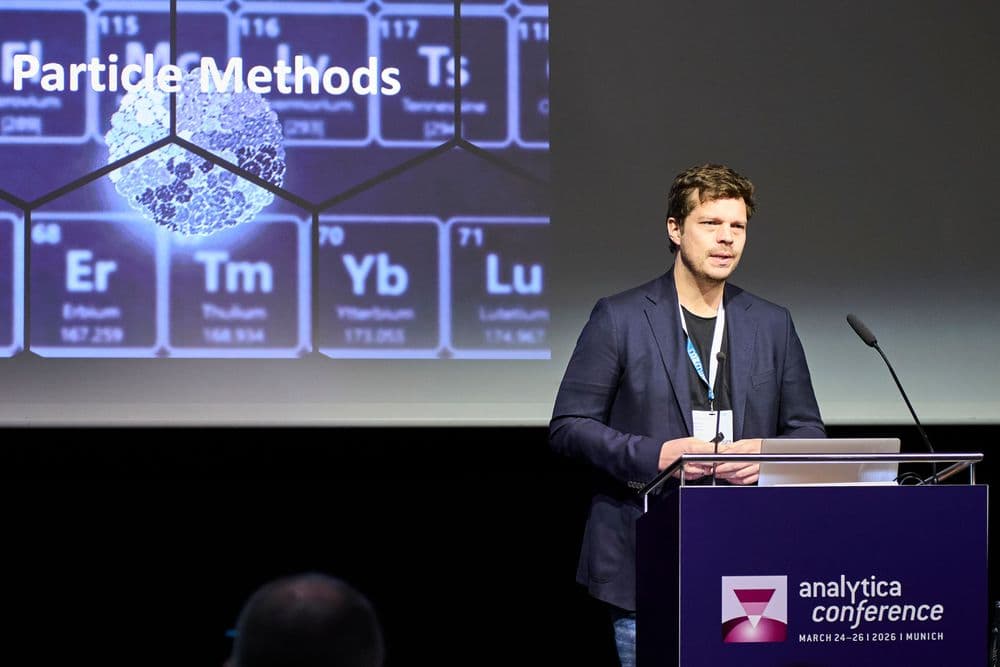
The Bunsen-Kirchhoff Award 2026 was presented to Prof. Dr. David Clases on 26 March 2026 on the occasion of the analytica conference in Munich – in recognition of his pioneering contributions to the further development of single-particle ICP-TOF-MS and the multimodal characterisation of nano- and microparticles.
"David Clases' work combines element-selective mass spectrometry with innovative analytical concepts for investigating complex particle systems, including in environmental and material samples. A particular focus is placed on non-targeted analyses, multimodal couplings with Raman spectroscopy and optofluidic methods, as well as new approaches to the characterisation of nanoparticles and microplastics. Professor Clases is distinguished by his creativity, scientific ingenuity and strong interdisciplinary collaboration. His numerous research studies have been published in leading journals and recognised at international Conferences."
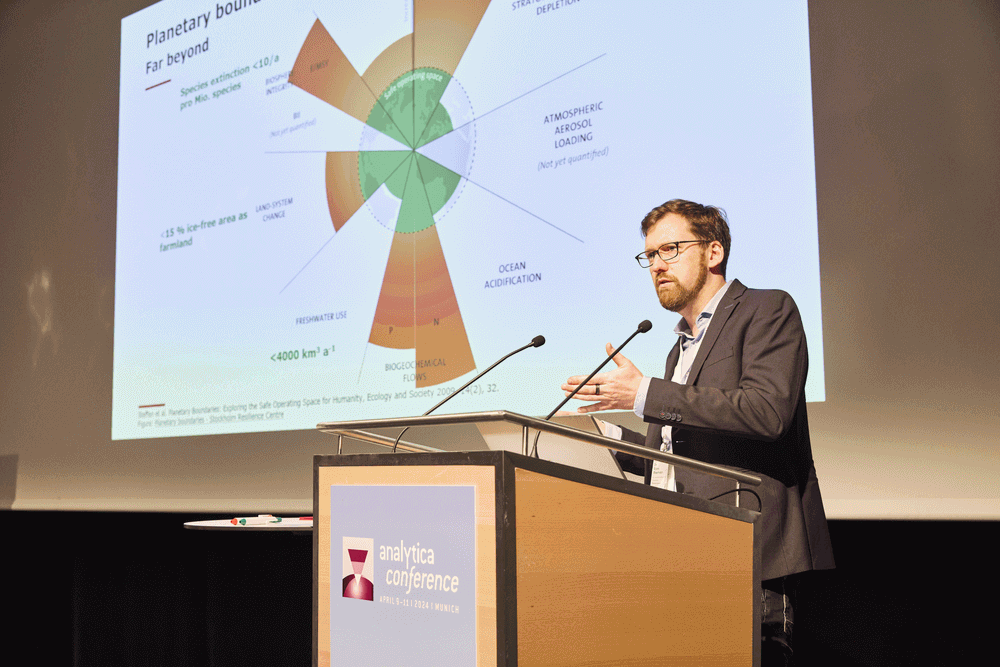
The Bunsen-Kirchhoff Award 2024 was presented to Dr. Björn Meermann (Federal Institute for Materials Research and Testing (BAM) in Berlin on 11 April 2024 at the analytica conference in Munich – in recognition of his outstanding developments in the field of analysing per- and polyfluorinated alkyl compounds.
"Dr. Björn Meermann is an outstanding expert in the field of atomic and molecular absorption spectrometry. In particular, he made a significant contribution to the further development of high-resolution-continuum source-graphite furnace molecular absorption spectrometry (HR-CS-GFMAS) for analysing sum parameters of PFAS. Due to their water-, grease- and dirt-repellent properties as well as their chemical and thermal stability, these analytes are found in numerous consumer goods and industries. However, PFAS accumulate in the environment because of their persistence and can in some cases have harmful effects on health. Mr Dr Meermann's contribution to the accurate determination of these analytes is therefore of particularly great importance."
The Bunsen-Kirchhoff Award 2022 was presented on 23 June 2022 on the occasion of the analytica conference in Munich to Dr. Carlos Abad Andrade (California Institute of Technology, Pasadena, California, USA) – in recognition of his excellent developments in the field of continuum source atomic absorption spectrometry (CS-AAS).
"Dr. Carlos Abad Andrade is an outstanding expert in the field of atomic and molecular absorption spectrometry. In particular, he made a significant contribution to the substantial further development of Echelle spectrometers for CS-AAS. This made it possible to achieve a quantitative approach to elements such as boron, chlorine, fluorine and sulphur using AAS. For the first time, Dr. Carlos Abad Andrade demonstrated, using a Zr modifier as an example, that the temporal resolution of the Echelle systems used enables mechanistic investigations into the effect of the modifier in the graphite furnace. Particularly noteworthy is his work on using CS-AAS for isotope analysis, which achieves an accuracy approaching that of multicollector inductively coupled plasma mass spectrometry (MC-ICP-MS). This opens up entirely new applications for technologically highly relevant fields, such as investigating the ageing of lithium batteries or analysing lithium in blood serum."
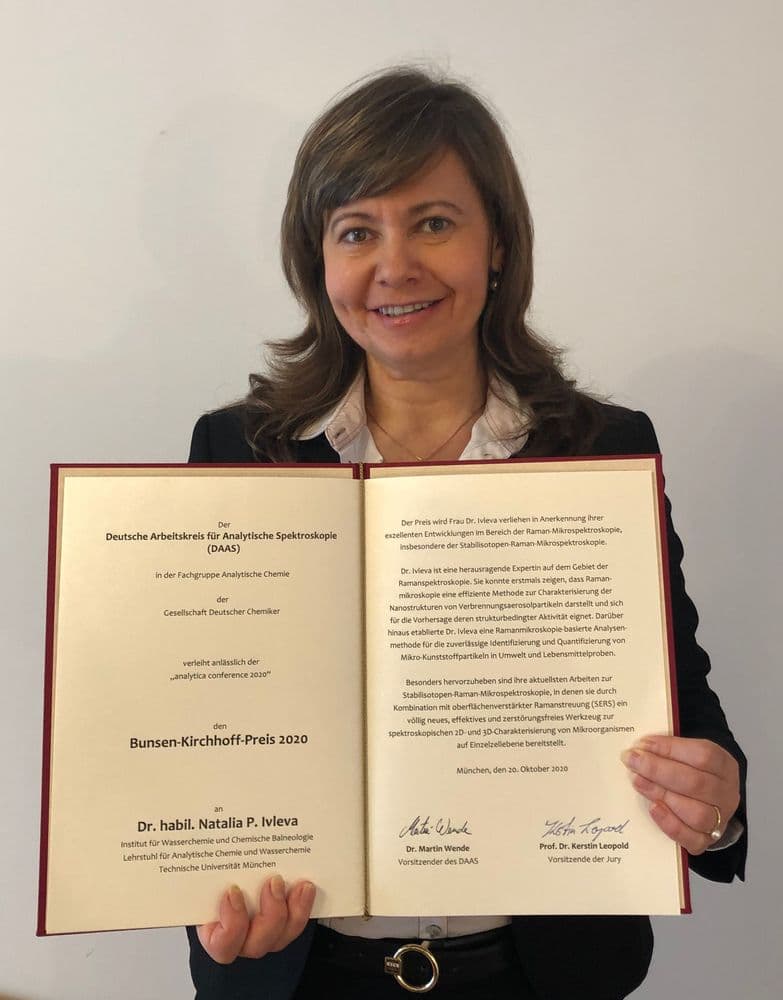
The Bunsen-Kirchhoff Award 2020 was presented to Dr. habil. Natalia P. Ivleva (Technical University of Munich, Institute of Water Chemistry and Chemical Balneology, Chair of Analytical Chemistry and water chemistry) on 20 October 2020 at the virtual analytica conference – in recognition of her excellent developments in the field of Raman microspectroscopy, particularly stable-isotope Raman microspectroscopy.
"Dr. Ivleva is an outstanding expert in the field of Raman spectroscopy. She was the first to demonstrate that Raman microscopy is an efficient method for characterising the nanostructures of combustion aerosol particles and is suitable for predicting their structure-related activity. In addition, Dr. Ivleva established a Raman microscopy-based analytical method for the reliable identification and quantification of microplastic particles in environmental and food samples. Her most recent work on stable-isotope Raman microspectroscopy is particularly noteworthy. By combining it with surface-enhanced Raman scattering (SERS), she has provided a completely new, effective and non-destructive tool for the spectroscopic 2D and 3D characterisation of microorganisms at the single-cell level."
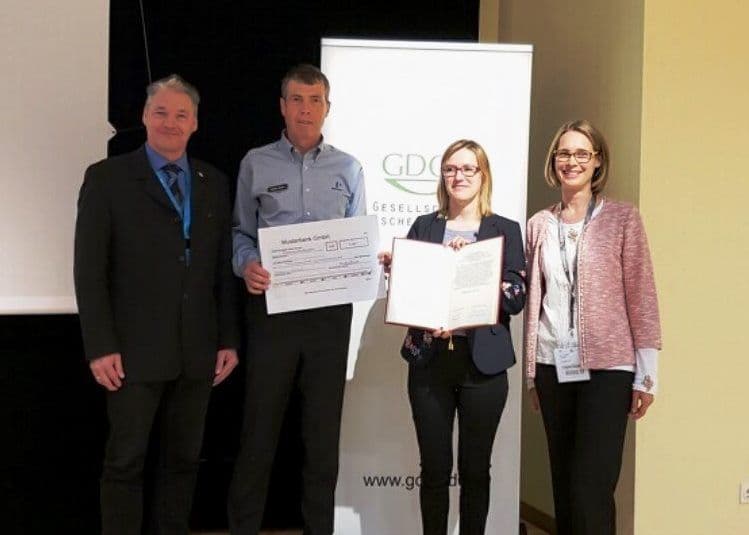
Presentation of the Bunsen-Kirchhoff Prize to Dr. Zsuzsanna Heiner (second from right) by Dr. Martin Dinse, PerkinElmer (second from left), Prof. Dr. Kerstin Leopold, Chair of the Bunsen-Kirchhoff Prize jury (right), and Dr. Wolfgang Buscher, Chair of the DAAS (left). (Photo: PerkinElmer)
| Year | Awardee/Affiliation* | Citation |
|---|---|---|
| 2026 | Prof. Dr. David Clases >University of Graz, AT | in recognition of his pioneering contributions to the advancement of single-particle ICP-TOF-MS and the multimodal characterisation of nano- and microparticles |
| 2024 | Dr. Björn Meermann >Federal Institute for Materials Research and Testing (BAM), Berlin | in recognition of his excellent developments in the field of the analysis of per- and polyfluoroalkyl substances |
| 2022 | Dr. Carlos Abad Andrade, California Institute of Technology, Pasadena, California, USA | in recognition of his excellent developments in the field of continuum source atomic absorption spectrometry (CS-AAS) |
| 2020 | Dr. habil. Natalia P. Ivleva Technical University of Munich | in recognition of her excellent developments in the field of Raman microspectroscopy, in particular stable-isotope Raman microspectroscopy |
| 2018 | Dr. Zsuzsanna Heiner | in recognition of her excellent developments in the field of sum-frequency spectroscopy (vibrational sum frequency generation, VSFG) at high repetition rates |
| 2017 | Prof. Dr. Jacob T. Shelley | in recognition of his outstanding research in the field of novel plasma-based ionisation sources in mass spectrometry |
| 2016 | Dr. Torsten Frosch Leibniz Institute of Photonic Technology | in recognition of his excellent developments in the field of miniaturised, fibre-based Raman sensors for addressing questions in environmental science, pharmaceuticals and biomedicine |
| 2015 | Prof. Dr. Martín Resano >University of Zaragoza, ES | in recognition of his outstanding developments in the use of atomic spectrometric methods for the direct trace element analysis of solids |
| 2014 | Dr. Oliver Reich >University of Potsdam | in recognition of his outstanding achievements in the field of photon-density-wave spectroscopy |
| 2013 | Prof. Dr. Maria Montes-Bayón >University of Oviedo, ES | in recognition of her groundbreaking developments in the use of mass spectrometric methods for the quantitative analysis of biomarkers |
| 2012 | Prof. Dr. Christoph Haisch, Munich | for his groundbreaking developments and applications in the field of laser-based spectrochemical analysis systems, particularly in the areas of laser-induced breakdown spectroscopy (LIBS), optothermal spectroscopy, photoacoustic spectroscopy and surface-enhanced Raman scattering (SERS) |
| 2011 | Dr. Daniel Pröfrock, Helmholtz Centre Geesthacht | for his outstanding work on the detection of biomolecules using covalently bound heteroatoms, as well as the development of miniaturised chromatographic techniques and their coupling with element- or molecule-specific mass spectrometric methods |
| 2010 | Prof. Dr. Janina Kneipp, Humboldt University of Berlin | for her work on analytical laser molecular spectroscopy using resonant Raman scattering in complex microstructured systems |
| 2009 | Dr. Joachim Koch, ETH Zurich, CH | for his analytical-spectroscopic work on laser ablation using femtosecond lasers |
| 2008 | PD Dr. Sebastian Schlücker, Würzburg | for his analytical-spectroscopic FT-IR and Raman work on label-free microscopic imaging for biomedical diagnostics |
| 2007 | Dr. Jörg Bettmer, Mainz | for his work on coupling methods for chromatography and plasma mass spectrometry for the investigation of metalloproteins |
| 2006 | Dr. Volker Deckert, Dortmund | for his work on tip-enhanced Raman spectroscopy |
| 2005 | Dr. Nicolas Bings, Hamburg | for his work on inductively coupled plasma time-of-flight mass spectrometry, with particular emphasis on analytical-methodological studies on the use of laser ablation, electrothermal vaporisation, hydride methods and couplings with capillary electrophoresis for the analysis of real samples |
| 2004 | Dr. Ewa Bulska, Warsaw, PL | for her work in the field of furnace atomic absorption spectrometry, with particular reference to the use of matrix modifiers, as well as the analysis of biological materials and studies on the conservation of works of art |
| 2003 | Dr. Sergei Boulyga, Mainz | for his work on the atomic spectrometric determination of the concentration and microdistribution of trace elements in environmental and tissue samples, particularly in connection with the reactor accident at Chernobyl |
| 2002 | Dr. Jürgen Popp, Würzburg | for his work on the spectroscopy of microparticles |
| 2001 | Dr. John A. McLean, Washington, DC, USA | for his work in the field of plasma spectrometry |
| 2000 | Dr. Dieter Fischer, Dresden | for adapting infrared and Raman spectroscopy for process analytics |
| 1998 | Dr. Annemie Bogaerts, Antwerp, BE | for her work on the modelling of glow discharges |
| 1995 | Dr. Paul W. J. M. Boumans, Bergeyk, NL | in recognition of his fundamental contributions to the development of analytical atomic spectroscopy |
| 1994 | Dr. D. Bruce Chase, Wilmington, USA | for his work on the development of Fourier-transform Raman spectroscopy |
| 1994 | Dr. W. J. Orville-Thomas, Salford, GB | for his work on elucidating the nature of the chemical bond |
| 1993 | Dr. Boris L'vov, St Petersburg, RUS | for his work in the field of electrothermal atomic absorption spectroscopy |
| 1992 | Dr. Kurt Laqua, Dortmund (1919-2013) | for his work in the field of analytical atomic spectroscopy |
| 1992 | Dr. Arnulf Röseler, Berlin | for his work in the field of infrared ellipsometry |
| 1991 | Dr. Hannes Aiginger, Vienna, AT | for his work in the field of total-reflection X-ray fluorescence analysis |
| 1991 | Dr. Peter Wobrauschek, Vienna, AT | for his work in the field of total-reflection X-ray fluorescence analysis |
| 1991 | Dr. Joachim Knoth, Geesthacht | for his work in the field of total-reflection X-ray fluorescence analysis |
| 1991 | Dr. Heinrich Schwenke, Geesthacht | for his work in the field of total-reflection X-ray fluorescence analysis |
| 1990 | Dr. Günter Snatzke, Bochum | for his work in the field of circular dichroism spectroscopy |
*At the time of the award.