Dr. Hans-Georg Weinig

Chemical Sciences and Society Symposia (CS3)

The Chemical Sciences and Society Symposia (CS3), launched in 2009 under the auspices of the DGCh, bring together leading chemists from China, Japan, the UK, Germany and the USA with the aim of proposing solutions to society’s global problems through chemistry.
The symposia are organised jointly by the chemical societies of the five participating countries.

"Chemistry for Sustainable Food" was the theme of the ninth Chemical Sciences and Society Symposium (CS3), held at the Chemical Society of Japan (CSJ) in Tokyo from 19 to 21 September. Around 30 scientists from China, Germany, the UK and Japan discussed future challenges from a chemical perspective, including “Food Engineering”, “Revolutionary Food Production” and “Circular and Sustainable Chemistry for Food Sustainability”. The American Chemical Society (ACS) took part with two presentations via video call. The findings are summarised in a white paper as recommendations for policy-makers, the scientific community and society.
The German delegation included Monika Pischetsrieder (Erlangen-Nuremberg, Co-Chair), Ute Weisz (Munich), Markus Fischer (Hamburg) and Holger Zorn (Giessen) from the Food Chemical Society (LChG), as well as Elisabeth Kapatsina from the GDCh. The CS3 series has been running since 2009 and is supported by the chemical societies and funding agencies of the participating countries as co-organisers; in Germany, this includes the German Research Foundation and the GDCh.
| Download | White Paper | English (PDF file, 3.5 MB) |

“Science to Enable Sustainable Plastics” was the theme of the 8th Chemical Sciences and Society Symposium, held from 10–13 November 2019 in London. Thirty scientists from China, Germany, Japan and the UK, along with representatives from the chemical societies and research funding bodies in these countries, discussed how chemistry can help to enable sustainable plastics. Keynote and position talks sparked discussion in four thematic sessions: new plastics, the recyclability of plastics, the degradation of plastics, and measuring the impact of plastics. In a summary session, recommendations for scientists, research funders, policy-makers and society were drawn up; these will be published alongside the results from the thematic sessions in a white paper later in 2020.
Andreas Greiner (Bayreuth) led the German CS3 delegation to London; other delegates included Markus Biesalski (Darmstadt), Christian Laforsch (Bayreuth), Stefan Mecking (Konstanz), Brigitte Voit (Dresden), Markus Behnke (DFG), and Hans-Georg Weinig (GDCh).
The Chinese Chemical Society (CCS), the Chemical Society of Japan (CSJ), the Royal Society of Chemistry (RSC), the GDCh and research funding bodies from all participating countries, including the German Research Foundation, support the CS3 series both financially and as co-organisers.
At the end of the meeting, delegates from all four countries took part in a live-streamed online panel discussion, moderated by BBC environment reporter Laura Foster, to discuss key outcomes of the CS3 and answer questions from online followers worldwide. The webcast is available at: https://www.youtube.com/watch?v=P4f_HR57AcM
| Download | White Paper | English (PDF file 3.24 MB) |

At the invitation of the Chinese Chemical Society (CCS), the 7th Chemical Sciences and Society Symposium (CS3) took place in Dalian, China, from 5 to 8 September 2017. Around 40 scientists and representatives from chemical societies and funding organisations from the participating countries – China, Germany, the UK, Japan and the USA – discussed the contributions that chemistry can make to this year’s conference theme, ‘Solar Energy for a Sustainable Future’. The German CS3 delegation was led by Professor Ferdi Schüth (MPI Mülheim).
The results of the symposium were summarised in a white paper and presented at a press conference on 19 March 2018 as part of the ACS National Meeting in New Orleans, USA.
| Download | White Paper | English (PDF file 648 KB) |

From 14 to 18 September 2015, the GDCh organised the 6th Chemical Sciences and Society Symposium (CS3) on the theme of “Chemistry and Water”. 42 experts from five countries travelled to Leipzig for the event.
Water chemists and chemical engineers from China, Germany, the UK, Japan and the USA discussed the role of chemistry in ensuring a safe global drinking water supply. The scientific committee, chaired by Torsten Schmidt (University of Duisburg-Essen and Chair of the Society of Water Chemistry), had set the following priorities for the thematic sessions: drinking water, health and the environment, detection, wastewater treatment and recycling, and the recovery of valuable materials from water.
The results of the symposium were summarised in a white paper and presented at a press conference on 14 March 2016 as part of the 251st ACS National Meeting in San Diego, USA.
Download White Paper & English (PDF file, 993 KB)
White Paper German (PDF file, 936 KB)

The fifth Chemical Sciences and Society Symposium (CS3), on the theme of ‘Efficient Utilisation of Elements’, took place in Tokyo, Japan, from 16 to 19 September 2013.
In this field, chemistry played a particularly important role, both now and in the future, in the substitution of critical elements and materials, in recycling, and in the development of new materials. Furthermore, the outcomes of the discussions among the participating scientists also informed science policy with regard to future resource strategies and geopolitical issues. As in previous years, high-profile scientists from the USA, the UK, China, Japan and Germany took part in this year’s CS3 in Tokyo.
The results of the symposium will be summarised in a white paper and made available to all relevant stakeholders.
Download White Paper & English (PDF file, 778 KB)

The fourth Chemical Sciences and Society Symposium (CS3) took place in San Francisco, USA, from 17 to 20 September 2012. The central theme of the CS3 was: “Chemistry for Next-Generation Sustainable Electronics”.
30 leading scientists from the participating countries – the USA, the UK, China, Japan and Germany – discussed key issues in four thematic sessions and one concluding session, and made recommendations to policymakers, the scientific community and society at large regarding the contributions chemistry can make to the above-mentioned topic. The results of the symposium were summarised in the white paper “Organic Electronics for a Better Tomorrow: Innovation, Accessibility, Sustainability”.
| Download | White Paper | English (PDF file, 1 MB) |

The third Chemical Sciences and Society Symposium (CS3) took place in Beijing from 13 to 15 September 2011. The central theme was “Chemistry for Better Health”. Every year, the chemical societies of China, Germany, the UK, Japan and the USA, with the support of their respective research funding organisations, send high-ranking chemists to the CS3 meetings to discuss topics in chemistry that are important to society. Professor Horst Kessler (Munich) led the German delegation of six scientists to Beijing on behalf of the GDCh. The experts’ findings and resulting recommendations are incorporated into the White Paper “Chemistry for Better Health” – for the purpose of dialogue with the scientific community and society at large, and in particular to inform policy-making.
Further information on the White Paper and a download link can be found on the RSC website http://rsc.li/health-report-2012
The White Papers “Sunlight as an Energy Source for the Earth”, based on the first CS3 in Kloster Seeon, and “Chemistry for a Sustainable Global Society”, resulting from the second CS3 in London, have been published to date.
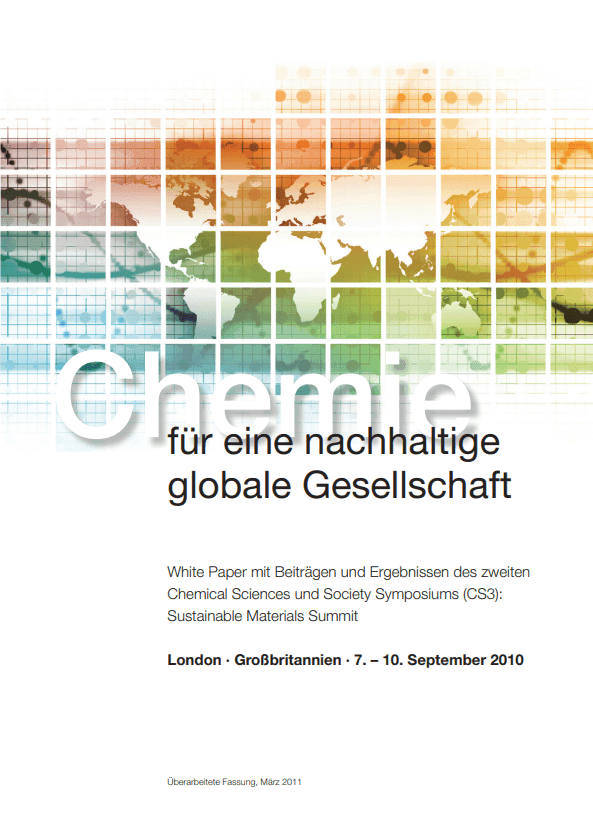
The aim of the second Chemical Sciences and Society Symposium, held in London from 7 to 10 September 2010, was to promote international collaboration in materials chemistry and to discuss the potential contributions of materials chemistry to a sustainable global society. Following the GDCh’s organisation of the first symposium in the CS3 series in Germany in 2009, the RSC took the lead this time. The symposium was conceived in collaboration with the chemical societies of China, the UK, Japan and the USA. Funding was provided by the research funding organisations of the five participating countries.
Thirty internationally renowned scientists accepted the invitation to London and spent two and a half days discussing the key research objectives relating to sustainable materials chemistry.
Following the symposium, the scientists agreed that materials chemistry will play a central role in addressing many of the challenges of the future, from energy conversion and storage to the conservation of rare raw materials. The scientists summarised the outcomes of the London meeting in the white paper ‘Chemistry for a Sustainable Global Society’ in the following points:
| Download | White Paper | German (PDF file, 447 KB) |
| White Paper | English (PDF file, 3.1 MB) |
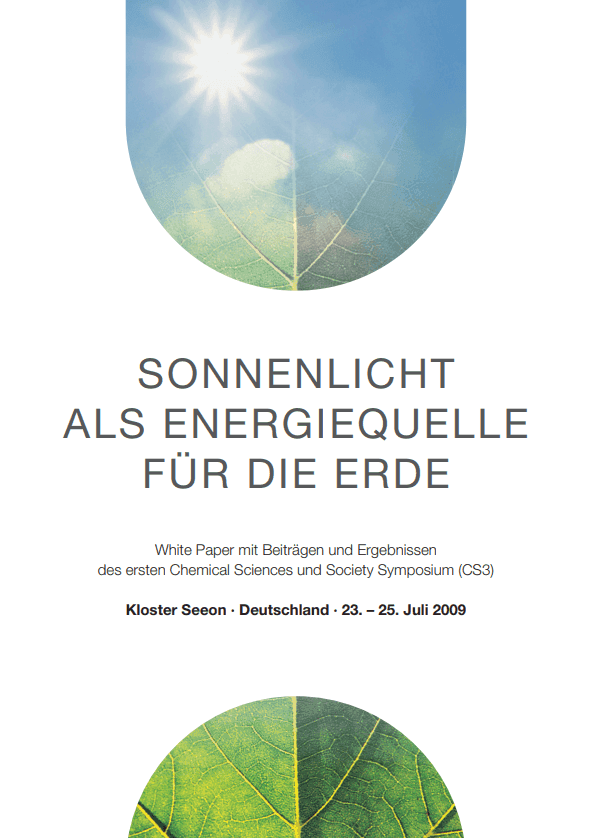
From 23 to 25 July 2009, the first CS3 Chemical Sciences and Society Symposium, on the theme “Using sunlight to address energy issues – sunlight to power the world”, took place at Seeon Abbey (Bavaria).
The German Chemical Society (GDCh) took the lead in organising the event. The symposium was organised in collaboration with the American Chemical Society (ACS), the Chinese Chemical Society (CCS), the Chemical Society of Japan (CSJ) and the Royal Society of Chemistry (RSC).
Funding was provided by the research funding organisations of the five participating nations: the German Research Foundation (DFG), the US National Science Foundation (NSF), the National Science Foundation of China, the Japan Society for the Promotion of Science (JSPS) and the British Engineering and Physical Sciences Research Council (EPSRC).
30 leading scientists identified the key research objectives relating to the use of solar energy. Chemistry will undoubtedly play a key role in the conversion and storage of solar energy. The outcomes of the discussions at the Seeon Conference were summarised in the closing plenary session and adopted by consensus among all the scientists present.
The message from the first Chemical Sciences and Society Symposium is set out in the paper “Powering the World with Sunlight”.
| Download | White Paper | German (PDF file, 305 KB) |
| White Paper | English (PDF file, 624 KB) |
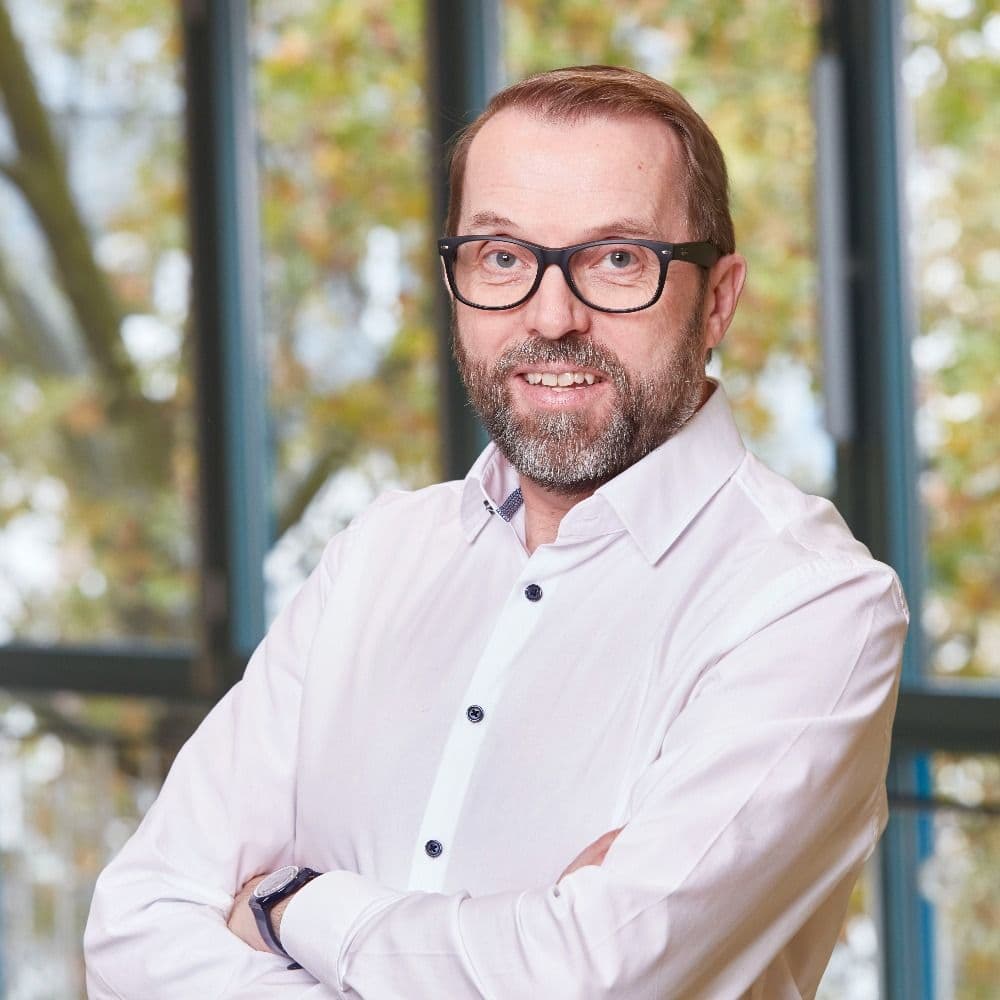
Dr. Hans-Georg Weinig