
Awards & Honors
The Division of Sustainable Chemistry awards a prize every two years for the best doctoral thesis in the field of sustainable chemistry. The award includes a certificate and prize money of 2,000 euros. The prize is generally presented in even-numbered years during the Division conference. The award decision is made by a panel of reviewers appointed by the Division Board. The prize may be shared.
The prize is not currently open for applications (next call for proposals: early 2028).
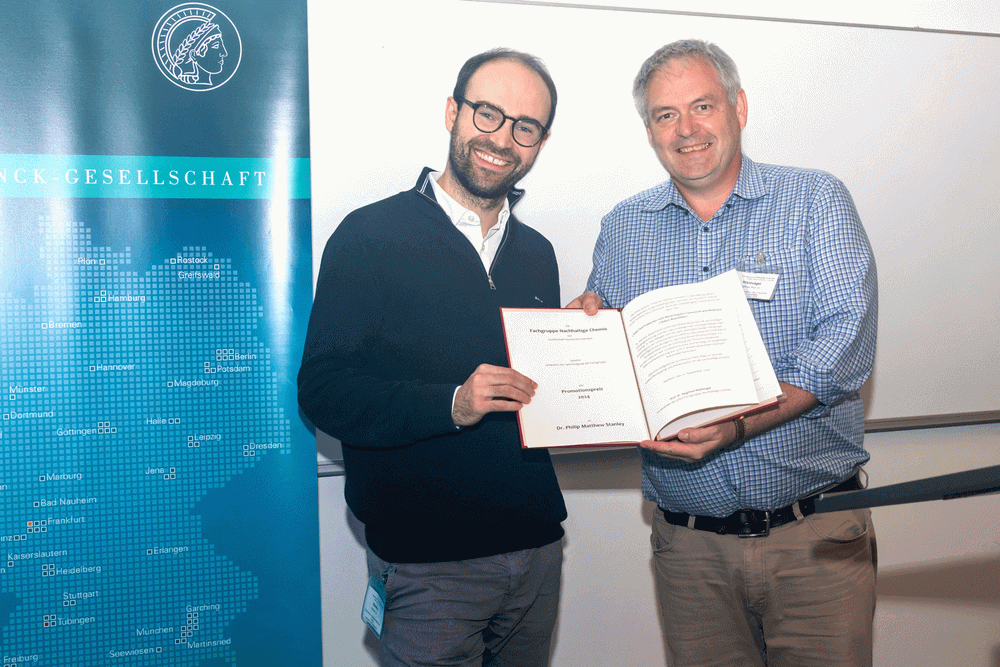
The 2024 PhD Award of the GDCh Division sustainable chemistry was presented to Dr. Philip Matthew Stanley on 12 September 2024 on the occasion of the Division’s annual meeting in Mülheim, in recognition of his dissertation entitled “Solar Fuel Production with Metal-Organic Framework and Molecular Catalyst Assemblies”,
"Dr. Stanley’s dissertation combines materials chemistry with sustainable energy generation and the underlying photophysical chemistry. He worked on the rational design of novel metal-organic framework structures (MOFs) and explored their potential for future applications in artificial photosynthesis. A milestone was increasing the photon yield from light to 36%. In addition, he was the first to report long-lived electron storage from light in three-dimensional porous materials. These are significant steps on the way to solar fuel production and milestones for sustainable chemistry."

The 2022 PhD Award of the GDCh Division sustainable chemistry, sponsored by Evonik, was presented to Dr. Joel B. Mensah and Dr. Ruth D. Rittinghaus on 1 December 2022 at the „Sustainable Chemistry Online Symposium 2022".
Dr. Joel B. Mensah: awarded in recognition of his dissertation entitled „Chemo-Catalytic and Electrochemical Deoxygenation of Bio-Derivable 3-Hydroxydecanoic Acid – Production of Drop-In Fuels and Fine Chemicals“. "Dr Mensah’s PhD demonstrates in a particularly impressive way the interdisciplinary development of new value chains for sustainable fuels and fine chemicals from biomass. The focus was on the conversion of biotechnologically efficiently accessible 3-hydroxy fatty acid esters (HAAs). Mr Mensah succeeded in demonstrating both an efficient chemocatalytic and a direct electrochemical process to selectively produce either pure hydrocarbons, secondary alcohols or an oxygenate mixture from 3-HDS. In an impressive manner, the work builds a bridge from biotechnology through chemo- and electrocatalysis to internal combustion engines along the entire value chain."
Dr. Ruth Rittinghaus: awarded in recognition of her dissertation entitled „Iron Guanidine Complexes as Polymerization Catalysts for ROP and ATRP“. "As part of her dissertation, Dr Rittinghaus studied biocompatible catalysts for the ring-opening polymerisation of renewable lactones to bioplastics. She not only succeeded in surpassing the previous industrial, toxic standard in terms of polymerisation rate. Dr Rittinghaus also demonstrated very successfully through copolymerisation experiments that her iron–guanidine catalysts can catalyse both multi-mechanistic polymerisations and precisely control the microarchitecture of the resulting copolymers. She thus shows that intelligent catalyst design opens up completely new avenues for sustainable polymer chemistry and will enable new fields of application for customised bioplastics. She has already published four papers as first author in high-ranking journals."
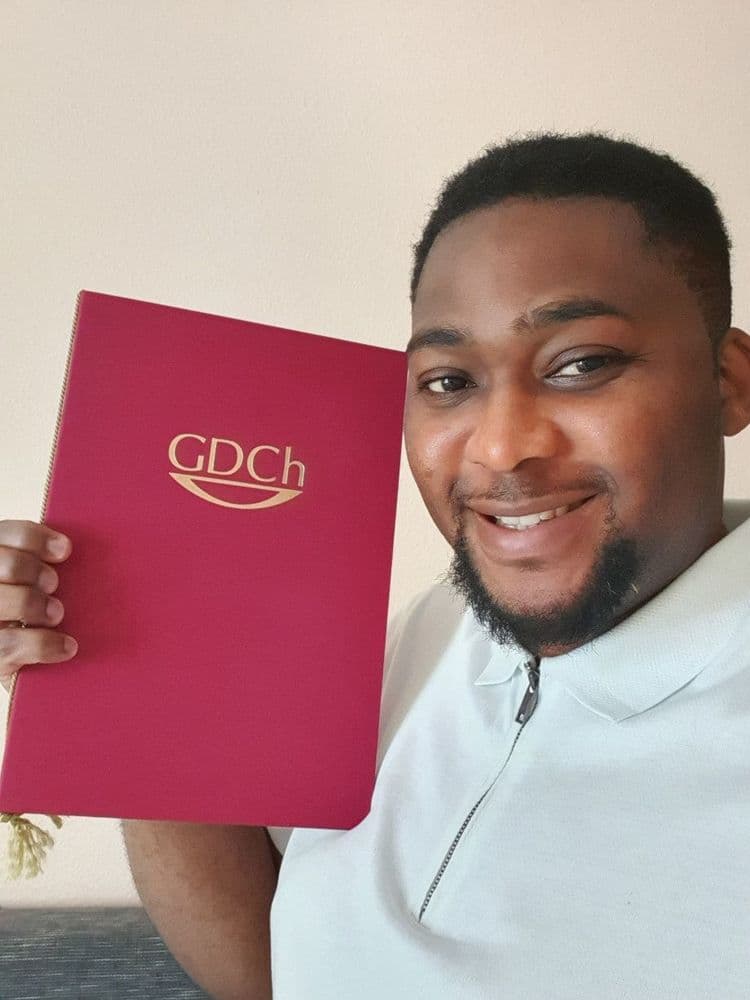

The Evonik-sponsored 2020 PhD Award of the GDCh Division sustainable chemistry was presented to Dr. Kelechukwu N. Onwukamike and Dr. Steffen Tröger-Müller.
Dr. Kelechukwu N. Onwukamike: "In recognition of his thesis entitled „Sustainable Cellulose Solubilization, Regeneration and Derivatization in a DBU-CO2 Switchable Solvent System“. Dr. Onwukamike investigated the modification of renewable raw materials in his thesis. By using switchable ionic liquids, he achieved a homogeneous modification of cellulose for the first time. He was able to render solubilization of the cellulose much more sustainable, and he obtained novel materials with promising properties. Dr. Onwukamike's thesis is characterized by excellent science and convinces due to high degrees of diversity and interdisciplinarity. His work is clearly oriented towards sustainable chemistry. Dr. Onwukamike also succeeded in publishing five articles in high-ranking journals as the first author during his doctoral period. The thesis work was conducted in the framework of a European Horizon 2020 project, mainly in the working group of Prof. Dr. M.A.R. Meier at the Karlsruhe Institute of Technology, but also at the University of Bordeaux."
Dr. Steffen Tröger-Müller: "In recognition of his thesis entitled „Truly Sustainable Imidazolium Ionics“. In his thesis, Dr. Tröger-Müller focused on the development of sustainable energy storage systems. He succeeded in synthesising imidazolium compounds from environmentally friendly starting materials and testing their applicability, for example in membranes. Dr. Tröger-Müller did not limit himself to the scientific and technical facets of sustainability. Rather, he also incorporates its social dimension and builds a bridge from chemistry as a science to the major task facing society as a whole: bringing our lifestyle into harmony with planetary boundaries. Within the remarkably short doctoral period of two and a half years, he had already published four articles in high-ranking journals as first author. The thesis was completed in the working group of Dr. Clemens Liedel at the Max Planck Institute of Colloids and Interfaces in Golm."
| 2024 | Dr. Philip Matthew Stanley, Munich |
| 2022 |
Dr. Joel B. Mensah, Aachen Dr. Ruth D. Rittinghaus, Aachen |
| 2020 | Dr. Kelechukwu N. Onwukamike, Karlsruhe/Bordeaux Dr. Steffen Tröger-Müller, Golm |
| 2018 | Dr. Thomas Seidensticker, Dortmund |
| 2016 | Dr. Johannes Huwer, Saarbrücken |
| 2014 | Dr. Josef C. Meier, Düsseldorf |
| 2012 | Dr. Hatice Mutlu, Karlsruhe |