PhD Award
The companies TANIOBIS and H.C. Starck Tungsten alternate in sponsoring the prize for an outstanding doctoral thesis in the field of inorganic solid-state chemistry and materials research. The prize is awarded annually by the Division of Solid-State Chemistry and Materials Research of the German Chemical Society (GDCh). The award comprises a certificate and prize money of 5000 euros.
Deadline: 31 October 2026
Purpose
The PhD Award is endowed by H.C. Starck Tungsten GmbH and is generally awarded every two years by the Division of solid-state chemistry and materials research of the German Chemical Society (GDCh) for the best PhD thesis in the field of solid-state chemistry and materials research.
The award
The award comprises a certificate and prize money of 5000 euros, endowed by H.C. Starck Tungsten. The conference at which the ceremonial presentation will take place will be announced shortly. The awardee will be invited to present the winning work in a short lecture. The Division will cover the costs of participation in the conference. The award is decided by a panel of reviewers appointed by the Division Board. The award may be shared.
Nominations
The respective academic supervisor is entitled to submit nominations. The thesis must have been submitted between 1 May 2025 and 31 October 2026. The informal application must include a justification for the nomination (including the nominee’s contact details) and the thesis itself. Applicants are asked to include a list of publications, conference contributions, invited lectures and similar achievements with the documents.
Submission
Please send your nomination in electronic form and combined into a single PDF file to the GDCh Office, for the attention of Maike Fries.
The TANIOBIS PhD Award 2026 for solid-state chemistry and materials research will be presented at the GDCh Conference on Inorganic Chemistry, taking place in Jena from 7 to 9 September.
Further information will follow.
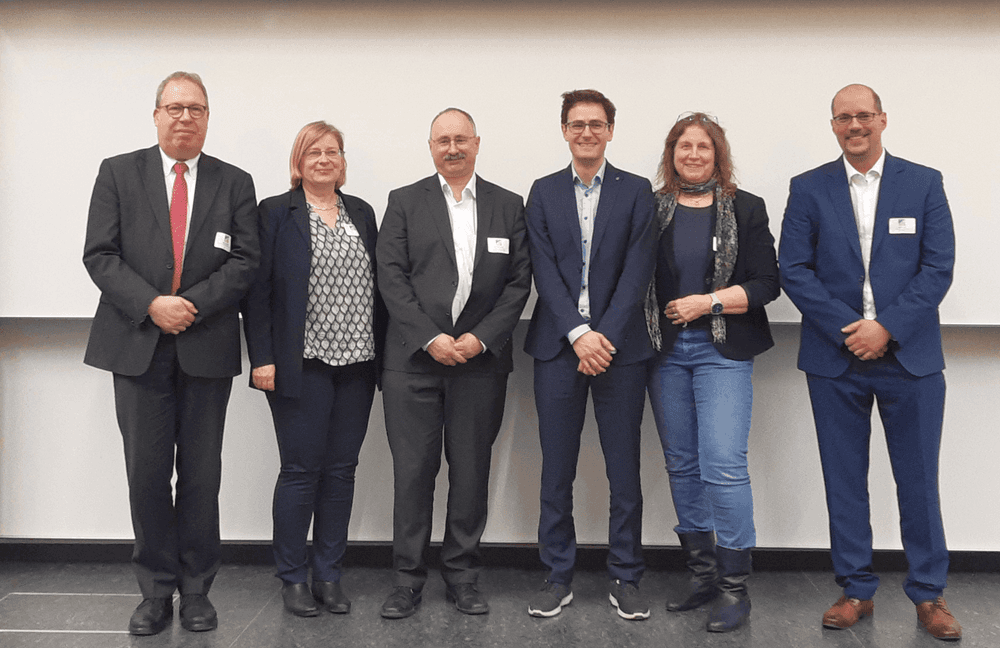
The H.C. Starck Tungsten PhD Award 2025 for solid-state chemistry and materials research was presented on 12 March 2026 on the occasion of the Hemdsärmelkolloquium in Bonn to Dr. Christian Ritschel, Karlsruhe Institute of Technology (KIT), .
"In recognition of his outstanding dissertation, entitled “Nanoparticles: Highly Reactive Metals and Concepts for Drug Delivery”, completed in the working group of Prof. Dr. Claus Feldmann at the Karlsruhe Institute of Technology, and his particularly comprehensive thesis featuring, among other things, pioneering work on the synthesis of highly reactive metal nanoparticles, as well as functional nanoparticles with a high concentration of medicinal agents as transport vesicles in cancer therapy, which are already being tested in in vivo studies."
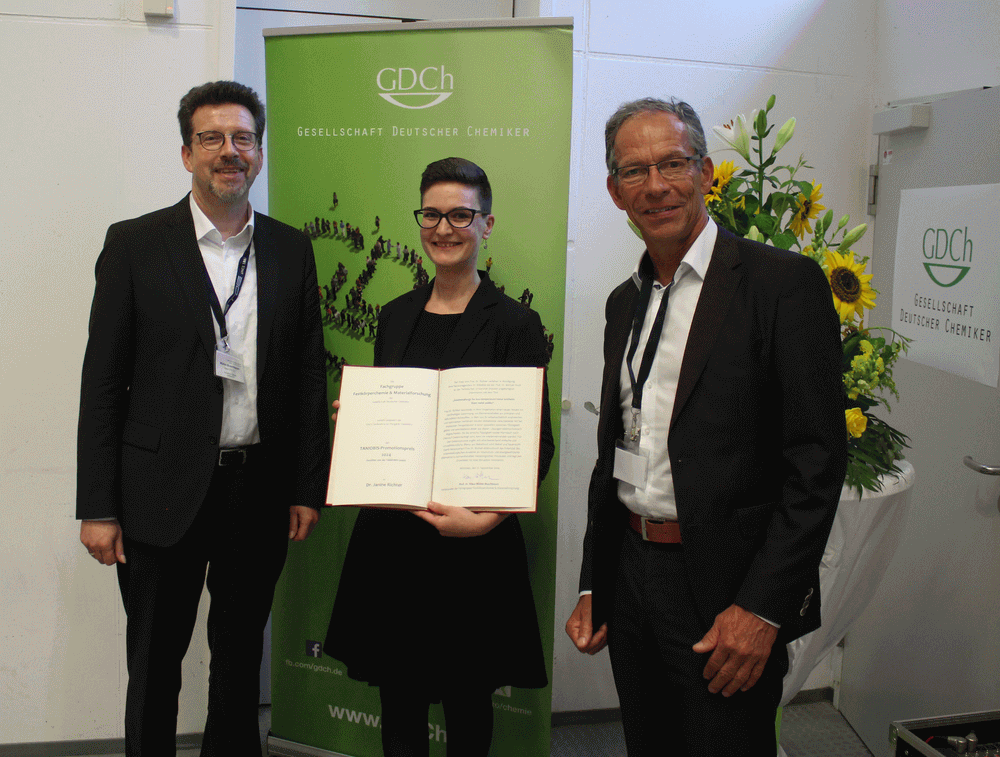
The TANIOBIS PhD Award 2024 for solid-state chemistry and materials research was presented to Dr. Janine Richter on 17 September 2024 in Munich on the occasion of the GDCh Conference on Inorganic Chemistry:
"In recognition of her outstanding dissertation, entitled „Ionometallurgy for low-temperature metal synthesis from metal oxides“, completed in the working group of Prof. Dr. Michael Ruck at Dresden University of Technology. In her dissertation, Dr. Richter describes a new approach to the sustainable recovery of elemental metals from primary and secondary raw materials. In the process she scientifically analysed and optimised, metal oxides of various types are dissolved at moderate temperatures in a special ionic liquid and subsequently deposited electrochemically directly from these solutions. As the ionic liquid is neither thermally nor chemically impaired, it can be reused. The overall process produces a remarkably simple and environmentally friendly balance: metal oxide becomes metal and oxygen. Dr. Richter thus impressively demonstrates the potential of the ionometallurgical approach as a resource- and energy-efficient alternative to conventional metallurgical processes and lays the foundation for a disruptive innovation."

The H.C. Starck Tungsten PhD Award 2023 for solid-state chemistry and materials research was presented to Dr. Stephan Müssig on 4 September 2023 in Leipzig on the occasion of the GDCh Science Forum Chemistry.
"in recognition of his outstanding dissertation, completed in the working group of Prof. Dr. Karl Mandel at Friedrich-Alexander-Universität Erlangen-Nürnberg, entitled „Development of Suitable Supraparticles as Magnetic Identification Features“ for the pioneering contributions described therein to the synthesis of complex magnetic particles and their ensemble fingerprint detection using Magnetic Particle Spectroscopy, which can be used, among other things, to record temperatures based on magnetism".
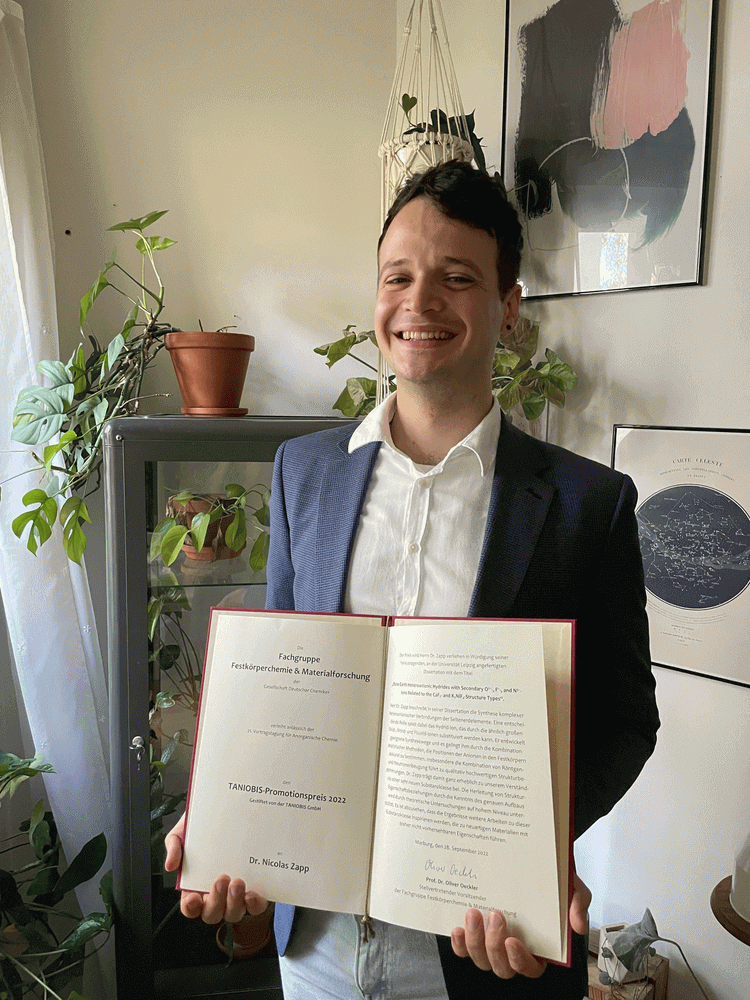
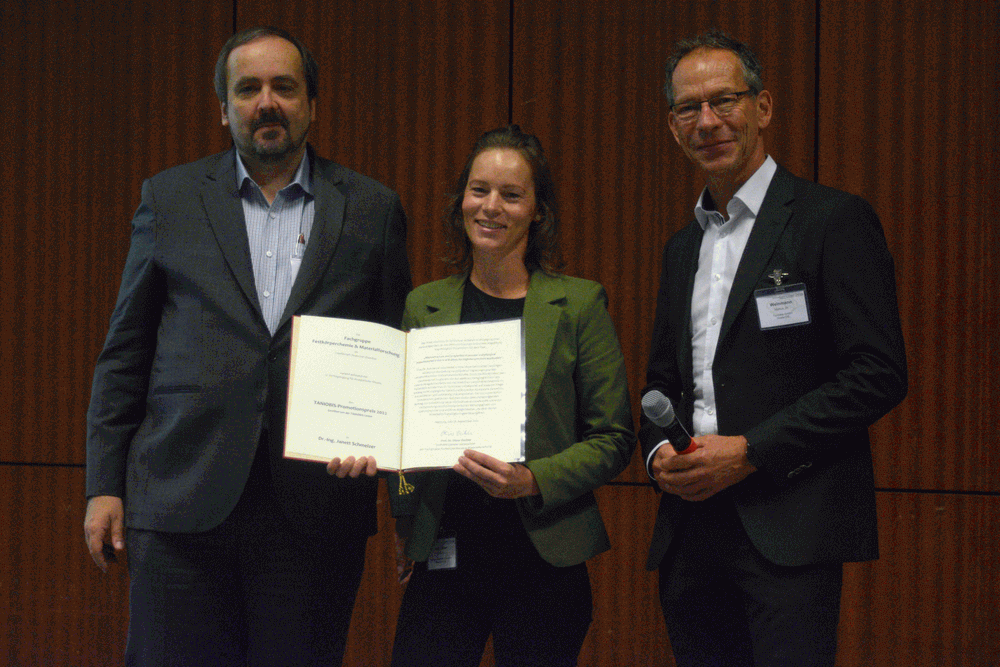
The TANIOBIS PhD Award for solid-state chemistry and materials research was presented to Dr.-Ing Janett Schmelzer and Dr. Nicolas Zapp on 28 September 2022 in Marburg on the occasion of the 21st Conference on Inorganic Chemistry.
Dr.-Ing. Janett Schmelzer "in recognition of her outstanding dissertation, completed at Otto von Guericke University Magdeburg, entitled „Microstructure and properties of powder metallurgical manufactured V-rich V-Si-B alloys for high-temperature application“. In her dissertation, Dr. Schmelzer describes an innovative approach to producing various alloy variants of vanadium-based multiphase materials. By combining mechanical alloying with additive manufacturing in the form of laser metal deposition and selective laser beam melting in a powder bed, Dr. Schmelzer was able to produce, consolidate and fully characterise previously unknown vanadium/silicon/boron composites that had not previously been accessible by other means. The work, supported by numerical simulations, makes an outstanding contribution to the development of new high-temperature materials and to improving the thermodynamic efficiency of gas turbines, and opens up possibilities that go beyond those of nickel-based superalloys."
Dr. Nicolas Zapp "in recognition of his outstanding dissertation, completed at Leipzig University, entitled „Rare Earth Heteroanionic Hydrides with Secondary O2– , F– , and N3– Ions Related to the CaF2 and K2NiF4 Structure Types“. In his dissertation, Dr. Zapp describes the synthesis of complex heteroanionic compounds of the rare earth elements. The hydride ion plays a decisive role, as it can be substituted by the similarly sized oxide, nitride and fluoride ions. He develops suitable synthesis routes and succeeds in accurately determining the positions of the anions in the solids by combining analytical methods. In particular, the combination of X-ray and neutron diffraction leads to high-quality structure determinations. Dr. Zapp thus makes a significant contribution to our understanding of a very new class of substances. Deriving structure–property relationships from knowledge of the precise structure is supported by high-level theoretical investigations. The results are expected to inspire further work on this class of substances, leading to novel materials with previously unforeseeable properties."
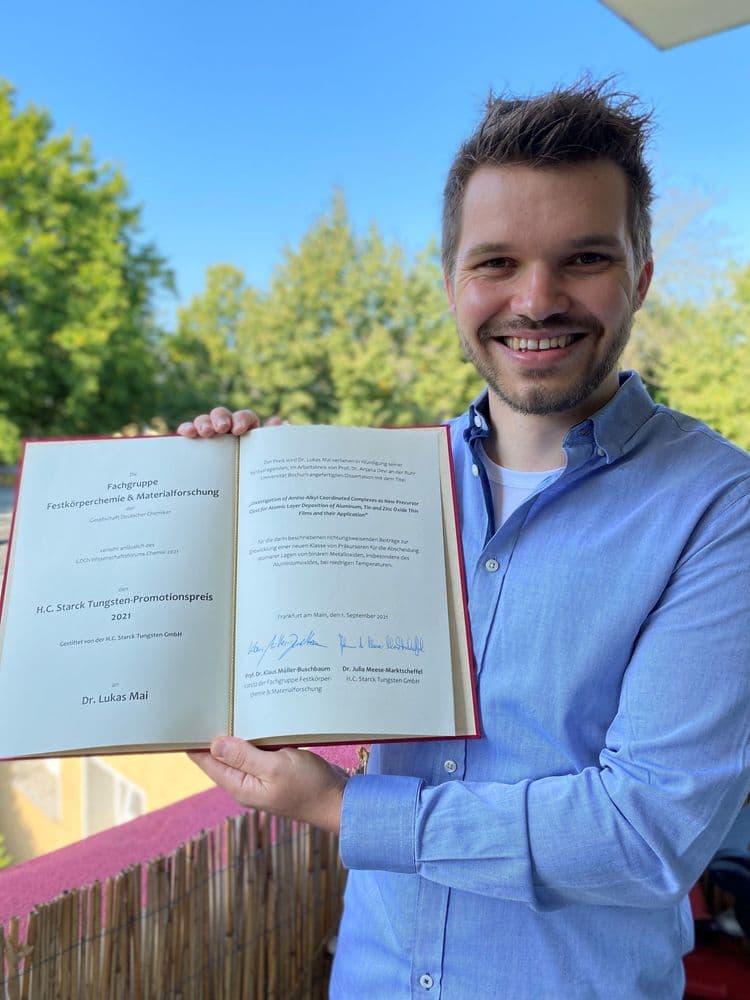
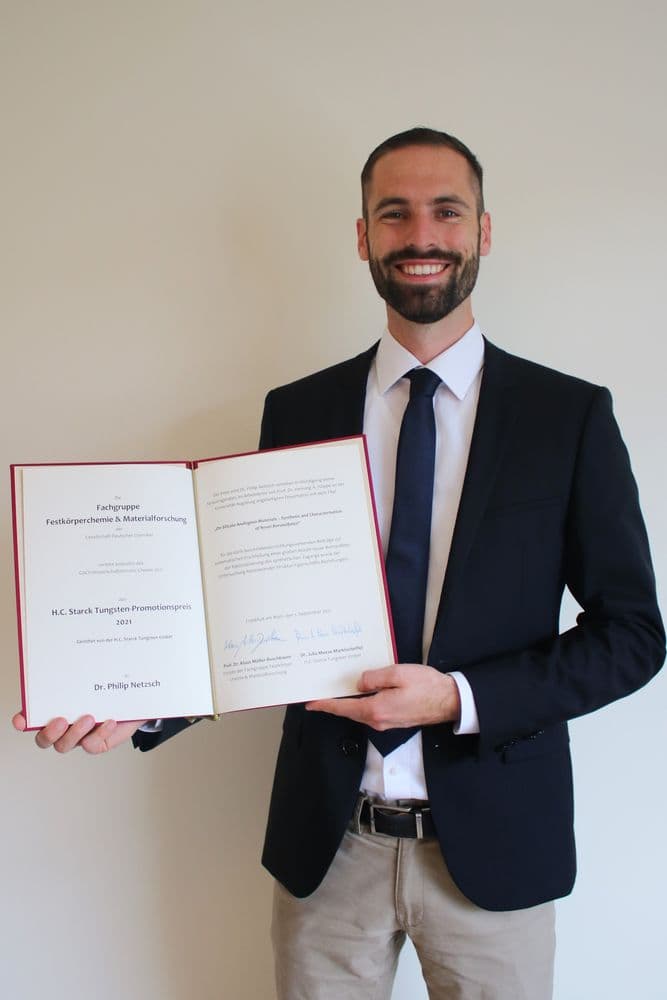
The H.C. Starck Tungsten PhD Award, endowed by H.C. Starck Tungsten GmbH, for solid-state chemistry and materials research was presented to Dr. Lukas Mai and Dr. Philip Netzsch at the GDCh Science Forum Chemistry 2021.
Dr. Lukas Mai was honoured for his outstanding doctoral thesis entitled: “Investigation of Amino-Alkyl Coordinated Complexes as New Precursor Class for Atomic Layer Deposition of Aluminum, Tin and Zinc Oxide Thin Films and their Application” and for the pioneering contributions described therein to the development of a new class of precursors for the deposition of atomic layers of binary metal oxides, particularly aluminium oxide, at low temperatures. The thesis was completed in the working group of Prof. Dr. Anjana Devi at Ruhr University Bochum.
Dr. Philip Netzsch was honoured for his outstanding doctoral thesis entitled: “On Silicate-Analogous Materials – Synthesis and Characterisation of Novel Borosulfates” for the pioneering contributions described therein to the systematic exploration of a large number of new borosulfates, the rationalisation of synthetic access and the investigation of fascinating structure–property relationships. The thesis was completed in the working group of Prof. Dr. Henning A. Höppe at the University of Augsburg.
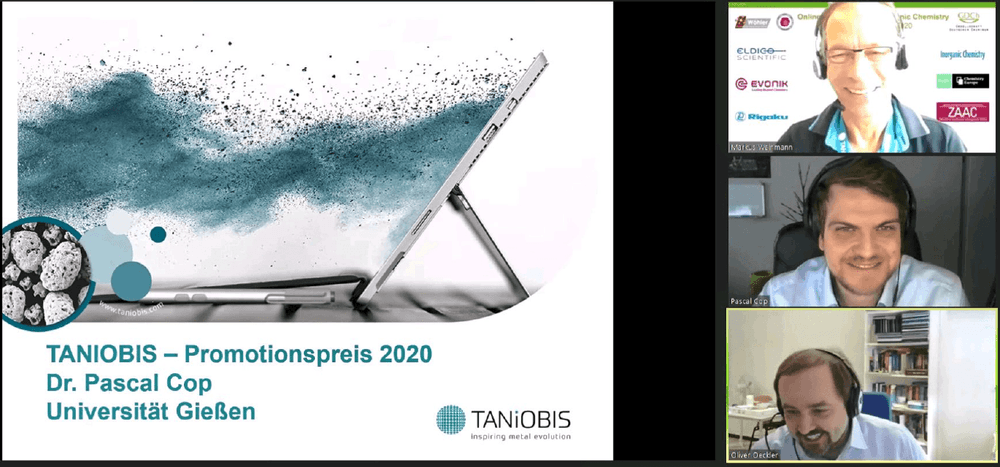
The TANIOBIS PhD Award (formerly: H.C. Starck Tantalum & Niobium PhD Award) for solid-state chemistry and materials research was presented to Dr. Pascal Cop at the Online Lecture Conference on Inorganic Chemistry 2020 in recognition of his outstanding dissertation entitled: “CeO2-based nanostructures as model catalysts for HCl oxidation”. Dr. Cop’s creative, in-depth and pioneering work on CeO2-based nanostructures represents excellent fundamental research while also addressing a highly topical and socially relevant issue, namely maximising the efficiency of chemical reactions, which, for example, enable efficient exhaust-gas purification and are indispensable in large-scale industry. HCl oxidation plays a very important role from an environmental protection perspective. Dr. Cop’s investigations into catalyst deactivation could in future contribute to the optimisation of catalyst materials for mass technologies and thus to the sustainability of various chemical processes. The dissertation was completed in the working group of Prof. Dr. Bernd Smarsly at Justus Liebig University Gießen.


The H.C. Starck Tungsten PhD Award 2019 for solid-state chemistry and materials research was awarded in equal parts to Dr. Heidi Schwartz and Dr. Simon Kloß on the occasion of the 2019 GDCh Science Forum in Aachen.
Dr. Heidi Annemarie Schwartz received the award for her outstanding dissertation entitled “Metal-Organic Frameworks as Crystalline Porous Hosts for Photoactive Molecules” and for the pioneering work described therein on structure–property relationships in metal-organic framework compounds as crystalline, porous host structures for photoactive molecules.
Dr. Simon David Kloß was honoured for his outstanding dissertation entitled “The High-Pressure Metathesis Route for the Preparation of Rare-Earth and Transition Metal Nitridophosphates” and for the pioneering discoveries described therein in the field of rare-earth and transition-metal nitridophosphates, as well as for the development of a groundbreaking new high-pressure metathesis method for opening up new areas in nitridophosphate chemistry.
| Year | awardee | Affiliation at the time of the award | PhD Award |
| 2025 | Dr. Christian Ritschel | Karlsruhe Institute of Technology | H.C. Starck Tungsten |
| 2024 | Dr. Janine Richter | Dresden University of Technology | TANIOBIS |
| 2023 | Dr. Stephan Müssig | Friedrich-Alexander University Erlangen-Nuremberg | H.C. Starck Tungsten |
| 2022 | Dr.-Ing. Janett Schmelzer | Otto von Guericke University Magdeburg | TANIOBIS |
| 2022 | Dr. Nicolas Zapp | Leipzig University | TANIOBIS |
| 2021 | Dr. Lukas Mai | Ruhr University Bochum | H.C. Starck Tungsten |
| 2021 | Dr. Philip Netzsch | University of Augsburg | H.C. Starck Tungsten |
| 2020 | Dr. Pascal Cop | Justus Liebig University Gießen | TANIOBIS |
| 2019 | Dr. Simon David Kloß | Ludwig Maximilian University of Munich | H.C. Starck Tungsten |
| 2019 | Dr. Heidi Annemarie Schwartz | University of Cologne | H.C. Starck Tungsten |
| 2018 | Dr. Sebastian Bette | Technical University Bergakademie Freiberg | H.C. Starck Tantalum & Niobium |
| 2018 | Dr. Chia-Chin Chen | University of Stuttgart | H.C. Starck Tantalum & Niobium |
| 2016 | Dr. Martin Heise | Dresden University of Technology | H.C. Starck |
| 2016 | Dr. Martin Oschatz | Dresden University of Technology | H.C. Starck |
| 2014 | Dr. Pascal Hartmann | Justus Liebig University Gießen | H.C. Starck |
| 2014 | Dr. Michael Schöneich | Dresden University of Technology | H.C. Starck |
| 2012 | Dr. Matthias Kellermeier | University of Regensburg | H.C. Starck |
| 2012 | Dr. Saskia Stegmaier | Technical University of Munich | H.C. Starck |
| 2010 | Dr. Bernhard Wahl | Dresden University of Technology | H.C. Starck |
| 2008 | Dr. Florian M. Stadler | Ludwig Maximilian University of Munich | H.C. Starck |
| 2006 | Dr. Martin Wilkening | University of Hanover | H.C. Starck |
| 2004 | Dr. Stefan Schlüter | Rheinische Friedrich Wilhelm University of Bonn | H.C. Starck |
| 2002 | Dr. Anja Verena Mudring | Rheinische Friedrich Wilhelm University of Bonn | H.C. Starck |
| 2000 | Dr. Hubert Huppertz | Ludwig Maximilian University of Munich | H.C. Starck |
| 2000 | Dr. Andreas Leineweber | University of Dortmund | H.C. Starck |
| 2000 | Dr. Ulrich Steinbrenner | University of Stuttgart | H.C. Starck |
| 1997 | Dr. Matthias Conrad | Philipps University Marburg | H.C. Starck |
| 1997 | Dr. Ingrid Denk | Max Planck Institute for Solid State Research, Stuttgart | H.C. Starck |
| 1995 | Dr. Claus Feldmann | Rheinische Friedrich Wilhelm University of Bonn | H.C. Starck |
| 1995 | Dr. Frank Thomas Lange | University of Karlsruhe (TH) | H.C. Starck |