
HA 2: Research
Prof. Dr. Holger V. Lutze (Chair)
Technical University of Darmstadt
More than 100 scientists from Germany, Austria, England, the Netherlands and Switzerland are involved in the Main Research Committee. In workshops, they discuss current developments in water research and technologies, bring them together and assess them with regard to their practical relevance. In order to meet the challenges in the field of water, it is essential to develop forward-looking technologies, methods and models. A particular focus is placed on interdisciplinary approaches, as the subject of water affects many different academic disciplines. The Main Research Committee is divided into 13 specialist committees.
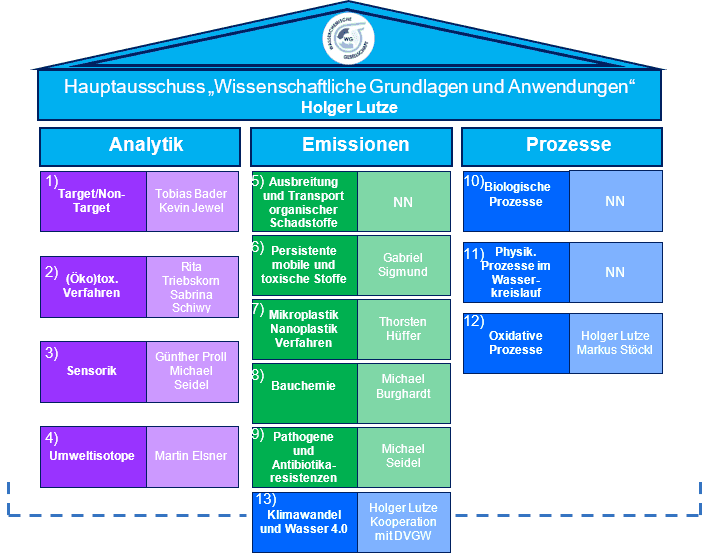
The specialist committees in the Analytical field focus on new methods for identifying new substances and expanding the analytical measurement window (FA1), (eco)toxicological effects (FA2), real-time measurements (FA3) and tools for investigating environmental processes (FA4).
In the Emissions field, the sources and transport of trace substances (FA5), the behaviour of polar low-molecular-weight trace substances (e.g. persistence and (eco)toxicology) (FA6), the formation, distribution and ageing of microplastics (FA7), emissions of substances from modern building materials (FA8) and the spread and behaviour of antibiotic-resistant bacteria (FA9) are addressed.
In the Processes field, the focus is on biological processes for pollutant degradation (FA10), physical processes in the aquatic environment and in treatment (e.g. colloidal substance transport, sorption processes, filtration) (FA11) and oxidative water treatment methods (FA12).
The specialist committee on Water 4.0 and Climate Change represents a cross-cutting topic (FA13), integrating all three fields (analytics, emissions and processes). It assesses the impacts of extreme events and future water-management requirements (availability and quality of resources) on water supply by means of digital representations (e.g. a digital twin) in the areas of water abstraction, treatment and distribution. The aim is to derive strategies for action to ensure an adequate supply of high-quality drinking water in the future.
Rules of Procedure for the Committees (as at 09/2016)