
Card game “Know Your Nuclides” & Karlsruhe Nuclide Chart
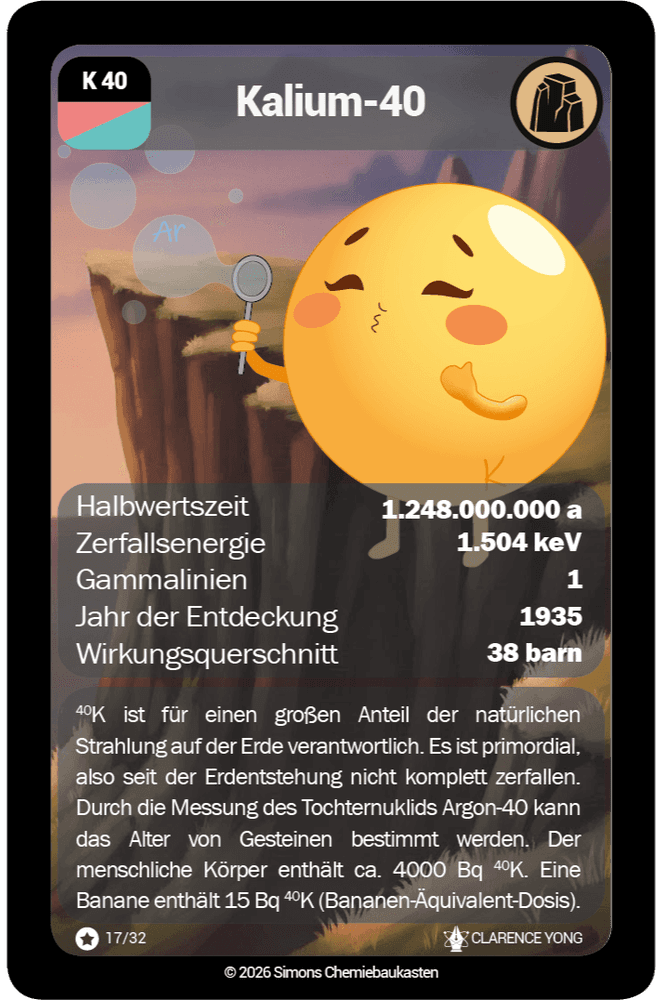
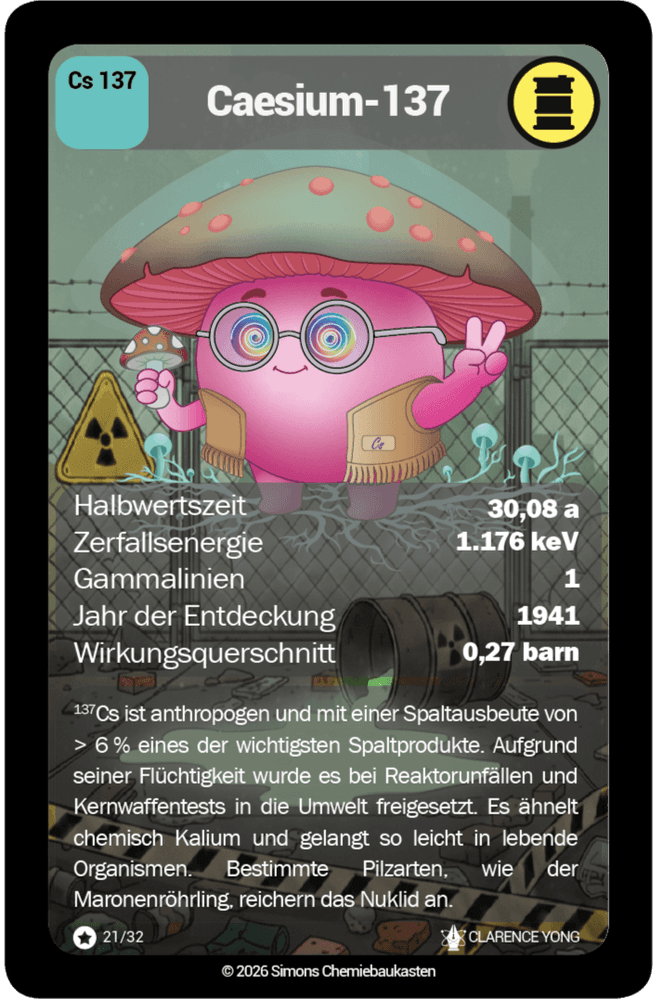
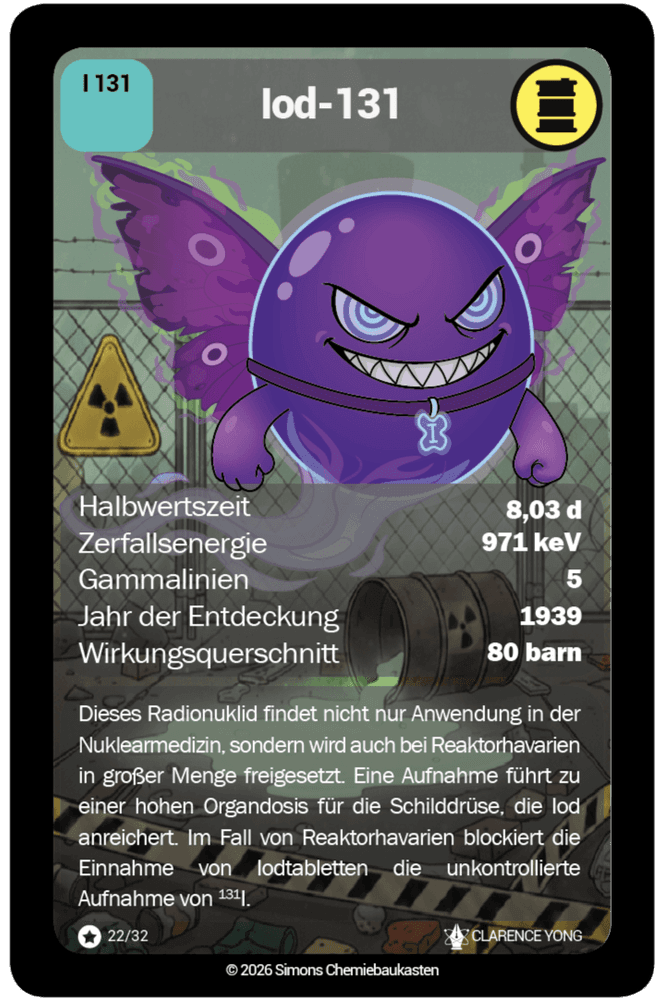
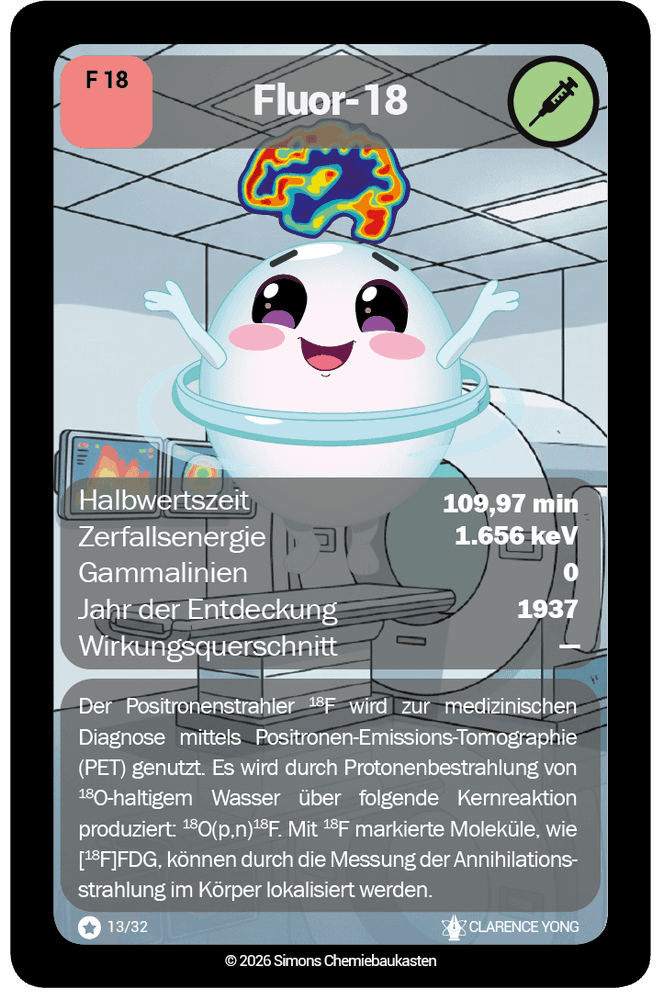
"Know Your Nuclides" is a card game that presents selected, important radionuclides on 32 intricately designed cards. Their key nuclear properties can be discovered in a playful way – either in the classic form of a quartet game or as a trump game.
The game is played with facts that really matter in nuclear chemistry: Who has the longest half-life, the highest decay energy, the most gamma-ray lines, the most recent year of discovery or the largest cross-section? This turns learning into a playful competition – and at the same time provides an introduction to the world of radionuclides.
The cards cover a diverse range of topics: from cosmogenic radionuclides and natural decay chains to artificial elements, radionuclides in the context of geochemistry and radionuclides involved in nuclear accidents, as well as exotic species and radionuclides used in medical applications, there is something exciting for everyone. Short information texts on the cards also help to put chemical and physical properties, as well as occurrence and fields of application, into better context.
The "Know Your Nuclides" card game is sent out twice a year as a welcome gift to new members. In addition, the card game can be ordered from the Simons Chemiebaukasten shop.
Images: © 2026 Simons Chemiebaukasten
This chart represents every nuclide detected experimentally to date by means of a square containing the element symbol and the nucleon number A. The nuclides have been arranged on the chart so that the associated proton number Z lies on the ordinate and the neutron number N = A - Z on the abscissa. The Karlsruhe Nuclide Chart provides precise data on the half-lives, decay modes of the radionuclides and the energies of the radiation they emit. In addition to radiation protection, nuclear and radiochemistry and astrophysics, it is also used in the life and Earth sciences (biology, medicine, agriculture, geology, etc.) and in materials research.
The brochure with an inserted folding chart can be purchased from the Nuklid Shop of Nucleonica.