
Reports from the Board
The "Reports from the Board" are brief summaries of the Board meetings and are published in the Division's Communications.

26 June 2026
One focus of the discussions was finalising the Board’s proposed list for the forthcoming Board election. It is a particular challenge to make this list as balanced as possible in order to represent the diversity of Division members effectively. An important agenda item was this year’s presentation of the Paul-Crutzen Award. Other topics included the involvement of Division members in GDCh and other committees, sponsorship activities and, of course, the upcoming events: a Perspectives Day at the UBA, the Young Environment Forum (JUF) and the Environment 2026 Annual Conference from 2 to 4 September in Essen.
22 May 2026
Topics discussed included the forthcoming Board election, the “GDCh Environment Lectureship”, standardising membership fees for young members and current developments in the postgraduate course in ecotoxicology and the think tanks on PFAS and ISP-CWP. The Division is receiving financial support for the newly launched “GDCh Environment Lectureship” from the special fund for exceptional Division activities during the award’s start-up phase. The award name was set as “GDCh-Umweltvorlesung / GDCh Environment Lectureship”. Sponsorship strategies, planning for Environment 2026 and 2027, and the assessment of submissions for the Paul-Crutzen Award were also on the agenda.
20 March 2026
An important topic was finding candidates for the new Board, which will be elected this autumn. Progress was also made on the planned UCÖT Lecture. The approach for the next two years was established and an application to the GDCh special fund was discussed in order to obtain start-up funding. Finding sponsors is very important for the continued financing of the Division’s work. The Board therefore also discussed possible sponsorship packages that the Division could offer.
23 January 2026
The Board election at the end of this year is casting its shadow ahead. Some members will be leaving the Board and new candidates are being sought for the 2027–2030 term of office. The current Board welcomes feedback and suggestions! The candidates are to introduce themselves in person at the General Assembly in the second half of the year. In order to give the topics of environmental chemistry and ecotoxicology greater prominence in the (academic) discourse, the Board is planning a lecture series (working title: UCÖT Lectures). Early-career scientists (postdocs, junior professors) are being sought as speakers to present their topic and, in doing so, the Division as part of GDCh colloquia at different universities. The topic of PFAS remains an important issue within the GDCh. In addition to the think tank, a GDCh Commission on PFAS is being established by resolution of the GDCh Board; it is intended to be able to act as an official body communicating with stakeholders and political actors. The issue of sponsorship for the Division was discussed controversially. Several points are under consideration and will now be pursued further. At the end of March, the Board will meet again for a digital meeting.
21 November 2025
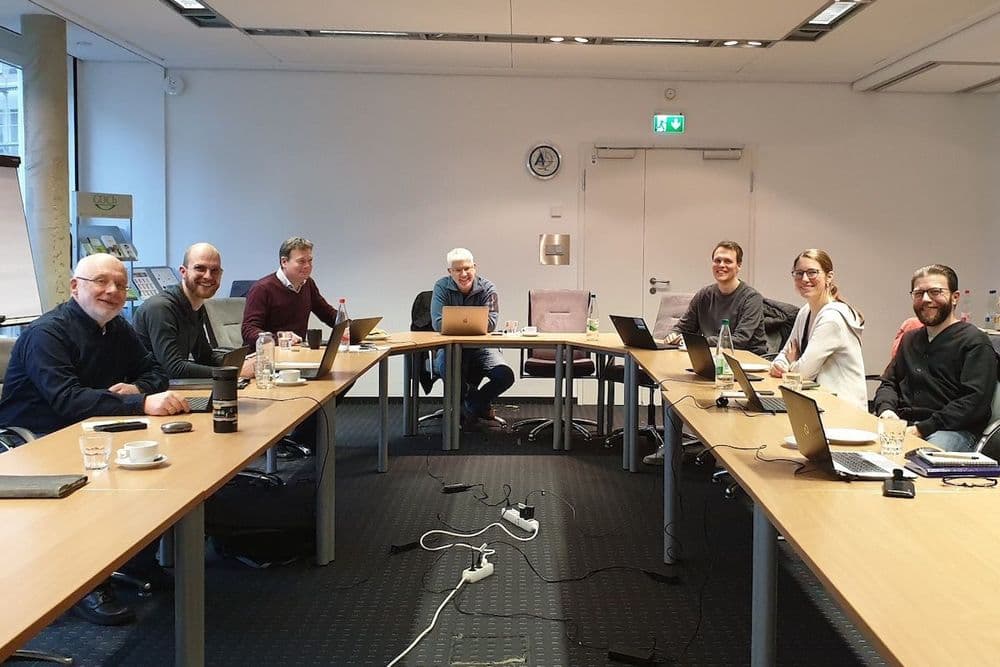
The main topics were preparations for the 2026 Board election and the further development of the planned lecture series to support younger scientists (postdocs, junior professorships) and make the topics of environmental chemistry and ecotoxicology more visible. This lecture series is intended to be linked to an award. The other upcoming events in the coming year were also discussed, as was the contribution of expertise from the Division’s areas of focus. The Board will meet in person again in January and looks forward to many reunions and discussions with members in 2026. With this in mind, the Board wishes everyone a Merry Christmas and all the best for a happy and eventful New Year!
5 September 2025
At the annual meeting of the extended Board, the Working Groups (WGs) reported on some highly successful Online meetings, including the Working Group Environmental Monitoring, with more than 90 participants, while the Working Group Soil is currently looking for new areas of focus. The Working Group Atmospheric Chemistry is planning another Online meeting in December, while the Working Group Chemical Assessment will offer an in-person meeting in Frankfurt in November. The discussion revealed that some topics discussed within the WGs are also of interest to members of other WGs. The Board asked the WG representatives to keep the website as up to date as possible and to make use of the Division’s social media account. The Board is happy to support them in this.
21 March 2025
The main topics were the Division’s financial situation, event planning and the visibility of the Division Awards. In the long term, the aim is to increase the Division’s financial scope through donations and sponsorships. Submissions for the 2025 Paul-Crutzen Award were discussed and measures to increase its visibility were agreed. It was also proposed to establish a lecture series to support younger scientists (postdocs, junior professorships) and make the topics of environmental chemistry and ecotoxicology more visible. Planning for the upcoming annual conference “Umwelt 2025” at the German Environment Agency in Dessau was discussed. A possible venue for Umwelt 2026 has also already been found. At a strategy meeting in July, the Board will consider in detail the topics “Future of the Division Newsletter” and “Donations / Sponsorships”.
24 January 2025
An important topic in the discussions was how to raise the Division’s profile among students and doctoral researchers. The proposals focused on how the Division could have a stronger presence at universities locally in order to present the work of the Division and its WGs. GDCh local sections could play an important role here. The Board also discussed the Fresenius Lectureship of the Division of Analytical Chemistry and will examine the extent to which a similar concept could also be implemented in our Division. Other topics discussed included the many events being organised or co-organised by the Division in 2025. Next on the programme is the German PharmTox Summit (25–28 March 2025; Hanover), followed in June by the ICCE in Belgrade (8–12 June 2025) and in September by the Umwelt 2025 annual conference in Dessau (22–24 September 2025). The jUCÖT are currently planning the next Perspektiventag and the JUF, which will once again take place on the first day of Umwelt 2025.