
Awards & Honors
Since 2023, the GDCh Division Chemistry & Energy has awarded the PhD Award Chemistry & Energy in odd-numbered years for an outstanding doctoral thesis that makes an important contribution to linking the fields of chemistry and energy. The award includes a certificate and prize money of 1000 euros donated by Heraeus Precious Metals. It is presented on the occasion of the biennial Division conference. The awardee is invited to present the award-winning work in a short lecture. The award is decided by an award committee appointed by the Division Board. In exceptional cases, the award may be shared.
Submission deadline: 31 October 2026
Objective
The GDCh Division Chemistry & Energy awards a prize in odd-numbered years for an outstanding dissertation that makes an important contribution to linking the fields of chemistry and energy.
The prize
The award includes a certificate and prize money of 1000 euros donated by Heraeus Precious Metals. The prize will be awarded at the next Division conference in spring 2027. As part of this event, the winning work is to be presented in a short lecture. The Division will cover the costs of attending the conference. The award decision is made by a prize committee appointed by the Division Board. The prize may be shared in exceptional cases.
Nomination/application
Nominations by the academic supervisor or independent applications are possible. The dissertation must have been completed at a German university or higher education institution between 1 November 2024 and 31 October 2026. All submissions must include the following documents (in German or English):
Submission
Please send the complete documents in electronic form and combined into a single PDF file to the GDCh Office, for the attention of Maike Fries.
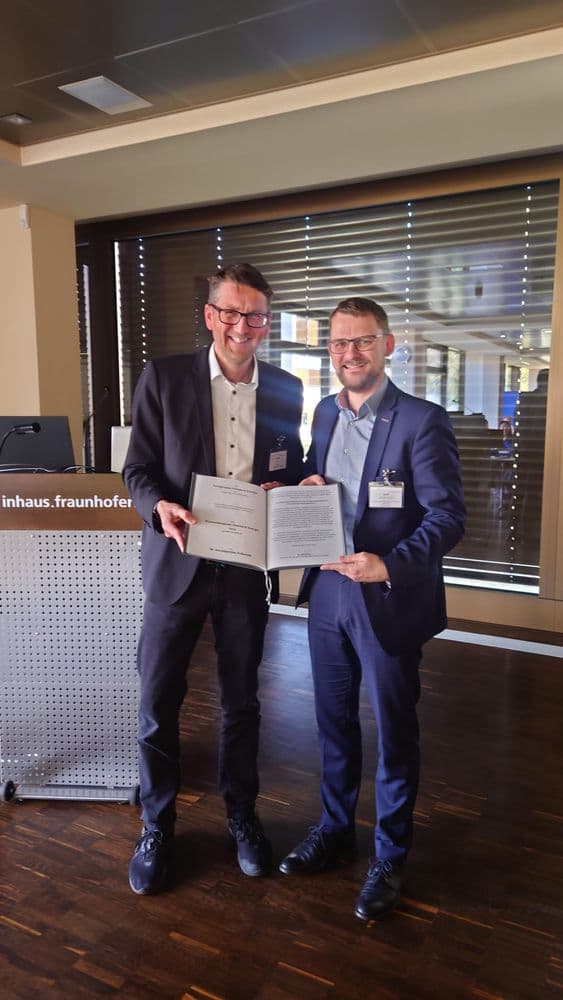
The PhD Award endowed by BASF SE was presented to Dr. Kevinjeorjios Pellumbi on 9 April 2025 on the occasion of the Division conference 2025, Green Energy Transformation - GET It Done, in recognition of his outstanding dissertation entitled: „Creating Holistic Pathways for the CO2 Electroreduction and Electrochemical Hydrogenations“, completed under the supervision of Prof. Dr. Ulf-Peter Apfel at Ruhr University Bochum and Fraunhofer UMSICHT.
"With great scientific commitment, Dr. Pellumbi made fundamental contributions to the electrification of the chemical industry and the sustainable use of CO2. His work provides groundbreaking insights into the electrochemical reduction and hydrogenation of CO2 and enables efficient, scalable technologies. By developing innovative catalyst systems and integrating them into electrolysis cells, he opened up new avenues for converting greenhouse gases into valuable chemicals. His research is already influencing industrial pilot plants and contributing to the implementation of sustainable energy concepts.
Dr. Pellumbi's scientific vision combines fundamental principles with practical applications in industry. His exceptional commitment, creativity and spirit of research make him an outstanding figure in the field of sustainable chemical conversion processes."
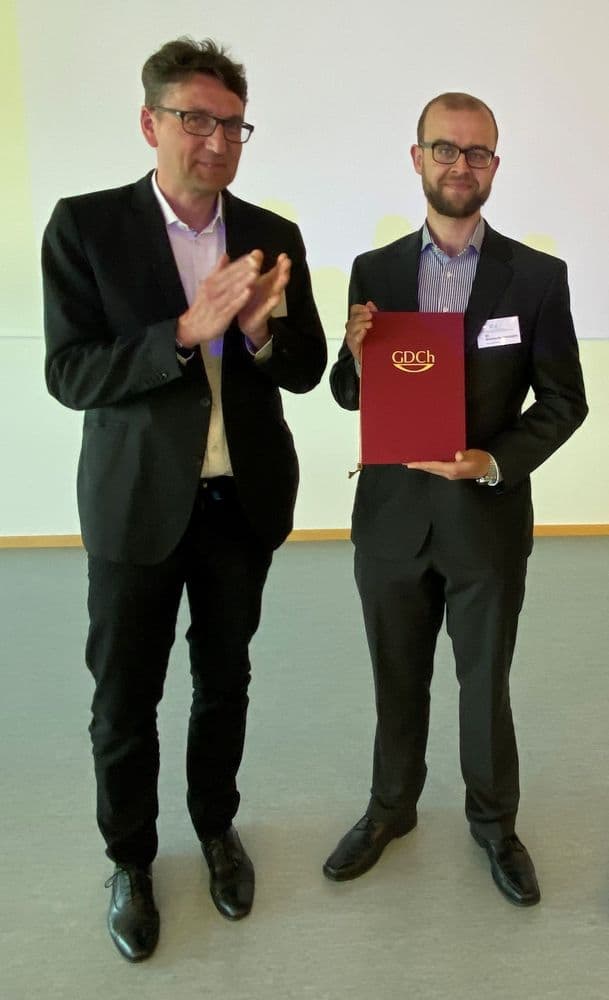
The PhD Award was presented to Dr. Konstantin Schutjajew on the occasion of the Division conference 2023, GREEN Materials – Processes – Industry, in recognition of his outstanding dissertation, completed at the University of Potsdam, entitled „Electrochemical Sodium Storage in Non-Graphitizing Carbons – Insights into Mechanisms and Synthetic Approaches towards High-Energy Density Materials“.
"In his dissertation, Mr Schutjajew investigated new mechanisms for the incorporation of sodium in quasi-metallic form into carbon materials. In doing so, he courageously and creatively pursued new and unconventional working hypotheses while simultaneously developing new analytical methods. Mr Schutjajew was able to demonstrate the possibility of reversible underpotential deposition of sodium and the relationships between the electrochemical signature and the structure of the carbon materials. He also developed concepts for the targeted production of carbon materials with so-called closed pores and consequently high plateau capacity. The impact of Mr Schutjajew's work will not remain limited to the field of sodium batteries, but will likewise drive materials development for other electrochemical energy-storage concepts.
May receiving this award encourage Mr Schutjajew, as a young researcher, to consistently continue along the path he has chosen and to pursue creative and unconventional chemical solutions to the energy challenges of the coming years."