
Ernst-Bayer Award
Working Group Separation Science presents the Ernst-Bayer Award each year as part of its doctoral seminar in Hohenroda to an early-career researcher. The award, consisting of a certificate and 1,000 euros, recognises an outstanding article in the field of analytical separation techniques that has already been published in, or accepted for publication by, an international journal with a peer-review system. Both nominations and applications are possible. Candidates should be no older than 30; their doctorate should have been completed less than one year previously. A jury appointed by the working group Board decides on the award; the decisive selection criterion is the scientific quality of the article.
Submission deadline: 31 October 2026
Objective
The Working Group Separation Science of the GDCh Division of Analytical Chemistry awards the Ernst-Bayer Award annually to recognise an outstanding publication by an early-career researcher in the field of analytical separation techniques.
The award
The award includes a certificate, prize money of 1000 euros and participation in the 37th PhD seminar of the working group, taking place from 17 to 19 January 2027 in Hohenroda. The awardee will present the prize-winning publication in a short presentation during the seminar. The award is decided by a panel of reviewers appointed by the working group Board; the decisive selection criterion is the scientific quality of the submitted work.
Nomination/application
Both nominations and applications are possible. The award is open to all first authors of a publication published or accepted in 2025 or 2026 in an international scientific journal with a peer-review system. The author should not yet have reached the age of 30, and the completion of the PhD should generally not have been more than one year previously. The application must clearly state which individual publication is being proposed for the award. All proposals must include a brief recommendation or assessment of the article, a CV (including contact details) and the publication itself.
Submission
Please send your proposal electronically and combined into a single PDF file to Dr. Martin Vogel, Chair of the Working Group Separation Science.
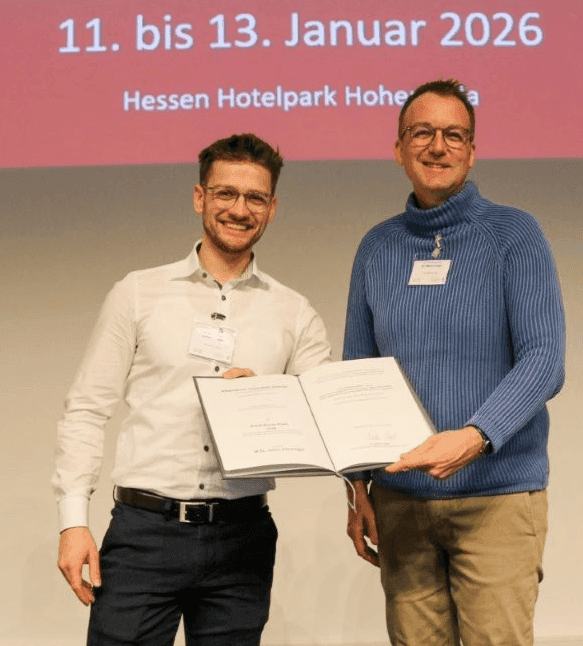
The Ernst-Bayer Award 2026 was presented to Julius Schwieger (University of Leipzig) on 12 January 2026 as part of the 36th Doctoral Seminar in Hohenroda. His publication
“Novel Pinhole Emitter Chip for Micro Supercritical Fluid Chromatography–Mass Spectrometry with Integrated Dilution-Free Fluidic Back-Pressure Regulation” in the journal Analytical Chemistry 2024, 96 (50), 20107-20114 was honoured.
| Year | awardee | Publication |
| 2026 | M.Sc. Julius Schwieger | Novel Pinhole Emitter Chip for Micro Supercritical Fluid Chromatography–Mass Spectrometry with Integrated Dilution-Free Fluidic Back-Pressure Regulation Analytical Chemistry 2024, 96(50), 20107-20114 |
| 2025* | Dr. Simon Jonas Jaag | Three-Minute Enantioselective Amino Acid Analysis by Ultra-High-Performance Liquid Chromatography Drift Tube Ion Mobility-Mass Spectrometry Using a Chiral Core−Shell Tandem Column Approach Analytical Chemistry 2024, 96, 2666-2675 |
| 2023 | Valentin Göldner | Electrochemistry-mass spectrometry bridging the gap between suspect and target screening of valsartan transformation products in wastewater treatment plant effluent Water Research 2023, 244, 120525 |
| 2022 | Robert G.H. Marks | How to Couple LC-IRMS with HRMS – A Proof-of-Concept Study Analytical Chemistry 2022, 94, 2981-2987 |
| 2021 | Nora T. Hartner | On-Line Coupling of Chip-Electrochromatography and Ion Mobility Spectrometry Analytical Chemistry 2020, 92, 15129-15136 |
| 2020 | Patrick Olaf Helmer | Mass spectrometric investigation of cardiolipins and their oxidation products after two-dimensional heart-cut liquid chromatography Journal of Chromatography A 2020, 1619, 460918 |
| 2019 | Bernhard Durner | High-resolution high performance liquid chromatography: Application of a saw tooth gradient for the separation of various polymers Journal of Chromatography A 2019, 1587, 88-100 |
| 2018 | Ulrich Woiwode | Imaging Peptide and Protein Chirality via Amino Acid Analysis by Chiral x Chiral Two-Dimensional Correlation Liquid Chromatography Analytical Chemistry 2018, 90, 7963-7971 |
| 2017 | Susanne Stephan | Contaminant screening of wastewater with HPLC-IM-qTOF-MS and LC+LCIM-qTOF-MS using a CCS database Analytical and Bioanalytical Chemistry 2016, 408, 6545-6555 |
| 2016 | Carsten Lotter | HPLC-MS with Glass Chips Featuring Monolithically Integrated Electrospray Emitters of Different Geometries Analytical Chemistry 2016, 88, 2856-2863 |
| 2015 | Marco Nestola | Universal Route to Polycyclic Aromatic Hydrocarbon Analysis in Foodstuff: Two-Dimensional Heart Cut Liquid Chromatography-Gas Chromatography-Mass-Spectrometry Analytical Chemistry 2015, 87, 6195-6203 |
| 2014 | Pablo A. Kler | Non-aqueous electrolytes for isotachophoresis of weak bases and its application to the comprehensive preconcentration of the 20 proteinogenic amino acids in column-coupling ITP/CE-MS Analytical & Bioanalytical Chemistry 2014, 406, 7163-7174 |
| 2013 | Andrea Francesco Giuseppe Gargano | Mixed-mode chromatography with zwitterionic phosphopeptidomimetic selectors from Ugi multicomponent reaction Journal of Chromatography A 2013, 1317, 12–21 |
| 2012 | Dorothea Kujawinski | When Other Separation Techniques Fail: Compound-Specific Carbon Isotope Ratio Analysis of Sulfonamide Containing Pharmaceuticals by High-Temperature-Liquid Chromatography-Isotope Ratio Mass Spectrometry Analytical Chemistry 2012, 84, 7656-7663 |
| 2011 | Marek Mahut | Plasmid DNA manufacturing: Topology-selective chromatography reveals Plasmid supercoiling shifts during fermentation and allows rapid and efficient preparation of topoisomers Angewandte Chemie International Edition, DOI: 10.1002/anie.201106495 |
| 2010 | Stefanie Fritzsche | Chip Electrophoresis with Mass Spectrometric Detection in Record Speed Lab on a Chip 2010, 10, 1227 – 1230 |
| 2009 | Nathanael Delmotte | Repeatability of peptide identifications in shotgun proteome analysis employing off-line two-dimensional chromatographic separations and ion-trap MS Journal of Separation Science 2009, 32, 1156 - 1164 |
| 2008 | Wiebke Lohmann | Generation and Identification of Reactive Metabolites by Electrochemistry and Immobilized Enzymes Coupled On-Line to Liquid Chromatography/Mass Spectrometry Analytical Chemistry 2007, 79, 6831-6839 |
| 2007 | Ivo Nischang | Key to Analyte Migration and Retention in Electrochromatography Analytical Chemistry 2006, 78, 3601-3608 |
| 2006 | Pavel A. Levkin | Combining the Enantioselectivities of L-Valine Diamide and Permethylated ß-Cyclodextrin in One Gas Chromatographic Chiral Stationary Phase Analytical Chemistry 2006, 78, 5143-5148 |
| 2005 | Suzanna Maria van Leuwen | Prediction of clozapine metabolism by on-line electrochemistry/liquid chromatography/mass spectrometry Analytical & Bioanalytical Chemistry 2005, 382, 742-750 |
| 2004 | Jens Dahlmann | Liquid chromatography-electrospray ioniosation-mass spectrometry based method for the simultaneous determination of algal and cyanobacterial toxins phytoplankton from marine waters and lakes followed by tentative structural elucidation of microcystins Journal of Chromatography A 2003, 994, 45-57 |
| 2003 | Felix C. Leinweber | Chromatographic performance of monolithic and particulate stationary phases. Hydrodynamics and adsorption capacity Journal of Chromatography A 2003, 1006, 207-227 |
*Adjustment of the award year to the year of awarding