
Noddack biography
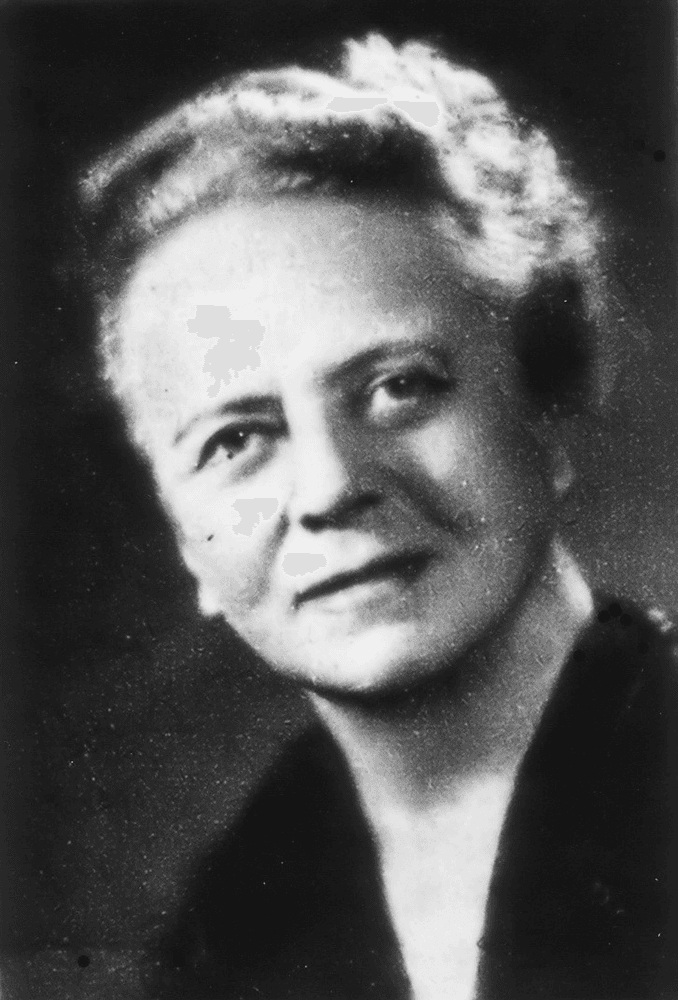
Together with her husband, Ida Noddack searched for new elements and discovered rhenium. She is also regarded as a pioneer of nuclear fission. She was nominated for the Nobel Prize several times, but never received it.
Ida Eva Noddack (née Tacke) was born on 25 February 1896 in Lackhausen in the Lower Rhine region, which is now part of Wesel. She attended a girls’ secondary school and then the St Ursula Gymnasium in Aachen for two years. With strong support from her father, she was one of the first women in Germany to study chemistry, and in 1921 she was awarded a doctorate in engineering sciences at the Technical University of Berlin. The title of her dissertation was “On anhydrides of higher aliphatic fatty acids”. She then worked in industry at AEG for several years.
In 1925, she joined the Physikalisch-Technische Reichsanstalt (PTR) in Berlin as a research chemist, where she met Walter Noddack (1903–1960), a student of Nobel Prize winner Walter Nernst (1864–1941), whom she married soon afterwards. The two had already been conducting research together before their wedding. Together with chemist Otto Berg (1873–1939), a specialist in X-rays, they searched for new elements. They focused on the elements with atomic numbers 43 and 75, whose existence had been predicted by Dmitri Mendeleev (1834–1907), the developer of the periodic table of the elements.
As early as 1925, the trio succeeded in discovering the element with atomic number 75. It was named rhenium (Latin Rhenus for Rhine) after Ida Noddack’s homeland. The discovery of rhenium was quickly confirmed, and in 1928 the Noddacks succeeded in extracting one gram of the purest rhenium from 660 kilograms of molybdenite ore. A second discovered element, which was supposed to be the element with atomic number 43, was named masurium in memory of Walter Noddack’s Masurian homeland. However, this discovery was vehemently questioned by the scientific community because the Noddacks were unable to confirm the preparation. This may also be why, although Ida Noddack was nominated for the Nobel Prize in Chemistry several times in the 1930s, she never received it. The incontrovertible proof of element 43, now known as technetium, was provided in 1937 by researchers from Italy.
The Noddacks moved to the University of Freiburg in 1932. In 1934, Ida Noddack caused considerable sensation with a contribution to the renowned journal “Angewandte Chemie”. In it, she expressed the supposition that heavy atomic nuclei bombarded with neutrons should split into several larger fragments – into isotopes of known elements. Her theory of such nuclear fission met with fierce opposition because it was not consistent with contemporary ideas about atomic nuclei. One of its greatest critics was chemist Otto Hahn, who is quoted as saying: “Your assumption that the atomic nucleus would burst apart is surely absurd.” Four years later, Lise Meitner (1878–1968), Otto Hahn (1879–1968) and Fritz Straßmann (1902–1980) observed the first nuclear fission. Only Hahn and Straßmann received the Nobel Prize in Chemistry for this in 1944. It was only shortly before his death that Hahn acknowledged Noddack’s early insight, saying: “And Ida was right after all.”
From 1942, the Noddacks conducted research and taught in Strasbourg at the Reich University founded by the National Socialists at the end of 1941. After the Second World War, the couple moved to Bamberg, where they established the Research Institute for Geochemistry at the Philosophical and Technical University, the predecessor institution of the University of Bamberg. Following her husband’s unexpected death in December 1960, Ida Noddack continued working at the institute and from that point also turned to biochemical questions. She retired in 1968.
Ida Noddack died on 24 September 1978 at the age of 82 in a nursing home in Bad Neuenahr. She was buried in Bamberg beside her husband, who had died 18 years earlier.
Although Noddack did not receive a Nobel Prize for her pioneering research findings, she received numerous honours, including, in 1931, becoming the first woman to receive, together with her husband, the Liebig commemorative coin of the Verein Deutscher Chemiker, the predecessor organisation of the German Chemical Society (GDCh). In 1937, she was elected a member of the Leopoldina, and in 1966 she was awarded the Grand Cross of Merit of the Federal Republic of Germany.
Literature
• F. Habash: Ida Noddack and the missing elements. Education in Chemistry, Vol. 46, No.2, Royal Society of Chemistry, 2018, p. 48
• I. Noddack: On element 93, Angewandte Chemie 47 (37), 1934, p. 653
• I. Tacke, W. Noddack, O. Berg: The ekamanganese, Naturwissenschaften 13 (26), 1925, p. 567
Authors
Prof. Dr. Eberhard Ehlers
Prof. Dr. Heribert Offermanns
Editorial work
Dr. Uta Neubauer
Project management
Dr. Karin J. Schmitz (GDCh-public relations)
The authors are responsible for the content of the biographies.
The content presented on these pages has been carefully prepared. Nevertheless, the authors, Editorial staff and publisher accept no responsibility or liability for the completeness and accuracy of the content or for typographical errors.