
Feikes’ biography
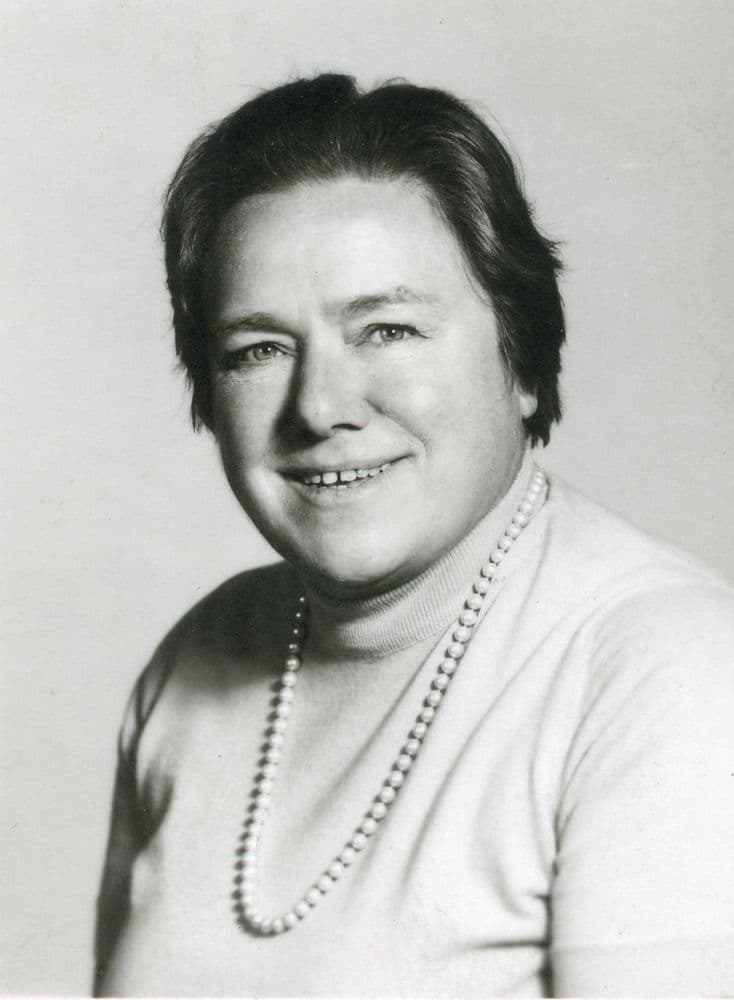
From 1953 to 1984, Lieselotte Feikes worked for Freudenberg in Weinheim an der Bergstraße. On behalf of the company, among other things she developed a cleaning process for tannery wastewater. At the end of her career, she was awarded the Federal Cross of Merit for this work.
Lieselotte Feikes was born in 1923 in the small town of Viersen near Düsseldorf. After the early death of her father Josef, who had worked as a private tutor, she grew up with her sister in a female household strongly shaped by their mother’s friendly nature. She developed a keen interest in mathematics while still at school, but found the subject too dry to study at university. Chemistry, on the other hand, appealed to her because of its experimental nature.
After completing her school-leaving examinations in March 1942, she therefore wanted to study chemistry. However, after leaving school she first had to complete her compulsory service with the Reich Labour Service. It was not until the summer semester of 1943, thanks to the support of relatives, that she was able to enrol in chemistry at the University of Halle. Her most important academic teacher was the future Nobel Prize winner Karl Ziegler (1898–1973). After only three semesters, however, Feikes had to interrupt her studies in the summer of 1944 because lectures were no longer being held as a result of the war. In the following months, she worked as a laboratory assistant on war service at the University of Halle’s chemical institute. In October 1944, she became a laboratory assistant there under Margot Goehring (later Becke-Goehring, 1914–2009).
After the end of the war, Feikes initially returned to her home town of Viersen, but from there she once again applied for a position with Goehring, who by then was teaching and conducting research at the University of Heidelberg. She was accepted and studied chemistry, with physics and geology as subsidiary subjects, at Heidelberg University from 1946 to 1953. During her studies, she worked as an assistant in the analytical laboratory of the chemical institute.
In 1953, Feikes was awarded her doctorate for her dissertation entitled “On the Reaction between Polythionate Ions and Hydrogen Sulphide”. While the graduation ceremony was still taking place, she was advised to visit Karl Freudenberg (1886–1983), the Director of the Institute of Organic Chemistry. He found her a position at the family-owned Carl Freudenberg & Co. KG in Weinheim an der Bergstraße. The company had grown out of a tannery, but even then also manufactured seals and non-woven materials. The company’s best-known products include household articles under the Vileda brand.
From the end of July 1953, Feikes worked for the Carl Freudenberg works in Weinheim, initially on a three-month trial basis. The 29-year-old chemist mainly worked on analysing the wastewater produced by the company. After the probationary period, she requested a permanent position. In her application, she wrote: “The work is still in full swing, and I really enjoy working here in the laboratory!” Hans Freudenberg (1888–1966), then a member of the management of the Freudenberg Group, recognised her scientific potential and offered her continued employment.
From November 1953 to May 1973, Feikes worked in the company’s leather laboratory, which she also headed from 1969 onwards. She was additionally tasked with overseeing the treatment of tannery wastewater at the company’s sites in Weinheim and Schönau, which posed a considerable threat to people and the environment – partly because, at the beginning of the 20th century, Freudenberg had developed a tanning process using chromates rather than plant-based substances. Feikes devised a multi-stage process (mechanical, chemical and biological) for treating tannery wastewater, which was implemented at two newly built treatment plants operated by the company in Weinheim and Schönau. She also contributed her expertise to the later construction of treatment plants belonging to the Freudenberg Group in France, Brazil and Mexico. From the early 1970s, Feikes was responsible for the Freudenberg Group’s environmental protection as a whole. In 1983, she wrote the widely acclaimed book “Ecological Problems of the Leather Industry”.
For her services to environmental protection and wastewater treatment, Feikes was awarded the Federal Cross of Merit in August 1985. As early as May 1979, she had received the annual prize of the Association for Tannery Chemistry and Technology for her contribution to solving the environmental problems of the leather industry. In 1984, she was awarded honorary membership of the Association of Austrian Leather Technicians, and in 1989 honorary membership of the Association for Tannery Chemistry and Technology.
Although Feikes retired in January 1984, she continued to work as a consultant for the Freudenberg Group until 1991. She therefore remained the company’s environmental protection officer until 1987. Lieselotte Feikes died in Weinheim on 29 January 2008 at the age of 84.
(Contributions: Dr. Michael Horchler, Head of the Company Archive / Freudenberg Group)
Literature
• S. M. Schwarzl and M. Hertel, Nachrichten aus der Chemie 50, 2002, p. 639
• German Chemical Society (GDCh): Women Chemists – They Existed and Still Exist, brochure 2003, p. 29
• Company Archive of Freudenberg & Co. KG, Weinheim
Authors
Prof. Dr. Eberhard Ehlers
Prof. Dr. Heribert Offermanns
Editorial work
Dr. Uta Neubauer
Project management
Dr. Karin J. Schmitz (GDCh-public relations)
The authors are responsible for the content of the biographies.
The content presented on these pages has been carefully prepared. Nevertheless, the authors, Editorial staff and publisher accept no responsibility or liability for the completeness and accuracy of the content or for typographical errors.