
Woker biography
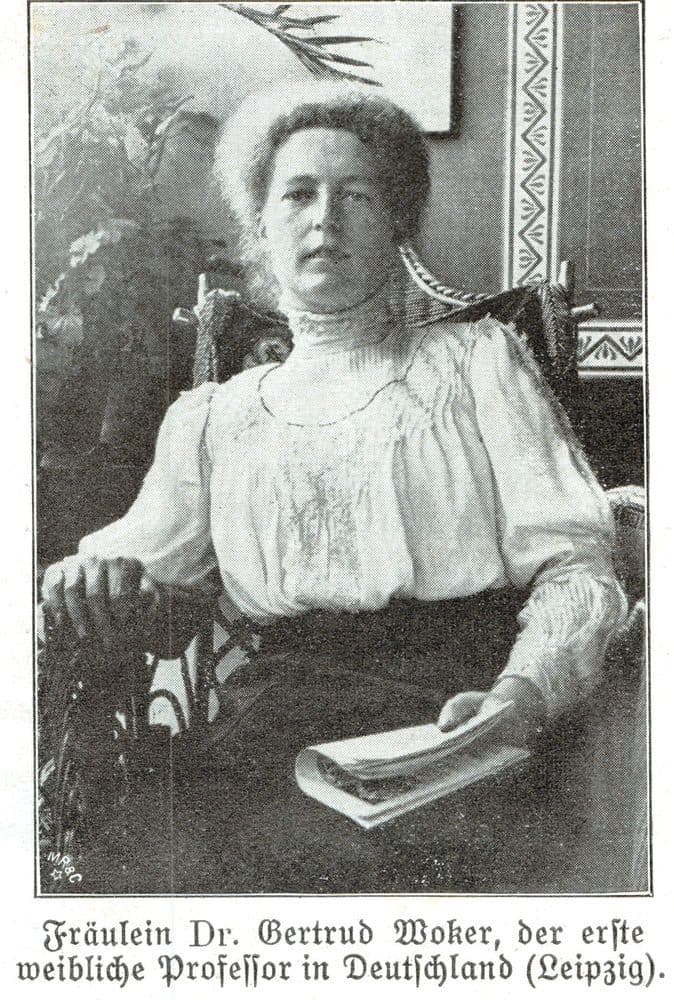
Through her work on catalysis and the toxicity of leaded petrol, Swiss chemist Gertrud Woker initially forged a Career at the University of Bern. Yet as a woman she did not have an easy time in science, especially as she campaigned vehemently for ethical principles in science, equality and world peace.
Gertrud Woker was born in Bern on 16 December 1878, the daughter of a family of scholars. Her father, Philipp Woker (1847-1924), who came from Brilon in the eastern Sauerland, was a historian and professor of canon law. Education and knowledge were highly valued in the Woker family, and Gertrud Woker was an exceptionally gifted and hard-working, though sometimes headstrong, pupil. She completed her schooling with the highest mark in every subject. Hoping that she would choose a medical Career, her father sent her to Erfurt after she finished school, to stay with an uncle who worked as a senior physician.
Woker, however, did not want to become a doctor but a natural scientist. With great commitment and persistence, she prevailed and began studying chemistry at the University of Bern in 1900. She completed her studies in 1903, aged 25, with a doctorate in organic chemistry. Her doctoral thesis was awarded summa cum laude, and on 17 January 1904 the Neue Wiener Tagblatt reported: “Within a few years, a young Swiss woman, Miss Gertrud Woker, has passed the following examinations at the University of Bern: the matriculation, secondary-school teacher, doctoral and grammar-school teacher examinations.”
After a period of study in Berlin, during which she turned to physical chemistry, Woker received the right to teach at the University of Bern in 1907. She was thus the first female lecturer in chemistry at a German-speaking university. In her inaugural lecture on catalysis, she explained her future field of research, which was to develop into an important scientific field at the interface between chemistry and biology. A report from 16 June 1907 in the Wochenblatt Wiener Hausfrau describes this phase of her life: “With the beginning of the summer semester, the University of Bern has gained its second female lecturer. […] The new, still very young private lecturer, Miss Gertrud Woker, completed her chemistry studies in Bern several years ago and will now embark on her new Career with her inaugural lecture on the topic ‘Problems of Catalytic Research’.” From 1911, Woker headed the Institute of Physical-Chemical Biology in Bern. She declined an appointment to Leipzig in the same year.
Woker always kept the practical benefits of her findings in mind. As early as 1917, she pointed out the toxicity of leaded petrol. She called for unleaded fuel and published the first widely acclaimed proposals for producing unleaded motor petrol. Despite her scientific successes, she did not have an easy time as a woman. It was not until 1933, after foreign researchers had campaigned vehemently on her behalf, that she was promoted to extraordinary professor at the age of 55.
Woker is regarded as a pioneer in the forward-looking field at the interface between chemistry, physics, pharmacy and biology. Her textbook “The Chemistry of Natural Alkaloids”, published in 1953, received much recognition. She also published a book on the role of catalysis in analytical chemistry. It should be noted that her earlier books on women’s employment and the devastating use of poison gases in armed conflicts were burned at the stake by Berlin’s National Socialist student body.
Since the First World War, Woker had campaigned vehemently for adherence to ethical principles in science, world peace and women’s rights. Like Clara Immerwahr (1870-1915), the wife of Fritz Haber (1868-1934), the later Nobel laureate and advocate of gas warfare, she became involved in the fight against chemical weapons, which she described as a “perversion of science”.
Woker witnessed the use of poison gas in the First World War, the atomic bombs dropped by the USA on Hiroshima and Nagasaki in August 1945, and the devastating effects of chemical weapons during the Vietnam War. From 1915, she found fellow pacifists in the international Women’s League for Peace and Freedom, whose Swiss branch she helped to establish.
As a pacifist, Woker was branded a traitor and a communist in both Switzerland and Germany. She denied ever having argued “against the necessity of national defence for Switzerland” and emphatically stressed that she had “always opposed only gas warfare”. She supported national defence and was certainly not a communist, but firmly adhered to the faith of the Old Catholic Church. Nevertheless, she had to endure numerous slanders and affronts. Eventually, she sacrificed her scientific Career to world peace – the “greater whole”, as she put it. She was diagnosed with a mental illness, and her own family called her “crazy Aunt Trudi”. Her anti-war activism also earned Woker the nickname “Gas Trudi”. Her closest colleagues had worn her down to such an extent that she suffered from persecutory delusions. At the age of 88, she was admitted to a psychiatric hospital. There, in Marin in the canton of Neuchâtel, Gertrud Woker died on 13 September 1968 at the age of 90.
It was only years after her death that the University of Bern established an independent institute of biochemistry. Streets in Bern and other cities now bear the name of Getrud Woker.
Literature
Franziska Rogger: Der Doktorhut im Besenschrank: Das abenteuerliche Leben der ersten Studentinnen – am Beispiel der Universität Bern, Bern, 1999, pp. 178-198.
Gerit von Leitner: Wollen wir unsere Hände in Unschuld waschen? Gertrud Woker (1878-1968), Chemikerin & Internationale Frauenliga 1915-1968. Weidler Buchverlag, Berlin, 1998
Authors
Prof. Dr. Eberhard Ehlers
Prof. Dr. Heribert Offermanns
Editorial work
Dr. Uta Neubauer
Project management
Dr. Karin J. Schmitz (GDCh-public relations)
The authors are responsible for the content of the biographies.
The content presented on these pages has been compiled with care. Nevertheless, the authors, editorial staff and publisher accept no responsibility or liability for the completeness and accuracy of the content or for typographical errors.