
Kornfeld biography
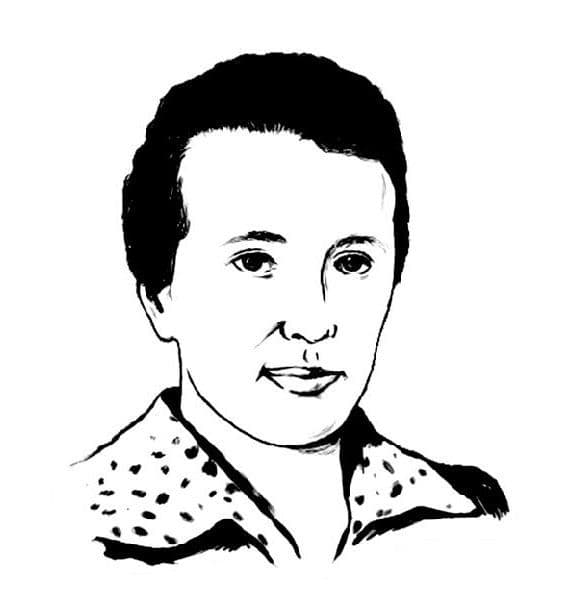
After the National Socialists withdrew her venia legendi, it was impossible for Gertrud Kornfeld to continue her university Career. She emigrated to the USA and continued her research until the end of her life in the service of the photographic film manufacturer Eastman Kodak.
Gertrud Kornfeld was born in Prague on 25 July 1891. As the daughter of a German-speaking Bohemian family of manufacturers belonging to the upper-class Jewish bourgeoisie, she received an excellent school education. She eventually gained the qualification to study with the Austrian Abitur.
From 1910 to 1915, Kornfeld studied chemistry, physical chemistry and physics at the German-speaking Karl-Ferdinands-Universität in Prague. From 1914 onwards, she conducted research there in the working group of her mentor Viktor Rothmund (1870-1927), whose work focused primarily on the electrochemical reduction and so-called passivity of metals. Kornfeld was awarded her doctorate in 1915 for a thesis on “Hydrates in Solution” and worked as an assistant at the chemical institute of Prague University until 1918 or 1919 (see note below). With the outbreak of the First World War, women scientists at several German universities were finally allowed to take up academic positions. During this period, Kornfeld deepened her knowledge of chemical reaction kinetics, a burgeoning field of research at the time.
As Kornfeld belonged to Prague’s German-speaking population, she left the city in 1919 when Czechoslovakia was founded. As a former assistant to Rothmund, she immediately obtained a research assistant position with Max Bodenstein (1871-1942) at the Technical University of Hanover, where she remained until 1923 or 1925 (see note below). Bodenstein is considered one of the founders of chemical reaction kinetics. He researched primarily light-induced chain reactions such as the chlorine explosion reaction, in which hydrogen chloride is formed from its elements. He also made further important contributions to photochemistry. Both fields – photochemistry and reaction kinetics – now became Kornfeld’s main research areas as well.
In 1923, Bodenstein was appointed to Berlin as the successor to Nobel Prize winner Walther Nernst (1864-1941), and Kornfeld moved with him to the physical chemistry institute of the university there. In 1928, she completed her habilitation in chemistry in Berlin. She continued to work as Bodenstein’s assistant, supervised several doctoral theses and fulfilled her teaching commitments with great enthusiasm. Kornfeld was also successful in research: around 1929, she developed the membrane manometer, which measures pressures of up to 16 millibars. It works on the principle that gas pressure bends a thin sheet of metal, thereby moving a pointer.
Alongside her successes, Kornfeld had to endure many disappointments and frustrations, which ultimately made a university Career impossible. After the National Socialists withdrew her venia legendi in autumn 1933, the now 42-year-old chemist travelled spontaneously to England with the help of a scholarship. She conducted research at the University of Nottingham and Imperial College London, but was unable to secure a permanent position. She never attained in Great Britain the relatively senior position in science that she had once held in Berlin. Supported by a further scholarship, she worked at the University of Vienna until 1936. From there, she emigrated to the USA in 1937 on a visitor’s visa.
In the United States too, Kornfeld was denied the continuation of her university Career. She took up a position as a research chemist at Eastman Kodak in Rochester, in the US state of New York. She worked for the manufacturer of film and other photographic equipment until the end of her life. In 1943, Kornfeld obtained American citizenship. She never married.
Kornfeld experienced both the university and industrial facets of her profession and is undoubtedly one of the outstanding women chemists of the first half of the 20th century. Her early research was pioneering for photochemistry, but she was not afforded the opportunity to build on these successes in the later stages of her life. Gertrud Kornfeld died in Rochester (USA) in summer 1955, a few weeks before her 64th birthday.
Literature
A. Vogt: Vom Hintereingang zum Hauptportal? Lise Meitner und ihre Kolleginnen an der Berliner Universität und in der Kaiser-Wilhelm-Gesellschaft, Franz Steiner Verlag, Stuttgart, 2007
H. Walter: Kornfeld, Gertrud. In: Neue Deutsche Biographie (NDB), Band 12, S. 590, Duncker & Humblot, Berlin, 1980
www.hu-berlin.de/de/ueberblick/geschichte/wissenschaftlerinnen/kornfeld
Note: different information is given in different sources
Authors
Prof. Dr. Eberhard Ehlers
Prof. Dr. Heribert Offermanns
Editorial work
Dr. Uta Neubauer
Project management
Dr. Karin J. Schmitz (GDCh-public relations)
The authors are responsible for the content of the biographies.
The content presented on these pages has been carefully compiled. Nevertheless, the authors, Editorial staff and publisher accept no responsibility or liability for the completeness and accuracy of the content or for typographical errors.