
Biography Cremer
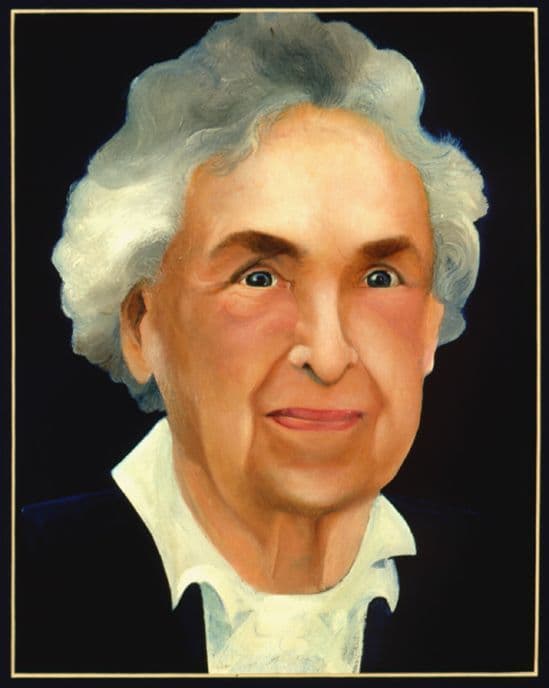
Her father was already encouraging her talent for science and technology, thereby laying the foundations for a career in chemistry. However, Erika Cremer did not receive the international recognition she deserved.
Erika Cremer was born in Munich on 20 May 1900. Her father, Max Cremer (1865–1935), was a renowned professor of physiology who helped develop the glass electrode. He encouraged his children’s interest in science and technology from an early age, and with great success: Erika Cremer, who later became Professor of physical chemistry at the University of Innsbruck, was not the only one to pursue a scientific career. Her elder brother Hubert (1897–1983) became Professor of Mathematics and Large-Scale Computing Systems at RWTH Aachen University, while her younger brother Lothar (1905–1990) was Professor of Technical Acoustics at TU Berlin and also Director of the Heinrich Hertz Institute of the Fraunhofer Society.
When Max Cremer accepted a position at the University of Berlin in 1911, the entire family moved to the German capital. In 1920, Cremer passed her Abitur at a secondary school for young women where the natural sciences were highly valued. She subsequently studied chemistry, physics and mathematics in Berlin. She completed her doctoral thesis, in which she investigated the chlorine–hydrogen explosion reaction, under the renowned physical chemist Max Bodenstein (1871–1942). She obtained her doctorate in 1927.
During her early scientific career, the young chemist mostly worked without pay, for example with the future Nobel laureate Georg Karl von Hevesy (1885–1966) in Freiburg and Michael Polanyi (1891–1976) at the Kaiser Wilhelm Institute (KWI) for physical chemistry and electrochemistry in Berlin. In 1936, Cremer returned to her main area of research, the rapidly progressing chain reaction between hydrogen and chlorine. Among other places, she worked with Otto Hahn (1879–1968) at the KWI for Chemistry in Berlin. In 1989, she wrote the highly regarded article “On the History of Unleashing Nuclear Energy” about this period in the Austrian Chemists’ Journal.
Cremer completed her habilitation in 1939 against the dean’s wishes. The following year, she moved to the Leopold-Franzens University in Innsbruck, where she was granted the right to teach and simultaneously entered the civil service on a probationary basis – initially without pay, however. In 1945, she assumed provisional leadership of the Institute of Physical Chemistry. Six years later, she was appointed extraordinary university professor and head of the institute. It was not until 1959 – more than three decades after completing her doctoral thesis – that the University of Innsbruck appointed Cremer Professor of physical chemistry. She held this professorship until her retirement in 1970.
Erika Cremer is regarded as the inventor of gas chromatography, the scientific foundations of which she developed primarily together with her student Fritz Prior. Although Cremer published more than 200 scientific articles, international recognition came only slowly and after a considerable delay. While the two British chemists Archer J. P. Martin (1910–2002) and Richard L. M. Synge (1914–1994) received the Nobel Prize in Chemistry in 1952 for their work on gas, column and paper chromatography, Cremer received nothing. Nevertheless, she made a major contribution to the development of new analytical techniques. The technical implementation of the methods she developed was always close to Cremer’s heart, which is why she collaborated with chemical and pharmaceutical companies as well as manufacturers of analytical instruments.
Cremer never married and had no children. She devoted all her energy to research and teaching. During her work in Innsbruck, she supervised more than 70 doctoral students and four habilitation candidates. One of her students described her style as follows: “She loved chaos; entropy was always a popular concept. She had ideas, she was brilliant – that was what made her strong.” Erika Cremer died in Innsbruck on 21 September 1996.
Literature
G. Oberkofler: Erika Cremer (1900–1996) – A Life for Chemistry, published by the Central Library for Physics in Vienna, Studien-Verlag Innsbruck/Vienna/Bozen, 1998
B. Bischof: Cremer, Erika, in: B. Keintzel, I. Korotin (editors): Women Scientists in and from Austria. Life – Work – Achievements, Böhlau Verlag, Vienna/Cologne/Weimar, 2002, pp. 121–124, ISBN 3-205-99467-1
German Chemical Society (GDCh): Women Chemists – They Existed and They Exist, brochure, 2003, p. 17
Authors
Prof. Dr. Eberhard Ehlers
Prof. Dr. Heribert Offermanns
Editorial work
Dr. Uta Neubauer
Project management
Dr. Karin J. Schmitz (GDCh-public relations)
The authors are responsible for the content of the biographies.
The content presented on these pages has been carefully prepared. Nevertheless, the authors, Editorial staff and publisher accept no responsibility or liability for the completeness and accuracy of the content or for typographical errors.