
School and University

    Students and Apprentices

    Undergraduate and PhD Students

    Teachers

    Higher Education Statistics

    Scholarships

Career

    Career Guidance

    Job Vacancies

    Salary Information and Income Survey

    Academy

    Mentoring

Community

    Divisions

    Young Chemists’ Forum (JCF)

    Local Sections

    Regulars' Get-Togethers

    Chem_Connect

    Equal Opportunities and Diversity

    Partnerships and International Activities

    Volunteering

    Membership

Discover Chemistry

    Top Topics

    “Nachrichten aus der Chemie” – Members’ Magazine

    Scientific Journals

    Statements and Position Papers

    Press Releases

    Brochures and Academic Publications

    Books, Videos and Podcasts

    The Fascination of Chemistry

    Cartoons

    Biographies of Female Chemists

Events

    Conferences

    Academy

    Lectures

    Further Events

Awards

    Prices

    Historical Sites of Chemistry

About Us

    Board and Other Bodies

    The Office

    Statutes and Code of Conduct

    Charities

    Press and Public Relations

    Sustainability

MyGDCh

GDCh

Chemistry for a better world

© 2026 Gesellschaft Deutscher Chemiker. All rights reserved.

NewsletterDownloadsPressContactGDCh Shop
Legal NoticeData PrivacyTerms & Conditions
Homepage/Career/Careers guidance/Diversity of Career Profiles in Chemist.../Career interviews/Crisis Management Lecturer

I AM: Lecturer in Crisis Management

“Turning my hobby into a career while helping to save people's lives is something special and makes me incredibly proud.”
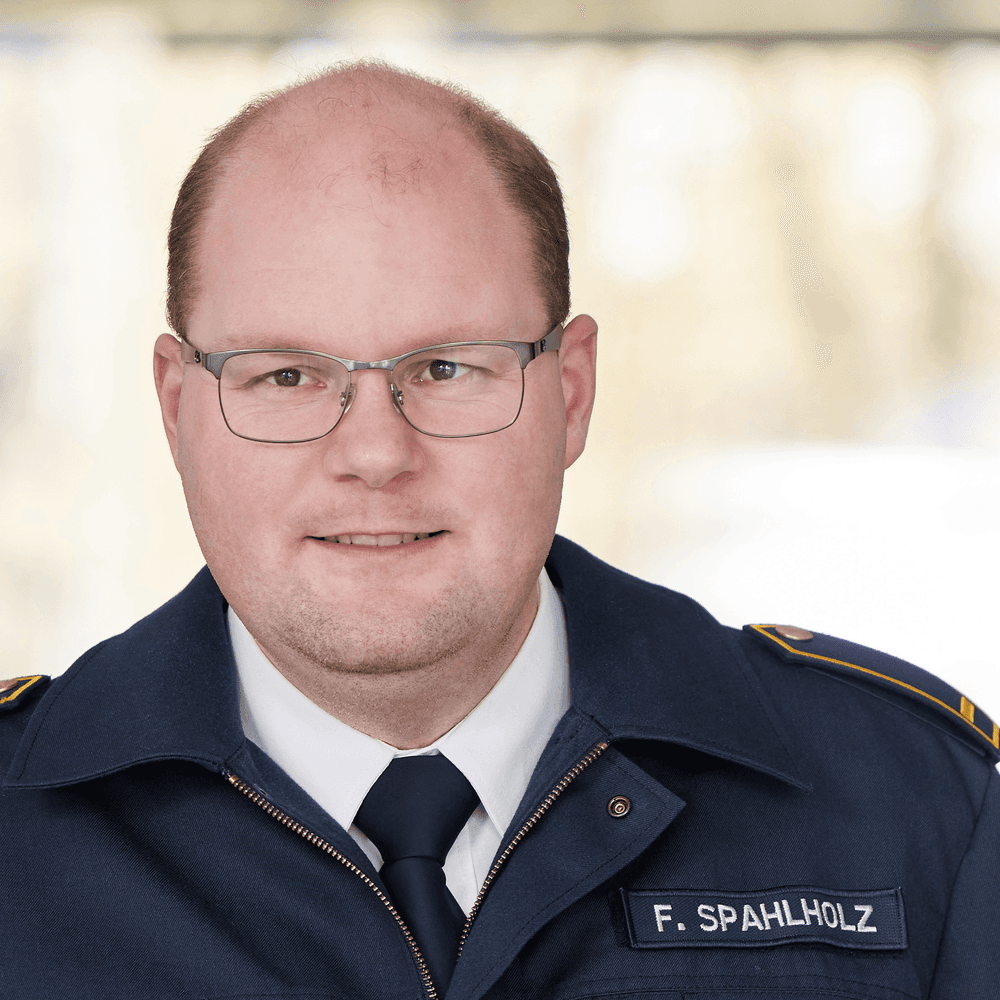
Fire Brigade Council Frank Spahlholz | NRW Institute of Fire Service

Frank Spahlholz ...

After studying chemistry, he decided to turn his hobby into a career and become a fire service officer. He completed his preparatory service in 2022 and has since worked as a senior fire officer and fire service lecturer in the fields of crisis management and civil protection.

The career interview

When I was little, I once said: “When I grow up, I’m going to be a firefighter!” At the age of 11, I joined the junior fire service in my local area and continued to be passionate about the fire service. After completing my Abitur, I began studying technical chemistry at TH Köln alongside my alternative military service with the volunteer fire service. Even then, I noticed the overlap between the fire service and chemistry, and I was able to put my knowledge to the test at two incidents involving hazardous chemical substances. After completing my Bachelor’s degree, I undertook my Master’s degree in Bonn. There, the voice inside me grew louder: “Turn your hobby into a career and you’ll have free time every day!” So that’s exactly what I did, and I’m now absolutely delighted.

Before starting my career, like all candidates for the second entry level of career group 2, I completed a traineeship. Here, I was taught comprehensive knowledge about the fire service. From the basics, such as how to couple two hoses together, through leadership theory at the various command levels, to management topics, I was given the tools I needed for my future role in the fire service. I learned to undertake leadership responsibilities and to coordinate larger-scale operations.

I was aware from the outset that a future career in the fire service was a possibility for me. After completing my studies, I was able to start my career training straight away.

The Institute of Fire Service in NRW is the central training and further education facility for fire service leaders in North Rhine-Westphalia. My role is to train operational and tactical staff. I prepare them for their complex and responsible duties, particularly during major incidents and disasters. In addition to working as a lecturer in fire service technology, preparing and following up lessons is also part of my daily work. Alongside my technical teaching duties, I remain active in operational service with my volunteer fire brigade in order to continue gaining practical experience.

Alongside physical fitness, mental resilience and the ability to make decisions under pressure are also absolute must-have criteria in my field, as sooner or later, when working on operations, you will encounter stressful situations. However, successfully saving people’s lives more than makes up for these difficult situations. Camaraderie is highly valued among us, as we can only function as a team during operations of any kind; often, we even entrust each other with our lives.

My typical working day usually begins days or weeks in advance: I check whether I have prepared everything for the courses and seminars taking place the following week, and also take care of preparing more elaborate staff exercises scheduled for the week after. My teaching day usually starts at 7.45 am. Before then, I am generally at the Institute of Fire Service to make the final preparations for the lessons or exercises. After work, I go home or to the institute’s own sports hall with fitness room.

During my studies, I was always among “like-minded people”; this is fundamentally different in the fire service. Expertise from a wide range of disciplines is required here to master the complex incidents that continually challenge the fire service. At the fire service, the team is crucial, as we have employed not only chemists but also biologists, physicists, engineers, architects and administrative specialists, as well as people with dual vocational training in technical fields (e.g. skilled trades). Studying chemistry has improved my ability to think analytically, enabling me to keep a cool head in complex incident situations and deal with them in a structured manner. In incidents involving hazardous chemicals, my studies enable me to assess the risks posed by numerous substances and thus protect my colleagues and the public from the dangers posed by these substances.

I can train people to make the tactically correct decisions in critical operational situations. That makes me incredibly proud. It is always challenging to see the participants in my courses and seminars taking the exam. This is where it becomes clear whether my teaching over the past few days has been successful or not.

With a bachelor’s degree, choosing to enter career group 2.1 (formerly the senior civil service) offers good opportunities for professional development. This may involve working in various specialist areas, such as training, technology, operational organisation or hazard prevention. Subject to professional performance, suitability and aptitude, it is possible to advance to career group 2.2 by completing a one-year preparatory service. With a master’s degree, choosing to enter career group 2.2 (formerly the higher civil service) offers even greater opportunities for professional development. However, you will primarily work in management positions as a department head or head of an authority.

You should be aware that working as a firefighter is a very special career, characterised by incredible variety and a high degree of responsibility. At the same time, however, it is also a very demanding profession that can give rise to particularly stressful situations, especially when responding to incidents.

Gender notice

For the sake of readability, the simultaneous use of gender-specific language forms has been dispensed with. All personal designations apply to all genders.