New ESIPT‐Dyes of Record Capacity to Fluorescence Detection of H‐Bond Donor and Acceptor Molecules, Including Local Water Concentration
Von Wiley-VCH zur Verfügung gestellt
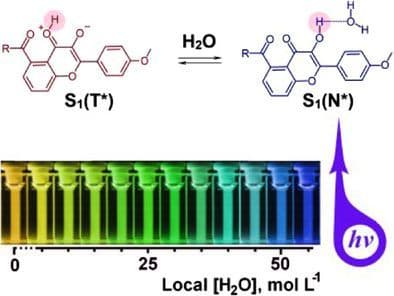
Multi-color fluorescent labels for detecting local water concentration at a selected cite of lipid-protein, protein-protein or protein-DNA complexes.
Abstract
5-Substituted 3-hydroxychromones (3-HCs) are challenging to synthesize but are of significant interest as fluorescent labels. This is primarily due to the pronounced modulation of their fluorescence by surrounding molecules, a consequence of the 5-substituent's proximity to the negative pole of the molecular dipole. The newly synthesized derivatives of 3-hydroxy-2-(4-methoxyphenyl)-4-oxo-4H-chromene-5-carboxylic acid exhibit unique fluorescence behaviors. Their color of emission is highly sensitive to the solvation environment and is strongly influenced by the nature of the functional group introduced at position 5. Notably, the fluorescence of acid demonstrates inhibition of ESIPT (excited-state intramolecular proton transfer) in both neutral and H-bond donor solvents, a phenomenon not previously observed in 3-HCs. Furthermore, investigated dye stands out as the first 3-HC compound whose fluorescence responds to the H-bond acceptor capacity of the environment, particularly in mildly acidic conditions (below pH 6). In contrast, methyl ester and glycine amide of key acid are responsive to the H-bond donor properties of their surroundings—a feature especially relevant in biological systems, where local water concentration plays a critical role. Thus, the derivatives such as N-terminal or lysine-labeled peptides incorporating these dyes can serve as valuable tools for investigating peptide-DNA, peptide-lipid, and other biomolecular interactions for the selected location of peptide.