Citrate‐Assisted Solvothermal Synthesis of SnO2 Porous Microflowers as Efficient Cathode for Advanced Hybrid Supercapacitor
Von Wiley-VCH zur Verfügung gestellt
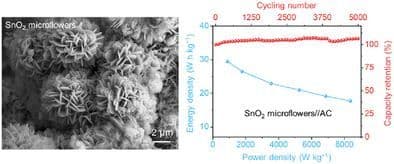
SnO2 porous microflowers were prepared by a citrate-mediated solvothermal route along with a post-annealing treatment in air. Such SnO2 flowers exhibited a battery-type electrochemical response with a great specific capacity of 177.2 C g−1 at 1 A g−1 in 2 M of KOH electrolyte. The assembled SnO2 microflowers//AC hybrid supercapacitor delivered a high specific energy of 29.5 W h kg−1 at 883.9 W kg−1.
Abstract
Herein, mesoporous tin dioxide materials with distinct structures (SnO2 microflowers and SnO2 microsheets) were, respectively, prepared via a citrate-mediated solvothermal route along with a post-annealing treatment in air. Electrochemical tests revealed a typical battery-type charge storage behavior of SnO2 materials. Attributing to the 3D hierarchical flower-like structure and its good conductivity, the SnO2 microflowers possessed a specific capacity of 177.2 C g−1, slightly greater than 159.0 C g−1 achieved by SnO2 microsheets under 1 A g−1. When assembled into hybrid supercapacitors (HSCs) utilizing activated carbon (AC) as an anode, the SnO2 microflowers//AC HSC device delivered a high energy density (ED) of 29.5 W h kg−1 at 883.9 W kg−1, surpassing SnO2 microsheets//AC HSC (26.9 W h kg−1 at 881.7 W kg−1). Furthermore, both SnO2//AC HSCs exhibited long-term stability, showing 113.2% (SnO2 microflowers//AC) and 106.4% (SnO2 microsheets//AC) capacity retention over 5000 cycles. Notably, this synthesis strategy achieves facile morphological control and improved electrochemical properties of SnO2 materials by adjusting the sodium citrate amount. These results indicate that SnO2 microflowers and SnO2 microsheets are attractive candidates for high-performance HSC assembly. Furthermore, this cost-effective approach can provide a reference for synthesizing other advanced metal oxide-based electrode materials.