Synthesis of Dendritic Oligo‐Glycerol Amphiphiles with Different Hydrophobic Segments to Improve their Performance as Nanocarriers
Von Wiley-VCH zur Verfügung gestellt
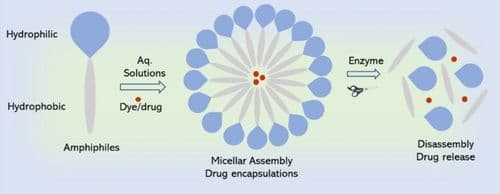
The synthesized dendritic oligoglycerol amphiphiles with different hydrophobic moieties show efficient micelle formation at low concentrations (CMC: 0.3–1.1 mg/mL) and a strong drug loading capacity, especially for Nile red and nimodipine. Long alkyl chains (C12) improve cargo encapsulation and biocompatibility, while release kinetics suggest potential for controlled drug delivery. These findings serve as a guide for the development of future nanocarriers
Abstract
A new class of non-ionic dendritic amphiphiles has been developed from biobased chemicals, in particular glycerol-based dendrons coupled to commercially available acids via the Steglich esterification process. These non-ionic amphiphiles are functionalized with different hydrophobic segments to investigate the contribution of the same towards their guest transport behaviour. Therefore, different alkyl chains i.e, C8 and C12, as well as two different aromatic units were introduced as a hydrophobic segments and G1-oligo-glycerol as a hydrophilic segment. Their physicochemical properties were characterized by different techniques such as dynamic light scattering and fluorescence measurements. The results show that these amphiphiles form a very uniform micellar supramolecular structures that is independent of the hydrophobic system. The critical micelle concentration for the prepared non-ionic amphiphiles was found to be in the range of 0.3 to 1.8 mg/mL, which depend on the type of hydrophobic units. The encapsulation capacities of the amphiphiles were tested using Nile Red and Nimodipine as model dye and drug, respectively. The encapsulation studies showed a preference for C12- and pyrene-based amphiphiles through relatively different mechanisms unraveled by molecular dynamics (MD) simulations. Further, the cytotoxicity and cellular uptake of these systems as well as the release profiles were investigated.