Structure‐Guided Identification and Evaluation of Epalrestat and Ranirestat‐Like Compounds Against Aldose Reductase: Therapeutic Management of Diabetic Neuropathy
Von Wiley-VCH zur Verfügung gestellt
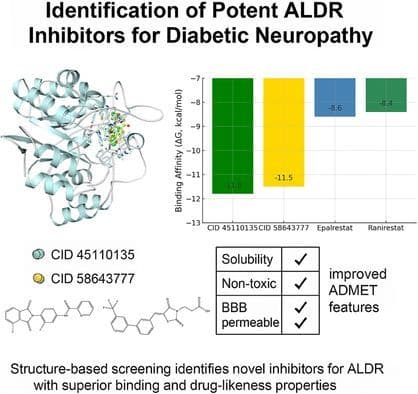
Structure-based virtual screening of PubChem compounds identifies two novel epalrestat and ranirestat-like inhibitors with improved affinity and pharmacokinetic profiles targeting aldose reductase. Molecular docking, ADMET filtering, and 500-ns molecular dynamics simulations confirm the stability and interaction specificity of the candidates, highlighting their potential for diabetic neuropathy therapy.
Aldose reductase (ALDR) is a critical protein involved in the pathogenesis of diabetic complications such as retinopathy, neuropathy, and nephropathy. Due to the activation of inflammatory and cytotoxic pathways under hyperglycemic conditions, ALDR has become an important target for therapeutic development. Currently, available drugs such as epalrestat and ranirestat are suboptimal due to factors such as toxicity and low solubility. In this study, a structure-based approach was used to screen the PubChem database to identify novel ALDR inhibitors with a Tanimoto coefficient greater than 0.8 with the structural frameworks of epalrestat and ranirestat. A systematic virtual screening, including molecular docking, drug-likeness assessment, and molecular dynamics (MD) simulations, revealed two promising candidates, PubChem CIDs: 45110135 and 58643777. These compounds showed higher binding and selectivity toward ALDR than epalrestat and ranirestat in docking studies. MD simulations supported the stability and preferred dynamics of their interactions with ALDR. These findings suggest that compounds CID:45110135 (N-[3-fluoro-4-(4-fluoro-1,3-dioxoisoindol-2-yl)phenyl]pyridine-2-carboxamide) and CID:58643777 ([(5Z)-4-oxo-2-sulfanylidene-5-[[3-[3-(trifluoromethyl)phenyl]phenyl]methylidene]−1,3-thiazolidin-3-yl]propanoic acid) might have the potential to be lead compounds for the development of new drugs for diabetic neuropathy after required validation.