Synthesis and Mechanistic Study of a Copolymer Demulsifier for Dehydration of Water‐in‐Oil Emulsion of Crude Oil
Von Wiley-VCH zur Verfügung gestellt
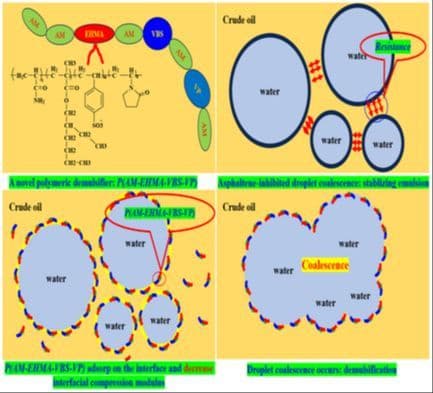
P(AM-EHMA-VBS-VP), a novel polymeric demulsifier, adsorbs at the interface, reduces interfacial modulus, overcomes asphaltene-inhibited coalescence, and promotes droplet coalescence for effective demulsification.
This study presents the synthesis and characterization of a novel polymeric demulsifier, P(AM-EHMA-VBS-VP), through emulsion polymerization for efficient separation of water-in-crude oil emulsions. The synthesis parameters are systematically optimized using orthogonal array design complemented by single-factor experiments. The demulsification performance is evaluated under simulated field conditions, with particular emphasis on dosage optimization and temperature effects. Comprehensive mechanistic investigations are conducted through dynamic interfacial tension measurements, interfacial dilational rheology analysis, and zeta potential characterization to elucidate the demulsification mechanism and the impact of inorganic salts on demulsification efficiency. The optimized synthesis conditions yield a copolymer with monomer mass ratios of AM:EHMA:VBS:VP = 1:4:4:1, achieved at 60 °C for 8 h with 30% monomer concentration and 0.15% initiator dosage. Optimal demulsification performance is observed at 80 °C with a demulsifier concentration of 300 mg L−1. The synthesized demulsifier demonstrates remarkable salt tolerance, maintaining effectiveness in environments containing up to 30 000 mg L−1 NaCl and 10 000 mg L−1 CaCl2. Mechanistic studies reveal that the demulsifier operates through interfacial adsorption, which simultaneously reduces the mechanical strength of the interfacial film and decreases the surface charge density of emulsion droplets. This dual mechanism effectively compromises the emulsion stability by diminishing both the film's resistance to deformation and the electrostatic repulsion between droplets.