Recent Progress of 2D Conductive Metal‐Organic Frameworks in Advanced Energy Storage
Von Wiley-VCH zur Verfügung gestellt
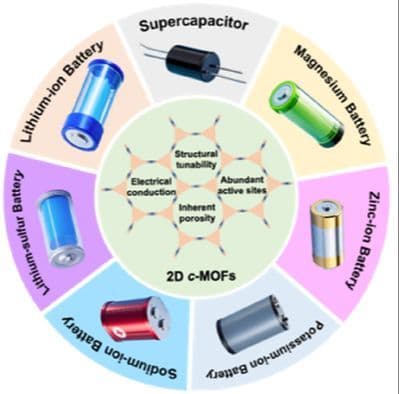
Two-dimensional conductive metal-organic frameworks (2D c-MOFs) show great potential for advanced energy storage due to their tunable structure and unique properties. This review covers the design principles, structural features, and recent advancements in their energy storage applications, focusing on structure-performance correlations to provide insights for optimizing next-generation 2D c-MOF-based devices.
Advanced energy storage systems play a critical role in energy capture, storage, and release across applications like smart devices, electrified transportation, renewable energy, and green power grids. However, the development of energy storage devices with large capacity, long lifespan, and high power density is hindered by challenges related to electrochemically active materials. Traditional electrode materials—such as graphite, metal oxides, polymers, and simple composites—suffer from poor electrical conductivity, unstable structures, slow ionic diffusion, and limited active site utilization during charge–discharge cycles. These issues necessitate the design of new materials with optimized charge transport and abundant active sites. Two-dimensional conductive metal-organic frameworks (2D c-MOFs), with tunable structures, inherent porosity, and unique properties, hold promise for advanced energy storage devices. They have shown potential in supercapacitors, lithium–ion, lithium–sulfur, sodium–ion, potassium–ion, zinc–ion, and magnesium metal batteries. This review systematically summarizes the design, structural characteristics, and recent advancements of 2D c-MOFs in energy storage, focusing on the structure-property relationship that drives their electrochemical performance, and aims to provide insights for the development of 2D c-MOF-based energy storage devices.