Recent Advances in Microenvironment Engineering for Selective Electrochemical C–N Coupling
Von Wiley-VCH zur Verfügung gestellt
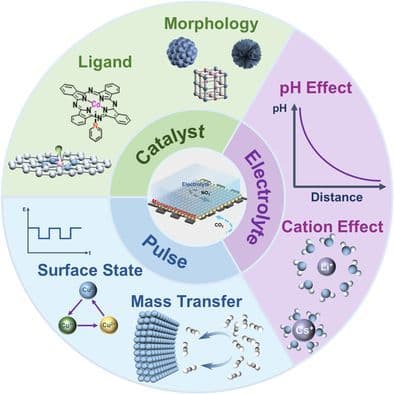
This review examines advances in microenvironmental engineering for electrochemical C–N coupling, focusing on active site design, electrolyte modulation, and dynamic pulse control. Prospective strategies are proposed to further improve catalytic efficiency and atom utilization in future systems.
Electrochemical C–N coupling via the coreduction of CO2 and nitrogenous species (N2/NO x ) presents a sustainable route to synthesize value-added C–N compounds under mild conditions. However, competing pathways and mismatched intermediate kinetics hinder the selective formation of products like urea, amines, and amides. Recent advances reveal that rational modulation of the electrochemical microenvironment can effectively steer reaction pathways and stabilize coupling-relevant intermediates. This review systematically summarizes how microenvironment engineering, originally developed for CO2 and NO x reduction reactions, can be leveraged to enhance C–N coupling efficiency and selectivity. The key strategies are categorized into 1) catalyst-centered design (e.g., ligand coordination, defect engineering, and morphology control), 2) ionic and electrolyte modifications (e.g., cation/pH effects), and 3) dynamic approaches such as pulsed electrolysis. These methods shape local fields, surface coverage, and mass transport properties, ultimately directing reactants toward cross-coupling over competing routes. By drawing parallels with well-established CO2RR/NO x RR systems and showcasing emerging examples in C–N coupling, the central role of microenvironment control is highlighted. Finally, a perspectives on strategies to further improve activity, selectivity, and atom economy in future C–N coupling systems are offered.