Process Enhancement of Calcium Looping through Combined Mechanical and Chemical Sorbent Reactivation
Von Wiley-VCH zur Verfügung gestellt
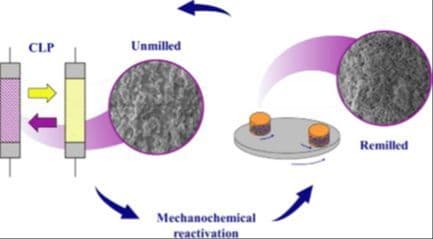
Remilling—mechanical and chemical reactivation via wet milling after each cycle in the calcium looping process—boosts CO2 capture by 2–3 times, enhances sorbent properties, and reduces deactivation and replacement rates, as confirmed by physicochemical characterization and supported by a semiempirical model.
This study tackles sorbent deactivation in the calcium looping process by combining mechanical and chemical reactivation via wet planetary milling. Consequently, sorbent performance is enhanced via leveraging reactivation agents and transient microenvironments simultaneously. Reactivation is systematically applied after each calcination–carbonation cycle, a process termed remilling. Remilled sorbents exhibit 2–3 times higher CO2 capture capacity than untreated ones over the first 10 cycles. This improvement is attributed to Ca(OH)2 formation during milling and the mechanical disruption of sintered particles, which both re-expose previously inaccessible CaO domains. A supporting semiempirical model is implemented and aligns with these findings. The model highlights the ongoing creation and closure of small-scale pores. The detailed physicochemical characterization of the sorbent properties reveals the dominant influence of the milling regime as well as de- and reactivation mechanisms. The observations underline an increased surface area, formation of small-scale pores, higher CaO conversion, and less deactivation. This suggests that high space-time yield within the overall process is obtained, and sorbent replacement rates are lowered. A large-scale scenario comparison of energy demand for remilling and sorbent replacement highlights the potential and boundaries of the suggested process adaptation.