Polymer, Water, and Salt Partitioning in Complex Coacervates Characterized by Femtosecond Stimulated Raman Microscopy
Von Wiley-VCH zur Verfügung gestellt
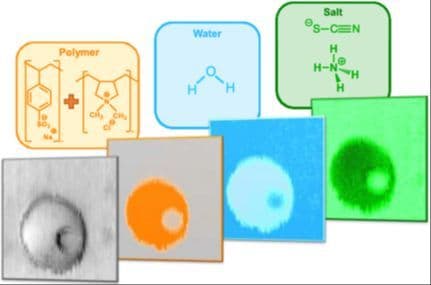
The partitioning of polymer, water, and salt within complex coacervates formed by the polyelectrolytes poly(diallyldiemthylammonium chloride) and poly(4-styrenesulfonate) is investigated using femtosecond stimulated Raman microscopy (FSRM). With FSRM, small sample volumes (≈20 μl) are characterized in a few minutes.
Complex coacervates can form through liquid–liquid phase separation in aqueous solutions containing oppositely charged macromolecules. This process results in macromolecule-rich droplets (coacervate phase) coexisting with a macromolecule-depleted supernatant phase. Here, femtosecond stimulated Raman microscopy (FSRM) is introduced as a tool to rapidly analyze both the supernatant and coacervate phases of complex coacervates. The well-known polyelectrolyte pair poly(diallyldimethylammonium chloride) and poly(4-styrenesulfonate) is investigated. Coacervate formation is induced by the addition of KBr and NH4SCN as a Raman-active salt. For both salts, the partitioning of polymer and water between the coacervate droplets and the supernatant phase is quantified. For the Raman-active salt NH4SCN, its partitioning between phases was also monitored. NH4SCN was found to be enriched in the coacervate phase, as confirmed by FTIR spectroscopy. Overall, FSRM proves to be a valuable tool for collecting new data on coacervate composition requiring only low sample volumes and simple sample preparation, while offering convenient data acquisition.