Wettability‐Controlled Electrocatalytic Carbon Dioxide Reduction
Von Wiley-VCH zur Verfügung gestellt
Herein, the evolution of catalytic interface configurations in eCO2RR is introduced, outlines the major challenges associated with constructing stable and efficient TPIs, and summarize recent advancements, such as hydrophobic polymer/molecular modifications and hierarchical structure fabrication to improve hydrophobicity.
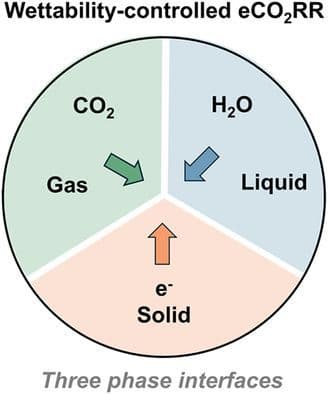
The electrocatalytic CO2 reduction reaction (eCO2RR) offers a promising pathway for converting greenhouse gases into valuable fuels and chemicals using renewable energy. Beyond advancements in catalyst and electrolyzer design, significant opportunities lie in the strategic modulation of the gas–liquid–solid three-phase interface (TPI) on the catalyst surface. After revisiting the evolution from traditional liquid–solid double-phase interfaces to advanced gas–liquid–solid TPIs, this concept outlines major challenges in constructing stable TPIs on eCO2RR gas diffusion electrodes and reviews recent progress in TPI modulation through hydrophobicity enhancement. Further, achieving a delicate balance between hydrophobicity and hydrophilicity—optimal wettability—is crucial for optimizing TPI construction, and enhancing overall electrocatalytic performance is emphasized. This work provides valuable insights for designing efficient TPIs in eCO2RR and other gas-involved electrochemical processes, contributing to advancements in sustainable energy technologies.