Experimental and Theoretical Mechanistic Study on the 6‐Iodo‐2‐pyridone‐Catalyzed Aminolysis of Esters
Von Wiley-VCH zur Verfügung gestellt
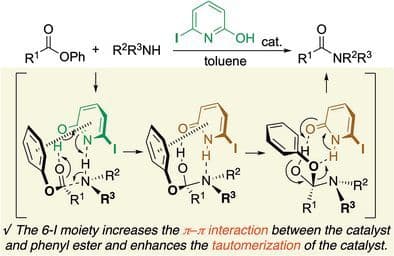
In the aminolysis of esters, acid–base bifunctional catalyst 6-iodo-2-pyridone exhibits high catalytic activity, particularly for phenyl esters. A π–π interaction between the catalyst and the phenyl ester is a key feature in the transition states. The 6-iodine substituent contributes to increasing the π–π interaction and enhancing the tautomerization of 2-pyridone/2-hydroxypyridine, thus decreasing the energy among the transition states.
Abstract
A rigorous evaluation of 6-halo-2-pyridone in the catalytic aminolysis of esters revealed that 6-iodo-2-pyridone exhibits high catalytic activity, particularly in the presence of phenyl esters. In this reaction, a series of amines and aromatic esters gave the corresponding amides in high yield. To elucidate the reaction mechanism of the 6-iodo-2-pyridone-catalyzed aminolysis of esters, 1H NMR experiments, kinetic studies, and density functional theory (DFT) calculations were conducted. The combined results demonstrate that the reaction proceeds via the formation of a 1:1:1 complex comprising the catalyst, the amine, and the phenyl ester. In this context, 6-iodo-2-pyridone thus works as an acid–base bifunctional catalyst, successfully activating both the ester and the amine. Notably, a π–π interaction was observed between the catalyst and the phenyl ester in the transition state. The stereoelectronic effect of iodine most likely contributes to a favorable degree of this π–π interaction, facilitating a smooth transition to the subsequent leaving of phenol. The low energy barrier for the tautomerization between 6-iodo-2-pyridone and 6-iodo-2-hydroxypyridine also facilitates the process.