Complex Material Analysis of Reverse Painting on Glass by Means of Photography, Microscopy, and Spectroscopic Techniques
Von Wiley-VCH zur Verfügung gestellt
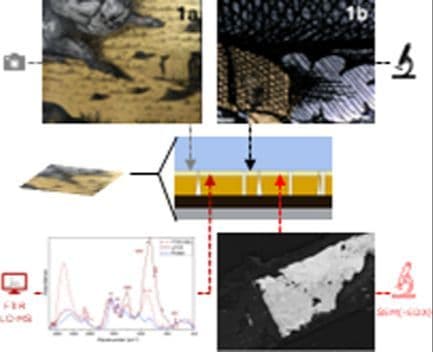
The material research of reverse paintings on glass combines infrared spectroscopy and liquid chromatography–mass spectroscopy to investigate the binders. Observation methods (macro- and microphotography) and the scanning electron microscopy with energy-dispersive spectrometer are used for research of metal composition.
Reverse paintings on glass are a group of specific artworks created in a reverse order with respect to conventional paintings. Their material research is particularly demanding because in many cases their dismantling is scarcely possible, limiting sampling and employing more sophisticated methods. Herein, different techniques ranging from noninvasive to destructive are employed in the investigation of two types, folk reverse paintings and reverse paintings with a metallic background. The potential of photography and digital microscopy observation is tested with the aim to help curators and restorers obtain as much information as possible without the need for expensive and hardly accessible analytical techniques. The acquired results were supported and, in some cases, clarified by scanning electron microscopy with energy-dispersive spectrometer analysis of the inorganic components, while organic components are studied by infrared (IR) spectroscopy and liquid chromatography–electrospray ionization–quadrupole time-of-flight mass spectrometry. The assessment of the different IR arrangements is also performed, suggesting the microattenuated total reflection Fourier transform infrared spectroscopy technique the most suitable for the analysis of reverse paintings on glass. The need for the utilization of complementary techniques is also demonstrated on the example of protein binder classification.