Unveiling Solvent‐Dependent Divergent Hydrogen Production Pathways during the Dehydrogenation of Formic Acid Using N,N′‐Iminopyridine Ruthenium(II) Complexes
Von Wiley-VCH zur Verfügung gestellt
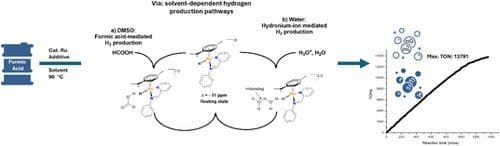
A readily available, efficient RuII catalyst mediates hydrogen production via formic acid dehydrogenation, via distinct, solvent-dependent hydrogen production pathways. In water, catalyst robustness is observed, generating turnover numbers (TONs) of 13 791 under stepwise addition, while displaying sustained activity under continuous addition conditions for 34 h.
The preparation of a panel of cationic, half-sandwich iminopyridine ruthenium(II) complexes of the type [(L1)RuCl(p-cymene)]Cl (C1–C11) is reported, where L = substituted N-phenyl-1-(2-pyridinyl)methanimine ligand derivates (L1–L9) and their efficiency in the catalytic dehydrogenation of formic acid (FA). The activity could be correlated with the nature of the substituent on the imine nitrogen and the solubility of the complexes in water, with C1 exhibiting the highest initial turnover frequency (TOF) of 281 hr−1 at 90 °C. Kinetic and mechanistic investigations are undertaken in dimethyl sulfoxide (DMSO) and H2O, revealing that the proton source in the hydrogen production step is solvent-dependent. FA is found to be responsible for H2 formation in DMSO, and H3O+ ions are involved in generating H2 in water. Complex C1 is more stable in water, as it maintains efficient gas evolution for 16 cycles without any deactivation, reaching a turnover number (TON) of 13 791. Furthermore, C1 is active, although with reduced activity (TOF = 43 hr−1), for over 34 h when operated under continuous FA addition conditions.