Unraveling the Mechanism of Ligand‐Regulated Palladium‐Catalyzed Regioselective Hydrocarboxylation of Propylene with Formic Acid
Von Wiley-VCH zur Verfügung gestellt
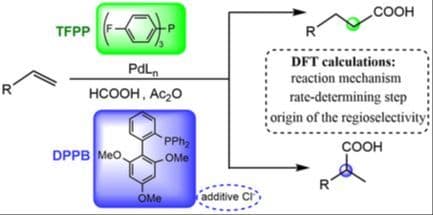
Density functional theory (DFT) studies reveal that Pd/tris(4-fluorophenyl)phosphine (TFPP) catalyzes propylene hydrocarboxylation via a bis-coordinated pathway, with CH···π and π−π interactions favoring linear selectivity. In contrast, Pd/2-(diphenylphosphino)-2',4',6'-trimethoxylbiphenyl (DPPB) follows a Cl−-assisted monocoordinated route, where cation–π interactions promote branched products.
Hydrocarboxylation of olefins with HCOOH provides a practical method for the construction of various biologically and chemically relevant carboxylic acids. Density functional theory calculations have been performed on the detailed mechanisms of this reaction catalyzed by palladium complexes with TFPP and DPPB ligands, suggesting that the reaction preferably proceeds through sequential steps of the activation of anhydride, hydropalladation, CO migratory insertion, and the generation of a new anhydride followed by its decomposition and reductive elimination. For the Pd-TFPP system, the bis-coordinated pathway is favored over the monocoordinated pathway both kinetically and thermodynamically, governing anti-Markovnikov-selectivity. In the Pd-DPPB case, the mechanism involves one phosphine ligand and the additive Cl-, and is kinetically favored for Markovnikov-selective hydropalladation. The total barriers for both of them are calculated to be 19.1 and 24.8 kcal mol− 1, respectively. These results are in line with the experimentally observed reactivity and regioselectivity. Noncovalent interaction analyses reveal that CH···π, π−π stacking, and cation–π interactions govern regioselectivity. This in-depth mechanistic insight accounts for the reactivity and regioselectivity at an atomistic level and provides guidance for designing next-generation palladium catalysts.