Understanding the Operation of a Gas Diffusion Electrode Setup for the Oxygen Reduction Reaction: Experiment versus 3D Multiphysics Modeling
Von Wiley-VCH zur Verfügung gestellt
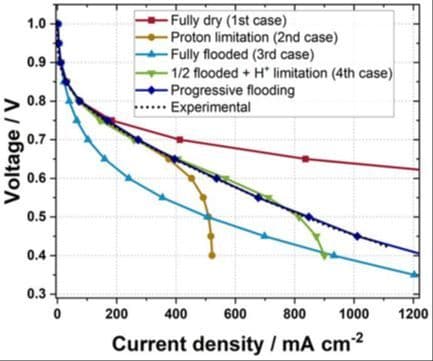
Multiphysics simulations highlight the significant impact of partial water flooding of the catalyst layer on the shape of the gas diffusion electrode (GDE) polarization curves and suggest that mass-transport limitation inside the catalyst layer may be limiting in a GDE setup, specifically at high current density.
Proton exchange membrane fuel cells (PEMFC) require highly efficient oxygen reduction reaction (ORR) electrocatalysts. The intrinsic ORR performance of advanced ORR catalysts (measured in rotating disk electrode, RDE) is often not obtained in membrane electrode assembly (MEA), which denotes for RDE inability to forecast intrinsic activity at large current density/low potential, owing to severe mass-transport limitation. The gas diffusion electrode (GDE) is a relevant tool to assess the intrinsic ORR activity of catalysts at high current density/low potential, so it enables to better forecast their performance in PEMFC MEA. Herein, ORR kinetics is studied in a GDE via cyclic voltammetry and electrochemical impedance spectroscopy; the polarization curve is modeled using multiphysics and multicomponent 3D simulations. The model allows to investigate the interplay between the electrochemical kinetics and the mass-transport of reactant and products in the flow channels of the monopolar plate, gas diffusion layer, porous electrode, and solution. The simulations highlight the significant impact of partial water flooding in the catalyst layer—even at a minimal thickness of 0.6 μm—on the shape of the GDE polarization curves and suggest that mass-transport limitation inside the catalyst layer may be limiting in a GDE setup, specifically at high current density.