Tuning the Fe‐Oxide Nanoparticle Properties by Playing with Salt Precursors and Camellia sinensis Extract Concentrations
Von Wiley-VCH zur Verfügung gestellt
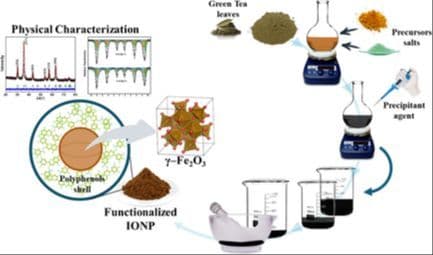
Functionalized iron-oxide nanoparticles exhibiting distinct physical characteristics (particle size and magnetic anisotropy) were successfully biosynthesized by modulating the precursor salts and using two different chemical synthesis pathways.
By varying salt precursors and precipitating agents, polyphenol-functionalized γ-Fe2O3 nanoparticles (NPs) were systematically biosynthesized with controlled particle sizes and varying polyphenol layer thicknesses via two distinct approaches. In the in situ process (ISP), green tea (GT) extract influenced the formation of particles with different sizes during the synthesis, while in the after synthesis process (ASP), it enabled the functionalization of preformed γ-Fe2O3 NPs. The use of GT extract significantly reduced the amount of precipitating agent (NH4OH or NaOH) commonly used in the coprecipitation method. However, even in a polyphenol-rich environment, the Fe3O4 phase is detected only a few hours after the ISP. Results from various characterization techniques revealed that altering the GT extract content—expressed as percent weight-to-volume (x = %w/v)—affects the nanocrystallite size, magnetic behavior, and hyperfine properties, particularly in samples biosynthesized via ISP. Functionalization with GT extract enhanced the effective magnetic anisotropy of the γ-Fe2O3 NPs compared to bare γ-Fe2O3 NPs; however, this anisotropy decreased progressively as the x-value increases. This trend suggests that the thicker organic layer reduced interparticle dipolar interactions by improving the dispersion of the magnetic NPs.