Toward Suppressing Hydrogen Evolution with Enhanced Performance for Bi‐Modified NaTi2(PO4)3 Anodes in Aqueous Na‐Ion Batteries
Von Wiley-VCH zur Verfügung gestellt
The modified NBTP-0.01 anode has the highest cycle life and best rate performance in this work. Furthermore, the expansion of the charge cut-off voltage resulted from the inhibition of the hydrogen evolution reaction by the Bi doping can greatly increase the discharge capacity and energy density of the modified NBTP-0.01//NMO full cell in contrast with those of the pristine NTP//NMO one, respectively.
Abstract
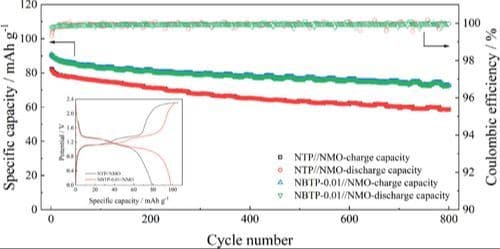
Aqueous sodium-ion batteries (ASIBs) show enormous difficulty to develop appropriate anode materials for their commercialization, mainly owing to the easy occurrence of hydrogen evolution from the decomposition of water at a negative potential with overlapping the operating potential of the anode for the Na+ intercalation/extraction reaction. Here, new anode materials Na1+xBixTi2−x(PO4)3/C (x=0, 0.005, 0.01, 0.02) composites are prepared through introducing Bi elements into NaTi2(PO4)3 (NTP, a promising anode material for ASIBs) with a facile sol-gel method. Thus, it firstly reports that the Bi doping can contribute to the inhibition of hydrogen evolution via regulation the electrode potential for hydrogen evolution at the anode, also accompanying with excellent electrochemical and charge/discharge performances. The full cell constructed by Na0.44MnO2 as cathode and Bi-modified NTP as anode, exhibits the better cycling performance with a larger capacity retention of about 80.1 % at 2 C-rate for 800 cycles and 80.2 % at 10 C-rate for 1400 cycles in contrast with the pristine one (71.2 %, 56.2 %), respectively. Furthermore, the expansion of the charge cut-off voltage resulted from the inhibition of hydrogen evolution after Bi doping into NTP can finally increase the discharge capacity and energy density of the modified full cell by 21.8 % and 17.3 %, respectively.