Targeting Ubiquitin‐Specific Protease 7 with Novel 5‐Amino‐Pyrazole Inhibitors: Design, Synthesis, and Biological Evaluation
Von Wiley-VCH zur Verfügung gestellt
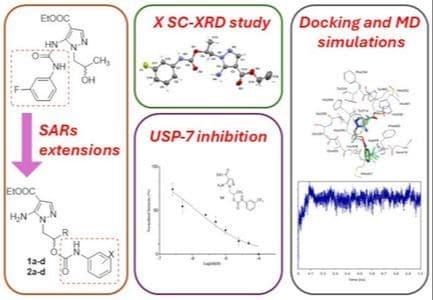
Ubiquitin-specific protease 7 (USP-7) is a novel target for anticancer therapy. To further extend the structure–activity relationships of the previously USP-7 inhibitor STIRUR-41, a library of 5-aminopyrazoles is reported. 1d shows a potency comparable to lead compound STIRUR-41 and promising in silico and in vitro pharmacokinetic properties. Computational studies identify the molecular basis of USP-7/1d interaction.
To further extend the structure–activity relationships (SARs) of the previously published ubiquitin-specific protease 7 (USP-7) inhibitor STIRUR-41, a small library of 5-aminopyrazoles 1a–d and 2a–d is designed and synthesized. The chemical identity of the desired structure is confirmed by nuclear magnetic resonance and single crystal X-ray diffraction analyses. All novel derivatives are tested as potential USP-7 inhibitors and compounds 1a–d block enzyme activity in a dose-dependent manner and with lower IC50 values compared to the lead compound STIRUR-41. Notably, 1d, bearing a meta-trifluoromethylphenyl group linked to the carbamate moiety, proved to be the most active candidate. Conversely, compounds belonging to series 2, which possess greater steric hindrance, exhibit no activity. The most effective compounds of series 1 are noncytotoxic across a panel of tumor and normal cell lines at 10 μM concentration. For the most active compound 1d, a parallel artificial membrane permeability assay is also performed, as well as docking and molecular dynamics simulations.