Sub‐1 nm CuO‐Phosphomolybdic Acid Nanosheets for Ultrasound‐Controlled Pyroptosis Activation and Tumor Immunotherapy
Von Wiley-VCH zur Verfügung gestellt
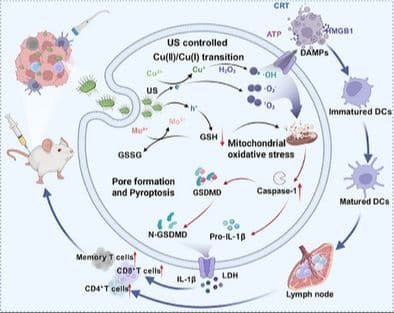
Under US irradiation, copper oxide-phosphomolybdic acid (CuO-PMA) effectively generates ¹O₂ and •O₂⁻, depletes GSH, and controls the valence transition of Cu(II)/Cu(I), enhancing the generation of •OH. This process leads to mitochondrial oxidative stress, releases damage-associated molecular patterns, and activates pyroptosis, triggering a strong antitumor immune response.
Abstract
Inducing pyroptosis effectively transforms immunosuppressive “cold tumors” into immunogenic “hot tumors” to enhance tumor immunotherapy. However, uncontrolled pyroptosis activation risks systemic inflammation and tumor metastasis. In this study, we used a solvothermal method to synthesize a sub-1 nm copper oxide-phosphomolybdic acid nanosheet (CuO-PMA) for ultrasound (US)-controlled reactive oxygen species (ROS) generation to induce pyroptosis. Owing to the narrow bandgap of CuO-PMA, the electron holes are rapidly separated under US irradiation, then quickly migrate through the sub-nanosheet structure to the surface to catalyze the formation of singlet oxygen (¹O₂) and superoxide anions (•O₂⁻), while simultaneously consuming glutathione (GSH). Furthermore, leveraging electron delocalization properties, US triggered the directional migration of electrons in CuO-PMA, facilitating the Cu(II)-to-Cu(I) transition to enhance hydroxyl radical (•OH) production. The ROS burst together with ions and h+-mediated GSH exhaustion synergistically provokes mitochondrial oxidative stress, activating the caspase-1/GSDMD axis to induce pyroptosis. In vivo experiments demonstrated that CuO-PMA significantly inhibited tumor growth and showed excellent antitumor immunotherapeutic effects. This sub-nanosheet amplifies ROS generation in response to the electronic delocalization characteristics of the US, which provides a new strategy for the ultrasound-controlled pyroptosis activation (sonopyroptosis) and tumor immunotherapy.