Structure–Performance Relationships in Anthraquinone‐Disulfonate Coordination Polymers for Li‐Ion and Na‐Ion Battery Cathodes
Von Wiley-VCH zur Verfügung gestellt
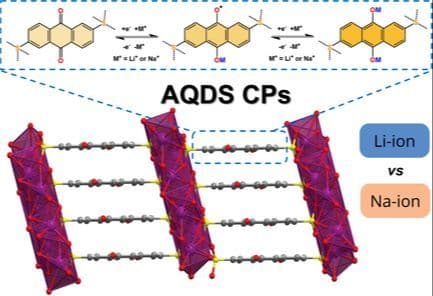
Anthraquinone-disulfonate coordination polymers (AQDS-Na, AQDS-Mg, AQDS-Cu) are synthesized and evaluated as cathodes for Li-ion and Na-ion storage. Structural dimensionality and coordinated water critically impact the practical capacity and cycling stability, highlighting design principles for organic-based energy storage materials.
Coordination polymers (CPs) based on organic redox-active moieties offer a promising route to sustainable electrode materials for next-generation batteries. Herein, the synthesis, crystal structure determination, theoretical characterization, and electrochemical evaluation of a series of anthraquinone-disulfonate (AQDS) CPs incorporating Na+, Mg2+, and Cu2+ ions (AQDS-Na, AQDS-Mg, AQDS-Cu) as cathode materials for lithium-ion and sodium-ion storage are reported. Single-crystal X-ray diffraction reveals that AQDS-Na adopts a 3D framework, while AQDS-Mg and AQDS-Cu form 2D layered structures with coordinated water molecules. These structural differences significantly influence the electrochemical performance. For Li-ion storage, AQDS-Na delivers an initial capacity of 120 mAh g−1, while AQDS-Mg and AQDS-Cu show lower initial capacities (95 mAh g−1 and 106 mAh g−1, respectively) and faster fading. For Na-ion storage, the performance divergence is even more pronounced: AQDS-Na achieves a stable capacity of 91 mAh g−1 after 100 cycles, while AQDS-Mg and AQDS-Cu suffer from significant capacity loss (47 and 18 mAh g−1 after 100 cycles, respectively), attributed to the presence of coordinated water molecules in the 2D frameworks. This study highlights the importance of structural dimensionality and coordination environment in designing high-performance cathode materials for battery systems.