Regulation of Relay Catalytic Mechanism for Efficient Methanol Oxidation Reaction
Von Wiley-VCH zur Verfügung gestellt
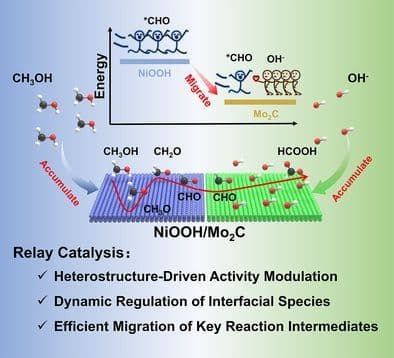
A NiOOH-Mo2C@C heterojunction interface is engineered to utilize differential adsorption properties of its phases for methanol and OH−, thereby regulating the interfacial distribution of reactive species. The spatial regulation facilitates migration kinetics of *CHO intermediates from OH−-deficient NiOOH to OH−-rich Mo2C surface, enabling relay catalysis to overcome kinetic barriers and enhance methanol oxidation efficiency.
Abstract
The methanol oxidation reaction serves as a representative model for multistep catalytic processes involving diverse intermediates. Catalyst design strategies that spatially arrange discrete active sites, analogous to relay runners, facilitate the sequential activation of reaction steps, thereby enhancing overall catalytic efficiency compared to single-site catalysts. This approach effectively decouples complex reaction networks into a sequence of coordinated elementary steps, thereby enhancing the production efficiency of the target products. Here, we propose a relay catalysis paradigm through electrochemical in situ construction of NiOOH-Mo2C@C heterojunction featuring with dual Lewis acid sites. By precisely controlling interfacial methanol/OH− concentration gradients, nearly 100% Faradaic efficiency for formate production is achieved during methanol electrooxidation. Multiscale characterizations combined with density functional theory computations reveal that the engineered interface regulates *CHO intermediate migration from NiOOH to Mo2C domains, thereby effectively shifting the rate-determining step from *CHO-OH− coupling to O─H bond cleavage. This spatial decoupling strategy reduces the thermodynamic barrier by 1.18 eV. This study elucidates a design strategy that tailors the spatial distribution of electrochemical interface species to guide catalytic pathway optimization. Furthermore, it highlights the essential role of heterojunction-mediated relay catalysis in enhancing electrocatalytic activity for the oxidation of organic small molecules.