Privileged Chiral Photocatalysts
Von Wiley-VCH zur Verfügung gestellt
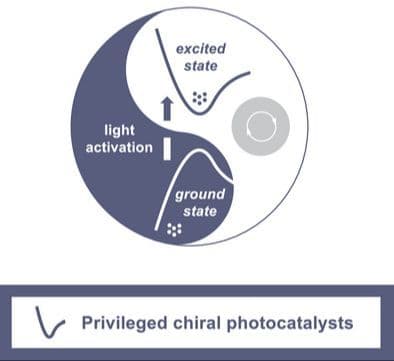
Privileged chiral catalysts have transformed asymmetric synthesis, conferring generality to processes that are routinely leveraged in the construction of societally important functional small molecules. This mini-review is intended to survey the conception and evolution of privileged chiral photocatalyst scaffolds that enable simultaneous orchestration of reactivity and enantioselectivity in non-ground state regimes.
Abstract
Privileged chiral catalysts have transformed asymmetric synthesis, conferring generality to processes that are routinely leveraged in the construction of societally important functional small molecules. Operating in the ground state, these catalysts are conspicuous in their ability to simultaneously regulate reactivity and translate chiral information, often with broad substrate tolerance: this technology continues to expedite chemical space exploration. In stark contrast to the specificity of many enzymatic transformations, this promiscuity affords remarkable latitude for creative endeavour in synthesis. Given the transformative impact that stereoselective photocatalysis has had over the last decade, identifying privileged chiral catalysts that permit reactivity and enantioselectivity to be regulated in excited-state scenarios has emerged as an attractive but challenging frontier. Providing solutions to address this paradox will require the reactivity/selectivity divide to be reconciled through the validation of chiral scaffolds that effectively operate in non-ground state environments. Inspired by the venerable treatment by Yoon and Jacobsen entitled “Privileged chiral catalysts” (Science 2003, 299, 1691–1693), this mini-review is intended to survey the conception and evolution of privileged chiral photocatalyst scaffolds, and offer a perspective on emerging contenders.