Predicting Liquid Organic Hydrogen Carrier Saturation in Dehydrogenation Cell Gas Diffusion Layers for Hydrogen Storage
Von Wiley-VCH zur Verfügung gestellt
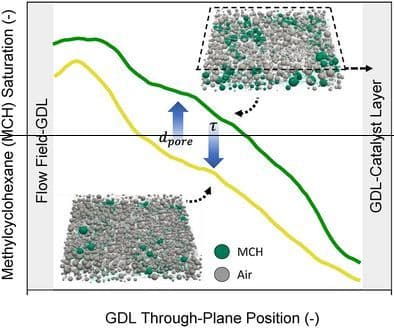
The influence of gas diffusion layer (GDL) microstructures on mass transport and methylcyclohexane saturation (MCH) in a dehydrogenation cell was investigated using pore network modeling. We reveal that GDLs with larger pore diameters (dpore ) and lower tortuosity (τ) enable enhanced MCH invasion, thereby improving reactant concentration at the catalyst.
Abstract
Dehydrogenating methylcyclohexane (MCH) as a liquid organic hydrogen carrier offers a promising method for producing stored hydrogen. However, the transport properties of the gas diffusion layers (GDLs) in dehydrogenation cells (D-cells) have not yet been optimized for high reactant saturation at the GDL-catalyst layer (CL) interface, which is crucial for increasing hydrogen production. We applied pore network modeling (PNM) to quantify the anisotropic transport properties and local saturation of MCH in GDLs with distinct microstructures. We demonstrate that GDLs with larger mean pore diameters and lower tortuosity exhibit higher MCH permeability and diffusivity. Moreover, a high porosity at the GDL-CL interface increases MCH saturation (from 0.05 to 0.11), highlighting the impact of local GDL porosity on MCH supply to the catalyst. The results of the invasion percolation simulation revealed that smaller pore sizes lead to a longer MCH transport pathway to the GDL-CL interface, thereby reducing MCH saturation at this interface (by more than twofold), which hinders reactant availability for hydrogen production. Therefore, we recommend a GDL that combines large pores for efficient MCH flow and small pores close to the CL for liquid retention to enhance MCH utilization in the anode of D-cell, particularly at high current densities.