ARTIKEL

N‐Confused Porphyrin as a Highly Active Ligand Scaffold for Molecular Catalysts of CO2 Reduction

28.08.2025
N‐Confused Porphyrin as a Highly Active Ligand Scaffold for Molecular Catalysts of CO2 Reduction

Von Wiley-VCH zur Verfügung gestellt


Abstract

Key to CO2 reduction transformation is the development of catalysts that efficiently activate inert CO2 molecules, enabling rapid reaction kinetics with minimal energy inputs. In this study, we introduce N-confused porphyrin (NCP) as a highly active ligand scaffold for transition metal-based catalysts in CO2 reduction reactions. By breaking the D4h symmetry inherent in conventional porphyrin structures, NCP promotes enhanced electron delocalization around corresponding metal complex, improving the catalytic efficiency. A comprehensive study demonstrates that NCP-based metal complexes (Fe, Co, and Ni) significantly outperform their parent metal-porphyrin counterparts. These results provide new insights into the design of more effective catalysts for CO2 reduction.

Verwandte Artikel

N‐Confused Porphyrin as a Highly Active Ligand Scaffold for Molecular Catalysts of CO2 Reduction
Organic Fluorophores for Studying Lipid Membrane Structures and Dynamics
N‐Confused Porphyrin as a Highly Active Ligand Scaffold for Molecular Catalysts of CO2 Reduction
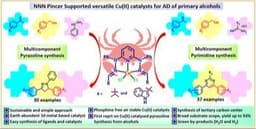
Phosphine‐Free NNN Pincer Supported Cu(II) Catalysts for Sustainable Multi‐Component Synthesis of Pyrazolines and Pyrimidines via Dehydrogenation of Renewable Primary Alcohols
N‐Confused Porphyrin as a Highly Active Ligand Scaffold for Molecular Catalysts of CO2 Reduction
CBr4 as an Efficient Halogen Bond Donor Catalyst in Pictet–Spengler Cyclizations: A Metal‐Free Approach to the Synthesis of Benzazepinoindoles and Tetrahydro‐β‐carbolines
N‐Confused Porphyrin as a Highly Active Ligand Scaffold for Molecular Catalysts of CO2 Reduction
Stimuli‐Responsive Supramolecular Polymers of Mono‐ and Bis‐triazolylphenylazoaniline‐Functionalized Copillar[5]Arenes: With Distinctive Binding Modes
N‐Confused Porphyrin as a Highly Active Ligand Scaffold for Molecular Catalysts of CO2 Reduction
From Inception to Innovation: 20 Years of Nanoarchitectonics