Low‐Coordination Indium Single‐Atom Sites Anchored on a Metal‐Organic Framework Single‐Layer Boosts Electroreduction of CO2 Into Formic Acid
Von Wiley-VCH zur Verfügung gestellt
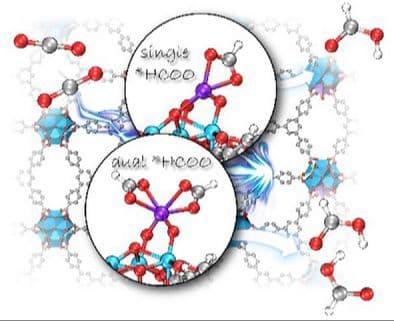
A single low-coordination indium(III) site anchored on a metal-organic framework can simultaneously bind and convert two carbon dioxide molecules into two formate products.
Abstract
The electroreduction of CO2 under acidic conditions presents both scientific significance and technical challenges. Herein, we developed a post-synthetic modification strategy to anchor unexpected tetrahedral In(III) ions onto Zr-oxo clusters of a single-layer zirconium metal-organic framework (denoted as Zr-MOF-In). Operating under harsh acidic conditions (pH = 1.67) at −1.8 V versus RHE, the Zr-MOF-In catalyst demonstrates exceptional performance with 95.7% Faradaic efficiency for formic acid production and a current density of 213.3 mA cm−2. The system maintains operational stability over 20 h without notable activity decay. Remarkably, when integrated into a membrane electrode assembly electrolyzer with solid-state electrolyte at 4 V full-cell voltage, Zr-MOF-In continuously generates pure formic acid solution (505.5 mmol L−1, 100% purity) free of electrolyte contamination, achieving a concentration 1.5-fold higher than the current state-of-the-art. Mechanistic investigations identify dual enhancement mechanisms: i) the low-coordinated In(III) single-atom sites facilitate dual *HCOO intermediate binding, enhancing reaction kinetics beyond conventional single-intermediate adsorption on high-coordination metal centers; and ii) the single-layer MOF configuration optimizes active site exposure, synergistically maximizing catalytic efficiency.