Investigating Lithium Segregation in Nickel‐Rich Layered Oxides via Atom Probe Tomography and its Impact on Performance
Von Wiley-VCH zur Verfügung gestellt
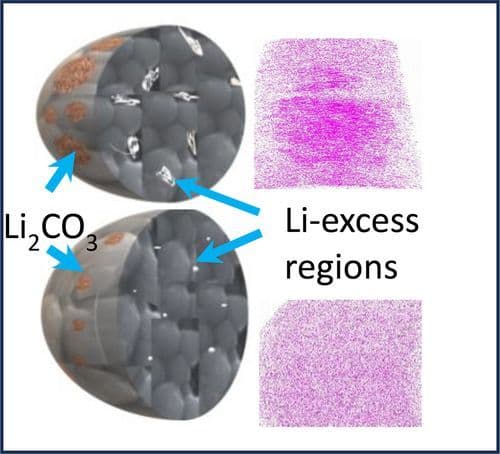
This study examines how excess lithium during synthesis affects surface impurity formation and lithium segregation within NCA particles. Excess lithium leads to the formation of residual compounds on the NCA particle surface. Atom Probe Tomography (APT) reveals lithium segregation into discrete regions within the secondary particles of NCA, highlighting the impact of excess lithium on structural uniformity.
Abstract
Nickel-rich LiNi0.8Co0.15Al0.05O2 (NCA) is a promising alternative to LiNi1−x−yCoxMnyO2 (NMC) with x + y≤0.2, providing high specific energy and power density, making it ideal for long-range electric vehicles. However, the formation of surface residual impurities and extreme sensitivity to moisture are detrimental to the large-scale synthesis and electrochemical performance of NCA. This paper investigates the formation of Li2CO3 surface impurities and the elemental distribution of lithium within the secondary particle in NCA synthesized with different lithium-to-transition metal ratios. X-ray diffraction (XRD), Fourier transform infrared spectroscopy (FTIR), and Raman spectroscopy confirm the presence of Li2CO3 on the surface of NCA prepared with 3 % excess lithium. Atom probe tomography (APT) analysis of the particle interior confirms the absence of carbonaceous products within the hierarchical structure. Instead, it reveals the segregation of lithium ions into discrete regions, which leads to the poor electrochemical performance of NCA synthesized with excess Li. Upon storage, the structural and electrochemical deterioration is more pronounced in NCA with a 3 % excess of lithium than the one prepared without excess lithium, as confirmed by XRD, Raman imaging, and electrochemical galvanostatic charge-discharge testing.