ARTIKEL

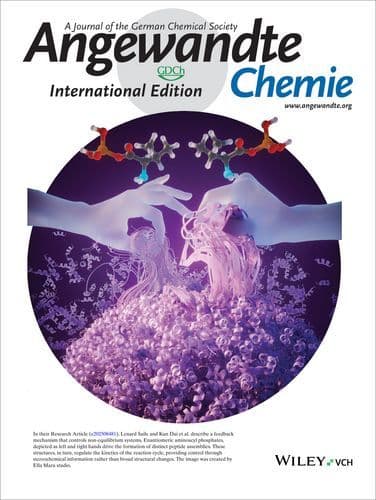
Inside Back Cover: Chirality Makes or Breaks Chemically Driven Self‐Assembly
02.09.2025
Inside Back Cover: Chirality Makes or Breaks Chemically Driven Self‐Assembly

In their Research Article (e202508481), Lenard Saile and Kun Dai et al. describe a feedback mechanism that controls non-equilibrium systems. Enantiomeric aminoacyl phosphates, depicted as left and right hands drive the formation of distinct peptide assemblies. These structures, in turn, regulate the kinetics of the reaction cycle, providing control through stereochemical information rather than broad structural changes. The image was created by Ella Maru studio.


Verwandte Artikel

Inside Back Cover: Chirality Makes or Breaks Chemically Driven Self‐Assembly
Preferential Texture of Surface Coating on Zn Anodes for Advanced Aqueous Batteries: Small Change but Big Gain
Inside Back Cover: Chirality Makes or Breaks Chemically Driven Self‐Assembly
P450 Enzyme LyoI Performs Hydro‐2,2′‐Bifuran Oxidation in the Polyether Ionophore Lysocellin
Inside Back Cover: Chirality Makes or Breaks Chemically Driven Self‐Assembly
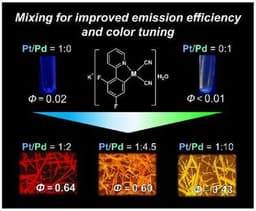
Enhancement of Emission Efficiency and Color Tuning by Mixing Platinum(II) and Palladium(II) Complexes in a One‐dimensional Chain
Inside Back Cover: Chirality Makes or Breaks Chemically Driven Self‐Assembly
Exercise Modulates Exocytosis: Chemical Insights from the Intracellular Vesicle Perspective
Inside Back Cover: Chirality Makes or Breaks Chemically Driven Self‐Assembly
Bio‐Transport Regulation Inspired 5‐Fluorouracil Keto to Enol Tautomerism Achieving High Proton Conductivity