In Vitro and In Live‐Cell Rapid Hydrazine Detection by Disaggregation of the AIEgen Microstructure
Von Wiley-VCH zur Verfügung gestellt
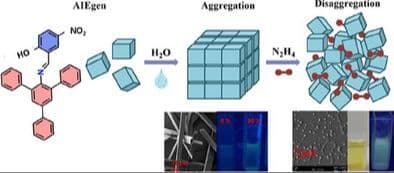
This study highlights the design and synthesis of AIEgens that exhibited excellent hydrazine detection in liquid and vapor phases and in live cell, with an impressive limit of 0.054 μμ by fluorescence turn on driven by hydrogen bonding and disaggregation of microstructures.
Abstract
In this study, efficient hydrazine detectors are developed using disaggregation of AIEgen microstructures. A new class of 2,4,6-triphenylaniline-based AIEgens are designed to alter the optoelectronic properties in different aggregated states. These 2,4,6-triphenylaniline-based molecules (SB1, SB2, and SB3) are self-assembled in the aqueous medium as well as in physiological condition, creating distinct microdomains and effectively showing tunable aggregation- induced emission (AIE) properties. The aggregation behavior was extensively investigated using advanced spectroscopic and microscopic techniques, by modulating the water content in acetonitrile solution. The aggregated state of SB3 emerged as the most sensitive hydrazine detector, achieving an exceptional detection limit of 0.054 µM, outperforming compounds SB1 (2.8 µM) and SB2 (2.2 µM). This attributed to hydrogen bond induced disaggregation of AIEgen aggregates, resulting in a pronounced turn-on fluorescence response by intramolecular charge transfer (ICT). Not only aqueous hydrazine or hydrazine vapor detection, but also the SB3 permeate cell membrane, localize in the perinuclear area, and detect intracellular hydrazine with great specificity. This on-site and real-time fluorogenic hydrazine detection have prospective applications in monitoring the environment and biomedical imaging.